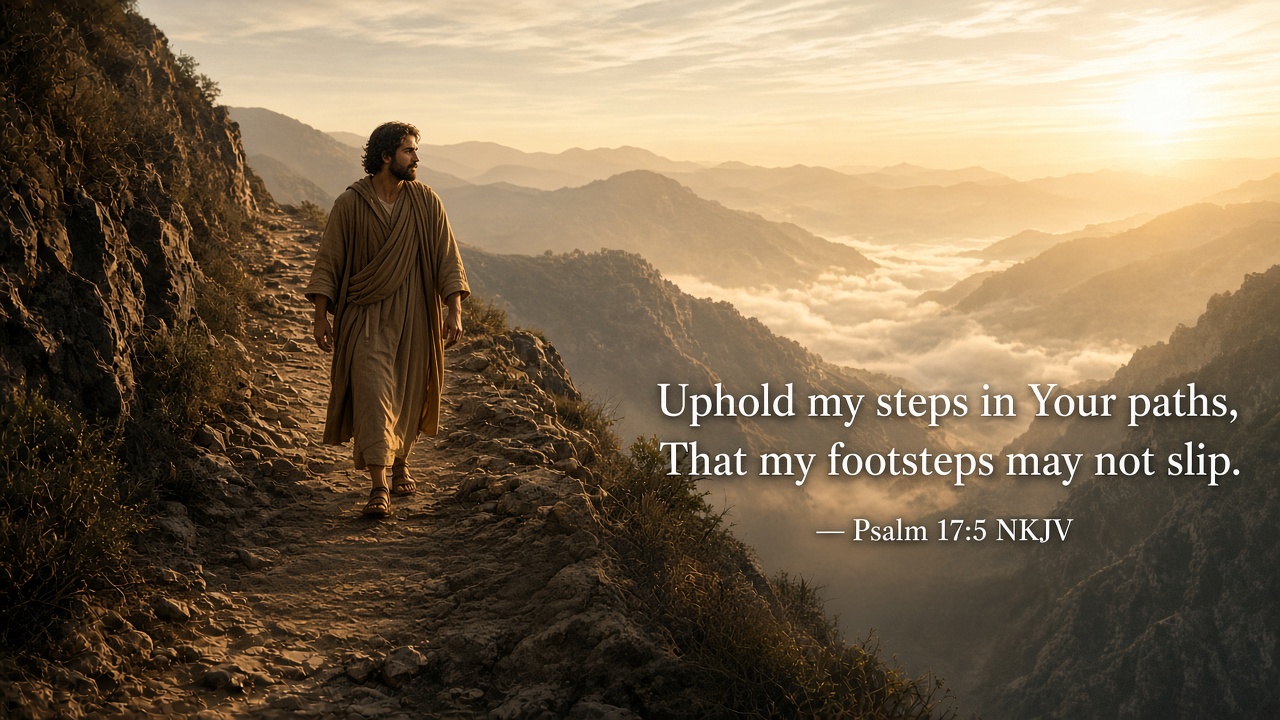
Psalm 17:5 NKJV
Uphold my steps in Your paths,
That my footsteps may not slip.
Held Up by Grace: Walking Steadily in God’s Paths

MY NOTES
“Uphold my steps in Your paths, That my footsteps may not slip.”— Psalm 17:5 NKJV
David is not asking for an easier road. He is asking for a steady hand on the road he is already on. When life gets hard—when people talk, when the pressure builds, when the temptation to strike back or quit feels strong—it is easy to lose your footing. The path may be right, but our steps are not always sure. So he prays the prayer of a man who knows his own weakness: “Hold me up.”
There is a quiet honesty in those words. David is not claiming he can keep himself on track. He has already seen how quickly a man can stumble. He knows the heart can be provoked, the tongue can get ahead of him, and the feet can slide even on ground that should be safe. So he asks God to do what he cannot do for himself. “Uphold my steps in Your paths.” Not just any path—Your paths. He wants to be held steady in the way God has marked out, not in some clever detour of his own.
“Trust in the LORD with all your heart, And lean not on your own understanding; In all your ways acknowledge Him, And He shall direct your paths.” —Proverbs 3:5-6 (NKJV)
Notice that God not only directs our paths; He enables us to continue walking in them.
The psalmist also declared:
“The steps of a good man are ordered by the LORD, And He delights in his way. Though he fall, he shall not be utterly cast down; For the LORD upholds him with His hand.”—Psalm 37:23-24 (NKJV)
The believer’s confidence is not found in the strength of his grip on God but in the strength of God’s grip on him. We often focus on our faithfulness to God, but Scripture repeatedly points us to God’s faithfulness to us.
Every day we remain standing spiritually is evidence of His sustaining grace.
That kind of prayer only makes sense if we believe two things at once. First, that the path itself is good. Second, that we still need help to stay on it. The road can be right, and our feet can still be unsteady.
As the psalmist later admits,
“But as for me, my feet had almost stumbled; my steps had nearly slipped” (Psalm 73:2).
The danger is real, even for those who want to do what is right. David refuses to pretend otherwise. He brings the weakness into the open and asks God to meet it with strength.
A humble request is also hidden in the words. By praying to be upheld in God’s paths, David is saying he does not want to invent his own route. If he has drifted, he wants to be brought back. If he is still on the right road, he wants to be kept there. He is not looking for permission to do whatever feels justified in the moment. He is looking for the grace to keep walking the way God has already shown him.
This is the daily need of anyone who wants to finish well. We are not strong enough on our own to guarantee we will not slip. The same God who called us to the path is the One who must hold our steps.
Isaiah spoke of the Servant whom God would uphold:
“Behold my servant, whom I uphold; mine elect, in whom my soul delighteth; I have put my spirit upon him: he shall bring forth judgment to the Gentiles.” (Isaiah 42:1).
Our Savior was sustained by the Father. How much more do we need that same upholding grace?
David’s prayer is practical. He is not asking for a life free of pressure. He is asking that, under pressure, his feet would not leave the path. That when the words come, they would still be true. That when the chance to get even appears, he would still walk straight. That the end of the day would find him still standing where God had placed him.
Prayer
Abba, the path is Yours, but my steps are not always sure. When the pressure rises, and my flesh tries to take over, hold me up. Keep my feet from sliding off the way You have marked. If I have already started to drift, bring me back. I do not ask for an easier road—only for the steadying hand that keeps me on the one You have given. Uphold me today, so that when the day is done I am still walking with You. In Jesus’ name I pray, Amen.
Key Takeaways
- The right path still requires God’s strength to keep walking it.
- Admitting we can slip is not weakness; it is the beginning of real dependence.
- Praying to be upheld in God’s paths includes the request to be brought back if we have left them.
- God does not leave His people to steady themselves. He holds their steps.

Proverb for Today
Where there is no wood, the fire goes out; And where there is no talebearer, strife ceases. As charcoal is to burning coals, and wood to fire, So is a contentious man to kindle strife. Proverbs 26:20-21 NKJV
Daily Scripture
And He said, “My Presence will go with you, and I will give you rest.” Exodus 33:14 NKJV
Closing

“The Lord bless you and keep you; The Lord make His face shine upon you, And be gracious to you; The Lord lift up His countenance upon you, And give you peace.” Numbers 6:24-26 NKJV
Grace be with you. Amen.
Please enter your email and click subscribe to be notified whenever I submit a new post.

Commentaries:
Charles Spurgeon
Under trial it is not easy to behave ourselves aright; a candle is not easily kept alight when many envious mouths are puffing at it. In evil times prayer is peculiarly needful, and wise men resort to it at once. Plato said to one of his disciples, “When men speak ill of thee, live so that no one will believe them;” good enough advice, but he did not tell us how to carry it out. We have a precept here incorporated in an example; if we would be preserved, we must cry to the Preserver, and enlist divine support upon our side. “Hold up my goings“—as a careful driver holds up his horse when going downhill. We have all sorts of paces, both fast and slow, and the road is never long of one sort, but with God to hold up our goings, nothing in the pace or in the road can cast down. He who has been down once and cut his knees sadly, even to the bone, had need redouble his zeal when using this prayer; and all of us, since we are so weak on our legs through Adam’s fall, had need use it every hour of the day. If a perfect father fell, how shall an imperfect son dare to boast? “In thy paths.” Forsaking Satan’s paths, he prayed to be upheld in God’s paths. We cannot keep from evil without keeping to good. If the bushel be not full of wheat, it may soon be once more full of chaff. In all the appointed ordinances and duties of our most holy faith, may the Lord enable us to run through his upholding grace! “That my footsteps slip not.” What! slip in God’s ways? Yes, the road is good, but our feet are evil, and therefore slip, even on the King’s highway. Who wonders if carnal men slide and fall in ways of their own choosing, which like the vale of Siddim, are full of deadly slime-pits? One may trip over an ordinance as well as over a temptation. Jesus Christ himself is a stumbling-block to some, and the doctrines of grace have been the occasion of offense to many. Grace alone can hold up our goings in the paths of truth.
______________________________________________________
Enduring Word
Uphold my steps: David felt that he was in danger of falling or slipping into disaster; he needed God to hold up his steps, so that his footsteps may not slip. (Guzik)
i. “The word of God affords us direction, but the grace of God must enable us to follow its direction, and that grace must be obtained by prayer.” (Horne)
ii. “What! Slip in God’s ways? Yes, the road is good, but our feet are evil, and therefore slip, even on the King’s highway.” (Spurgeon)
In Your paths: This again shows the significant humility of David’s prayer. He wants to be upheld, but only on God’s paths. Included in this is the unspoken prayer, “LORD, if I am not on Your path, please put me there. I want to be in Your paths, not my own.” (Guzik)
______________________________________________________
Albert Barnes
Hold up my goings in thy paths — He had been enabled before this to keep himself from the ways of the violent by the word of God Psalms 17:4; he felt his dependence on God still to enable him, in the circumstances in which he was placed, and under the provocations to which he was exposed, to live a life of peace, and to keep himself from doing wrong. He, therefore, calls on God, and asks him to sustain him, and to keep him still in the right path. The verb used here is in the infinitive form, but used instead of the imperative. DeWette. – Prof. Alexander renders this less correctly, “My steps have laid hold of thy paths;” for he supposes that a prayer here “would be out of place.” But prayer can never be more appropriate than when a man realizes that he owes the fact of his having been hitherto enabled to lead an upright life only to the “word” of God, and when provoked and injured by others he feels that he might be in danger of doing wrong. In such circumstances nothing can he more proper than to call upon God to keep us from sin.
That my footsteps slip not — Margin, as in Hebrew: “be not moved.” The idea is, “that I may be firm; that I may not yield to passion; that, provoked and wronged by others, I may not be allowed to depart from the course of life which I have been hitherto enabled to pursue.” No prayer could be more appropriate. When we feel and know that we have been wronged by others; when our lives have given no cause for such treatment as we receive at their hands; when they are still pursuing us, and injuring us in our reputation, our property, or our peace; when all the bad passions of our nature are liable to be aroused, prompting us to seek revenge, and to return evil for evil, then nothing can be more proper than for us to lift our hearts to God, entreating that he will keep us, and save us from falling into sin; that he will enable us to restrain our passions, and to subdue our resentments.
______________________________________________________
John Gill
Hold up my goings in thy paths,…. Which being spoken by David in his own person, and for himself, shows that he was conscious of his own weakness to keep himself in the ways of God, and to direct his steps therein; and that he was sensible of, the need he stood in of divine power to uphold and support him in them;
[that] my footsteps slip not; out of the paths of truth and duty, of faith and holiness; of which there is danger, should a man be left to himself, and destitute of divine direction and aid; see Psalm 73:2; and though Christ had no moral weakness in him, and was in no danger of falling into sin, or slipping out of the ways of God; yet these words may be applied to him in a good sense, as considered in human nature, and attended with the sinless infirmities of it, he being God’s servant, whom he upheld, and of whom he gave his angels charge to keep him in all his ways, Isaiah 42:1.
______________________________________________________
Matthew Henry
He prays for the work of God’s grace in him (v. 5): “Hold up my going in thy paths. Lord, I have, by thy grace, kept myself from the paths of the destroyer; by the same grace let me be kept in thy paths; let me not only be restrained from doing that which is evil, but quickened to abound always in that which is good. Let my goings be held in thy paths, that I may not turn back from them nor turn aside out of them; let them be held up in thy paths, that I may not stumble and fall into sin, that I may not trifle and neglect my duty. Lord, as thou hast kept me hitherto, so keep me still.” Those that are, through grace, going in God’s paths, have need to pray, and do pray, that their goings may be held up in those paths; for we stand no longer than he is pleased to hold us, we go no further than he is pleased to lead us, bear us up, and carry us. David had been kept in the way of his duty hitherto, and yet he does not think that this would be his security for the future, and therefore prays, “Lord, still hold me up.” Those that would proceed and persevere in the way of God must, by faith and prayer, fetch in daily fresh supplies of grace and strength from him. David was sensible that his way was slippery, that he himself was weak, and not so well fixed and furnished as he should be, that there were those who watched for his halting and would improve the least slip against him, and therefore he prays, “Lord, hold me up, that my foot slip not, that I may never say nor do any thing that looks either dishonest or distrustful of thee and thy providence and promise.”
______________________________________________________
Calvin’s Commentary
Uphold my steps. If we take God’s paths for the precepts of his law, the sense will be evident, namely, that although David had spoken according to truth, in boasting of having, in the midst of the most grievous temptations which assailed him, constantly practiced righteousness with a pure heart, yet, conscious of his own weakness, he commits himself to God to be governed by him, and prays for grace to enable him to persevere. His language is as if he had said, Since hitherto, under thy guidance, I have proceeded onward in the right path, I beseech thee, in like manner, to keep my steps from sliding with respect to the time to come. And certainly the more any one excels in grace, the more ought he to be afraid of falling; for it is the usual policy of Satan to endeavor, even from the virtue and strength which God has given us, to produce in us carnal confidence which may induce carelessness. I do not altogether reject this sense, but I think it more probable that David here beseeches God to bring his affairs to a prosperous issue, however dark the aspect of matters was at present. The import of his language is this, Lord, since thou seest that I walk in uprightness and sincerity of heart, govern thou me in such a manner as to make all men see that thou art my protector and guardian, and leave me not to be cast down at the will of my enemies. Thus, by the paths of the Lord, he will mean not the doctrine by which our life is regulated, but the power by which God upholds us, and the protection by which he preserves us. And he addresses God in this manner, not only because all events are in his hand, but because when he takes care of us all things in our lot go on prosperously. When he adds, that the soles of my feet may not slide, he refers to the many adverse events which threaten us every moment, and to the danger we are in of perishing, if not sustained by the hand of God.
______________________________________________________
Miscellaneous Comments
“Hold up my goings in thy paths, that my footsteps slip not.” Lord, hold me up, that I may hold out. Thou hast set the crown at the end of the race; let me run the race, that I may wear the crown. It was Beza’s prayer, and let it be ours, “Lord, perfect what thou hast begun in me, that I may not suffer shipwreck when I am almost at the haven.”
—Thomas Watson.

- Exploring the Beauty of Psalms: Insights and Commentaries
- Monthly Breakdown of Our Blog Content
- Psalms Commentary: Faith and Inspiration
Leave a Reply