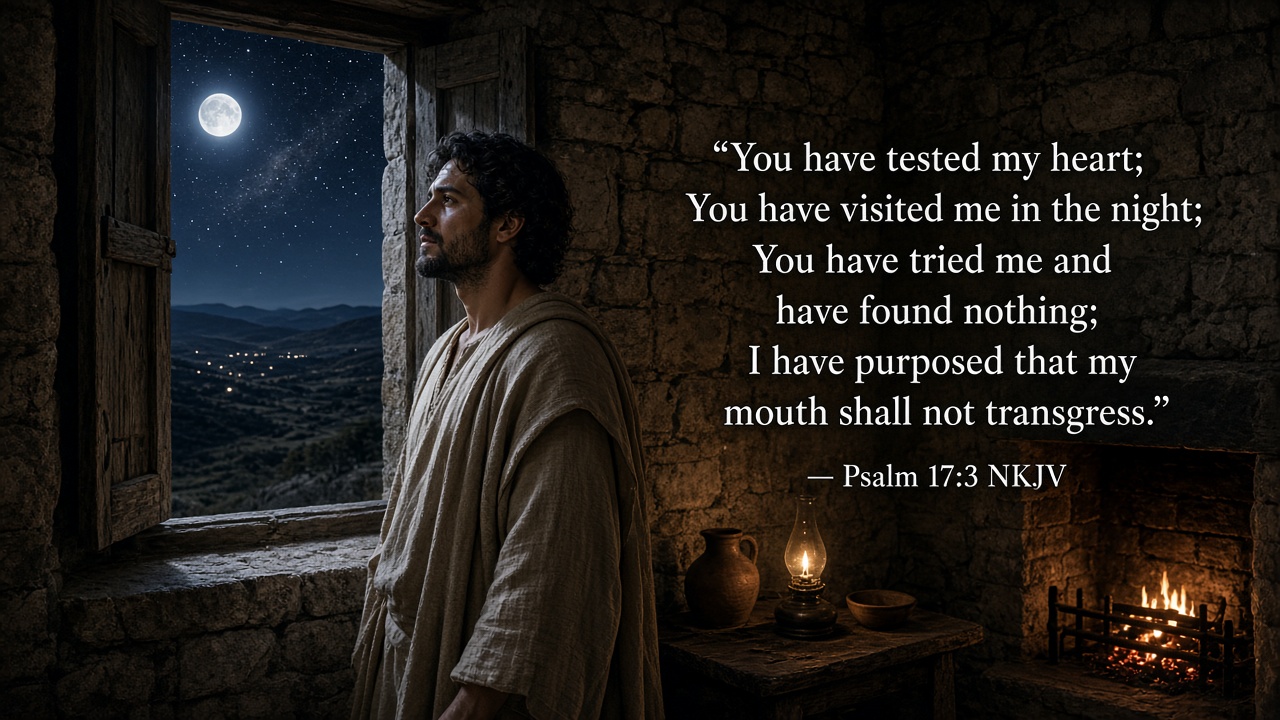
Psalm 17:3 NKJV
You have tested my heart;
You have visited me in the night;
You have tried me and have found nothing;
I have purposed that my mouth shall not transgress.
Faithful When No One Is Watching

My Notes
“You have tested my heart; You have visited me in the night; You have tried me and have found nothing; I have purposed that my mouth shall not transgress.” — Psalm 17:3 NKJV
There is a big difference between looking righteous in public and being faithful when no one is watching.
Most of us know how to present our best side. We can choose our words carefully, maintain a good reputation, and appear spiritual around others. But the true condition of the heart is revealed in private moments. It shows up in our thoughts when we are alone, our responses when we are wounded, and our conversations when no one else will ever hear them.
David understood this reality.
As he continued his prayer in Psalm 17, he did something remarkable. He invited God’s examination.
“You have tested my heart; You have visited me in the night; You have tried me and have found nothing.”
David was not claiming sinless perfection. Throughout the Psalms, he freely confessed his failures and his need for God’s mercy. Instead, he was declaring that regarding the accusations being leveled against him, God knew the truth. Others had questioned his motives, but God had already searched the deepest parts of his heart.
David’s confidence rested in the fact that God’s verdict is always based on reality, not appearances.
The God Who Visits in the Night
David continues:
“You have visited me in the night.”
Nighttime has a unique way of revealing what is really happening inside us. During the day, distractions keep us busy. Conversations, responsibilities, and activity often drown out the heart’s deeper issues.
But when the house grows quiet, and the lights go out, our thoughts become much harder to ignore. David understood that God had visited him during those private hours. The night often represents seasons of loneliness, uncertainty, and testing. Yet some of the sweetest encounters with God occur in those very moments.
When no one else is around, God draws near. He comforts, corrects, instructs, and reassures His children.
Many believers can testify that some of their deepest experiences with God happened not during public worship but in private moments of prayer on difficult nights.
The God who watches over us during the day is the same God who visits us in the darkness.
“And that You should visit him every morning, And test him every moment?” (Job 7:18)
This is the same God who led Israel through the wilderness:
“to humble you and test you, to know what was in your heart” (Deuteronomy 8:2)
God’s examination of our lives is not occasional. His loving attention is constant. He continually works within us to make us more like Christ.
Guarding the tongue
Most of us know how easily the tongue runs ahead of us. We mean to stay quiet or speak carefully, but the words come out anyway—defensive, sharp, or self-justifying. David’s response is deliberate: “I have set my mind that my mouth will not cross the line.” He is not trusting a vague hope. He is making a settled decision, the same kind of resolve he later expressed when he said,
“I will guard my ways, lest I sin with my tongue; I will restrain my mouth with a muzzle” (Psalm 39:1).
That kind of purpose does not come from willpower alone. It is the fruit of having already stood open before God and knowing the heart has been searched. James later reminds us that
“if anyone does not stumble in word, he is a perfect man, able also to bridle the whole body” (James 3:2).
Guarding the tongue is never easy.
There is real comfort here, and also a healthy caution. The comfort is that God already knows the difference between what we are accused of and what is actually true. He has seen the night hours. He knows the motives that never made it into words. The caution is that none of us would stand if the examination were about our overall record. Paul himself admitted,
“For I know that in me (that is, in my flesh) nothing good dwells” (Romans 7:18).
The “nothing” David speaks of is not absolute perfection.
It is the absence of the particular guilt his enemies claimed. For us, the deeper confidence is that God looks at us through the finished work of Christ. Jeremiah looked ahead to the day when
“the iniquity of Israel shall be sought, but there shall be none… for I will pardon those whom I preserve” (Jeremiah 50:20).
And Peter wrote that Jesus is the reason for the pardon Jeremiah spoke of:
“committed no sin, nor was deceit found in His mouth” (1 Peter 2:22).
The Purpose of God’s Testing
The testing David describes was not meant to destroy him. God never tests His children in order to make them fail. He tests them in order to reveal what He is accomplishing within them. Just as a furnace purifies gold, trials purify faith.
Prayer
Abba, You have already seen the parts of me I prefer to keep quiet. You know the midnight thoughts and the reactions no one else hears. I do not ask You to overlook what is wrong, but I do ask You to search me in the places the accusations do not reach. Where my heart is clean in this matter, let that be enough. Where it is not, show me. And help me to keep my mouth from crossing the line, especially when the words feel justified. I rest in the fact that You see me through Jesus, not only through my own record. In Jesus’ name, Amen.
Key Takeaways
- God already knows what is in the heart when no one else is looking. We can invite His examination instead of fearing it.
- Quiet hours often reveal what public hours hide. The night visit is not for condemnation but for honesty.
- A settled purpose to guard the tongue is evidence of integrity, especially when we have been slandered.
- Our ultimate confidence is not that God finds nothing wrong in us, but that He finds everything covered in Christ.

Proverb for Today
Do not exalt yourself in the presence of the king, And do not stand in the place of the great; For it is better that he say to you, “Come up here,” Than that you should be put lower in the presence of the prince, Whom your eyes have seen. Proverbs 25:6-7 NKJV
Daily Scripture
For this is the covenant that I will make with the house of Israel after those days, says the Lord: I will put My laws in their mind and write them on their hearts; and I will be their God, and they shall be My people. None of them shall teach his neighbor, and none his brother, saying, ‘Know the Lord,’ for all shall know Me, from the least of them to the greatest of them. For I will be merciful to their unrighteousness, and their sins and their lawless deeds I will remember no more.” Hebrews 8:10-12 NKJV
See Jeremiah 31:34 and Hebrews 10:17
Closing

“The Lord bless you and keep you; The Lord make His face shine upon you, And be gracious to you; The Lord lift up His countenance upon you, And give you peace.” Numbers 6:24-26 NKJV
Grace be with you. Amen.
Please enter your email and click subscribe to be notified whenever I submit a new post.

Commentaries:
Charles Spurgeon
“Thou hast proved mine heart.” Like Peter, David uses the argument, “Thou knowest all things, thou knowest that I love thee.” It is a most assuring thing to be able to appeal at once to the Lord, and call upon our Judge to be a witness for our defense. “Beloved, if our heart condemn us not, then have we confidence toward God.” “Thou hast visited me in the night.” As if he had said, “Lord, thou hast entered my house at all hours; and thou hast seen me when no one else was nigh; thou hast come upon me unawares and marked my unrestrained actions, and thou knowest whether or no I am guilty of the crimes laid at my door.” Happy man who can thus remember the omniscient eye, and the omnipresent visitor, and find comfort in the remembrance. We hope we have had our midnight visits from our Lord, and truly they are sweet; so sweet that the recollection of them sets us longing for more of such condescending communings. Lord, if indeed, we had been hypocrites, should we have had such fellowship, or feel such hungerings after a renewal of it? “Thou hast tried me, and shalt find nothing.” Surely the Psalmist means nothing hypocritical or wicked in the sense in which his slanderers accused him; for if the Lord should put the best of his people into the crucible, the dross would be a fearful sight, and would make penitence open her sluices wide. Assayers very soon detect the presence of alloy, and when the chief of all assayers shall, at the last, say of us he has found nothing, it will be a glorious hour indeed—”They are without fault before the throne of God.” Even here, as viewed in our covenant Head, the Lord sees no sin in Jacob, nor perverseness in Israel; even the all-detecting glance of Omniscience can see no flaw where the great Substitute covers all with beauty and perfection. “I am purposed that my mouth shall not transgress.” Oh those sad lips of ours! we had need purpose to purpose if we would keep them from exceeding their bounds. The number of diseases of the tongue is as many as the diseases of all the rest of the man put together, and they are more inveterate. Hands and feet one may bind, but who can fetter the lips? iron bands may hold a madman, but what chains can restrain the tongue? It needs more than a purpose to keep this nimble offender within its proper range. Lion-taming and serpent-charming are not to be mentioned in the same day as tongue-taming, for the tongue can no man tame. Those who have to smart from the falsehoods of others should be the more jealous over themselves; perhaps this led the Psalmist to register this holy resolution; and, moreover, he intended thereby to aver that if he had said too much in his own defense, it was not intentional, for he desired in all-respects to tune his lips to the sweet and simple music of truth. Notwithstanding all this David was slandered, as if to show us that the purest innocence will be bemired by malice. There is no sunshine without a shadow, no ripe fruit unpecked by the birds.
______________________________________________________
Enduring Word
You have tested my heart: David invited the test in the previous verses; here he speaks as having passed the test (You have tried me and have found nothing). (Guzik)
i. Clarke assumes (probably rightly) that this psalm comes from the context of Saul hunting David. “Thou hast seen me in my most secret retirements, and knowest whether I have plotted mischief against him who now wishes to take away my life.” (Clarke)
ii. It takes some level of patience and maturity to let God test one’s heart in this manner. We must accept the fact that we might be wrong and that someone else may be right in the matter. We must be more interested in God’s justice and His standard of right and wrong than we are in winning our cause. We must come to God and His word with a heart ready to be convicted and corrected. (Guzik)
iii. There are three questions for everyone to ask: “Do I allow God to test my heart? Can I be corrected? Will I listen to others when they tell me that I may be wrong?” (Guzik)
iv. David did allow God to test his heart, and therefore he came with great confidence in prayer. “Open and unconfessed sin is a great prayer barrier. An upright life is a strong basis for appeals.” (Boice)
v. Boice suggests these questions for examining our heart before prayer:
· Are we being disobedient?
· Are we being selfish?
· Are we neglecting some important duty?
· Is there a wrong we should first make right?
· Are our priorities in order?
I have purposed that my mouth shall not transgress: David was careful to not speak in a sinful way about his crisis. He could speak in a way that might deceive others or himself, and promote his own cause at the expense of God’s justice; yet David purposed that it would not be so. (Guzik)
i. “The strong professions of heart-cleanness and outward obedience which follow are not so much denials of any sin as avowals of sincere devotion and honest submission of life to God’s law.” (Maclaren)
______________________________________________________
Albert Barnes
Thou hast proved mine heart — In this verse he refers to his own character and life in the matter under consideration, or the consciousness of his own innocence in respect to his fellow-men who are persecuting and opposing him. He appeals to the Great Searcher of hearts in proof that, in this respect, he was innocent; and he refers to different forms of trial on the part of God to show that after the most thorough search he would find, and did find, that in these respects he was an innocent man, and that his enemies had no occasion to treat him as they had done. It is still to be borne in mind here that the trial which the psalmist asks at the hand of God was not to prove that he was innocent toward him, or that he had a claim to His favor on account of his own personal holiness, but it was that he was innocent of any wrong toward those who were persecuting him, or, in other words, that after the most searching trial, even by his Maker, it would be found that he had given them no cause for treating him thus. The word here rendered “proved” means “to try, to prove, to examine,” especially metals, to test their genuineness. See Psalms 7:9-10, note; Job 12:11, note. The psalmist here says that God had tried or searched “his heart.” He knew all his motives. He had examined all his desires and his thoughts. The psalmist felt assured that, after the most thorough trial, even God would not find anything in his heart that would justify the conduct of his enemies toward him.
Thou hast visited me — That is, for the purpose of inspecting my character, or of examining me. The English word “visit,” like the Hebrew, is often used to denote a visitation for the purpose of inspection and examination. The idea is, that God had come to him for the very purpose of “examining” his character.
In the night — In solitude. In darkness. When I was alone. In the time when the thoughts are less under restraint than they are when surrounded by others. In a time when it can be seen what we really are; when we do not put on appearances to deceive others.
Thou hast tried me — The word used here – צרף tsâraph – means properly “to melt, to smelt,” etc., metals, or separating the pure metal from the dross. The meaning is, that God, in examining into his character, had subjected him to a trial as searching as that employed in purifying metals by casting them into the fire.
And shalt find nothing — Thou wilt find nothing that could give occasion for the conduct of my enemies. The future tense is used here to denote that, even if the investigation were continued, God would find nothing in his heart or in his conduct that would warrant their treatment of him. He had the most full and settled determination not to do wrong to them in any respect whatever. Nothing had been found in him that would justify their treatment of him; he was determined so to live, and he felt assured that he would so live, that nothing of the kind would be found in him in time to come. “I am purposed.” I am fully resolved.
My mouth shall not transgress — Transgress the law of God, or go beyond what is right. That is, I will utter nothing which is wrong, or which can give occasion for their harsh and unkind treatment. Much as he had been provoked and injured, he was determined not to retaliate, or to give occasion for their treating him in the manner in which they were now doing. Prof. Alexander renders this “My mouth shall not exceed my thought; “but the common version gives a better idea, and is sanctioned by the Hebrew. Compare Gesenius, Lexicon.
______________________________________________________
John Gill
Thou hast proved mine heart,…. This properly belongs to God, who is the searcher of the heart and reins, and is desired by all good men; and though God has no need to make use of any means to know the heart, and what is in it; yet in order to know, or rather to make known, what is in the hearts of his people, he proves them sometimes by adversity, as he did Abraham and Job, and sometimes by prosperity, by mercies given forth in a wonderful way, as to the Israelites in the wilderness, Deuteronomy 8:2; sometimes by suffering false prophets and false teachers to be among them, Deuteronomy 13:3; and sometimes by leaving corruptions in them, and them to their corruptions, as he left the Canaanites in the land, and as he left Hezekiah to his own heart, Judges 2:22. In one or other or more of these ways God proved the heart of David, and found him to be a man after his own heart; and in the first of these ways he proved Christ, who was found faithful to him that appointed him, and was a man approved of God;
thou hast visited [me] in the night; God visited and redeemed his people in the night of Jewish darkness; he visits and calls them by his grace in the night of unregeneracy; and so he visits with his gracious presence in the night of desertion; and he often visits by granting counsel, comfort, and support, in the night of affliction, which seems to be intended here; thus he visited the human nature of Christ in the midst of his sorrows and sufferings, when it was the Jews’ hour and power of darkness. Elsewhere God is said to visit every morning, Job 7:18;
thou hast tried me; as silver and gold are tried in the furnace; thus the people of God, and their graces in them, are tried by afflictions; so David was tried, and in this manner Christ himself was tried; wherefore he is called the tried stone, Isaiah 28:16;
[and] shalt find nothing; or “shalt not find”: which is variously supplied; some “thy desire,” or what is well pleasing to thee, so Jarchi; or “thou hast not found me innocent,” as Kimchi; others supply it quite the reverse, “and iniquity is not found in me,” as the Septuagint, Vulgate Latin, and Ethiopic versions; or “thou hast not found iniquity in me,” as the Syriac and Arabic versions; to which agrees the Chaldee paraphrase, “and thou hast not found corruption”; which must be understood, not as if there was no sin and corruption in David; for he often makes loud complaints and large confessions of his sins, and earnestly prays for the forgiveness of them; but either that there was no sin in his heart which he regarded, Psalm 66:18; which he nourished and cherished, which he indulged and lived in; or rather there was no such crime found in him, which his enemies charged him with; see Psalm 7:3. This is true of Christ in the fullest sense; no iniquity was ever found in him by God, by men or devils, John 14:30, 1 Peter 2:22; and also of his people, as considered in him, being justified by his righteousness, and washed in his blood, Jeremiah 50:20; though otherwise, as considered in themselves, they themselves find sin and corruption abounding in them, Romans 7:18;
I am purposed [that] my mouth shall not transgress; by murmuring against God, on account of his visitation and fiery trials, or by railing at men for their false charges and accusations; this resolution was taken up by the psalmist in the strength of divine grace, and was kept by him, Psalm 39:9; so Christ submitted himself patiently to the will of God without repining, and when reviled by men reviled not again, Luke 22:42; and from hence may be learned, that the laws of God may be transgressed by words as well as by works, and that the one as well as the other should be guarded against; see Psalm 39:1.
______________________________________________________
Matthew Henry
What the evidence is by which he hopes to make good his appeal; it is the trial God had made of him (v. 3): Thou hast proved my heart. God’s sentence is therefore right, because he always proceeds upon his knowledge, which is more certain and infallible than that which men attain to by the closest views and the strictest investigations.
He knew God had tried him,
[1.] By his own conscience, which is God’s deputy in the soul. The spirit of a man is the candle of the Lord, with this God had searched him, and visited him in the night, when he communed with his own heart upon his bed. He had submitted to the search, and had seriously reviewed the actions of his life, to discover what was amiss, but could find nothing of that which his enemies charged him with.
[2.] By providence. God had tried him by the fair opportunity he had, once and again, to kill Saul; he had tried him by the malice of Saul, the treachery of his friends, and the many provocations that were given him; so that, if he had been the man he was represented to be, it would have appeared; but, upon all these trials, there was nothing found against him, no proof at all of the things whereof they accused him.
That he had a fixed resolution against all sins of the tongue: “I have purposed and fully determined, in the strength of God’s grace, that my mouth shall not transgress.” He does not say, “I hope that it will not,” or, “I wish that it may not,” but, “I have fully purposed that it shall not:” with this bridle he kept his mouth, Ps. 39:1. Note, Constant resolution and watchfulness against sins of the tongue will be a good evidence of our integrity. If any offend not in word, the same is a perfect man, Jam. 3:2. He does not say, “My mouth never shall transgress” (for in many things we all offend), but, “I have purposed that it shall not;” and he that searches the heart knows whether the purpose be sincere.
______________________________________________________
Calvin’s Commentary
Thou hast proved my heart. Some are of opinion that in the three first verbs the past tense is put for the future. Others more correctly and more clearly resolve the words thus: If thou provest my heart, and visitest it by night, and examinest it thoroughly, there will not be found any deceit therein. But without making any change upon the words, they may be suitably enough explained in this way: Thou, Lord, who understandest all the secret affections and thoughts of my heart, even as it is thy peculiar prerogative to try men, knowest very well that I am not a double man, and do not cherish any deceit within. What David intended to express is certainly very evident. As he was unjustly and falsely charged with crime, and could obtain neither justice nor humanity at the hands of men, he appeals to God, requesting he would become judge in the matter. But not to do this rashly, he subjects himself to an impartial examination, seeing God, whose prerogative it is to search the secret recesses of the heart, cannot be deceived by the external appearance. The time when he declares God to have visited him is during the night, because, when a man is withdrawn from the presence of his fellow-creatures, he sees more clearly his sins, which otherwise would be hidden from his view; just as, on the contrary, the sight of men affects us with shame, and this is, as it were, a veil before our eyes, which prevents us from deliberately examining our faults. It is, therefore, as if David had said, O Lord, since the darkness of the night discovers the conscience more fully, all coverings being then taken away, and since, at that season, the affections, either good or bad, according to men’s inclinations, manifest themselves more freely, when there is no person present to witness and pronounce judgment upon them; if thou then examinest me, there will be found neither disguise nor deceit in my heart. Hence we conclude how great was David’s integrity, seeing that, when purposely and leisurely taking account of his inmost thoughts, he presents himself so boldly, to be tried by the judgment of God. And he not only declares himself to be innocent of outward crimes, but also free from all secret malice. So far from cherishing malicious designs, while he covered them over with fair pretenses, as his enemies alleged, he protests that his words were a frank and undisguised representation of what was passing in his heart: My thought shall not pass beyond my mouth. Our thought is said to pass beyond our mouth when, for the purpose of deceiving, the mind thinks differently from what the tongue expresses. The word זמה,zimmah, which we have translated simply thought, may also be taken in a bad sense for deceitful and malicious devices.

- Exploring the Beauty of Psalms: Insights and Commentaries
- Monthly Breakdown of Our Blog Content
- Psalms Commentary: Faith and Inspiration
Leave a Reply