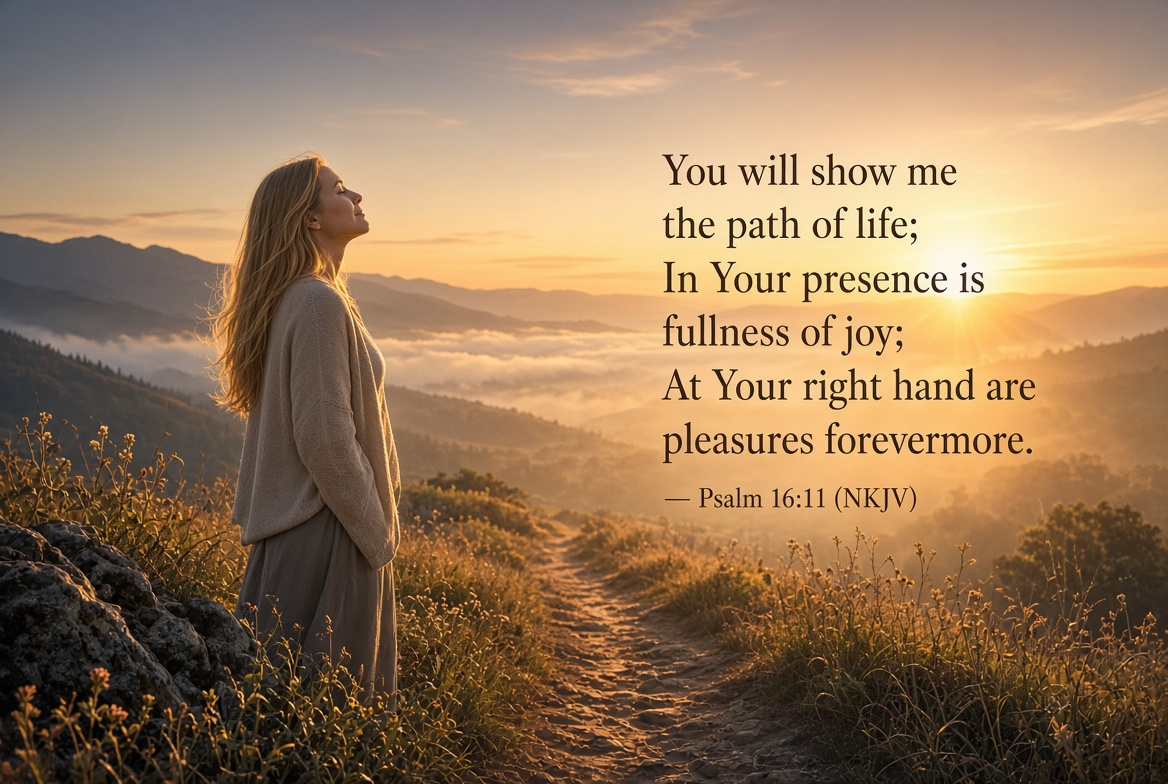
Psalm 16:11 NKJV
You will show me the path of life;
In Your presence is fullness of joy;
At Your right hand are pleasures forevermore.
The Path, the Presence, and the Pleasure

It’s curious to me that at certain times in life the Lord gives us scriptures at just the right time and place. Yesterday we had a memorial service for my sister Gloria, who passed away recently, and today, as I was looking to finish up Psalm 16, this is the verse that came up. For me, it’s just another way that the Lord comforts us and is there when we need him.
My Notes
You will show me the path of life; In Your presence is fullness of joy; At Your right hand are pleasures forevermore. — Psalm 16:11 (NKJV)
There are few verses in Scripture that paint a more beautiful picture of our future than Psalm 16:11. In just a few words, David takes us from the uncertainty of life on earth to the certainty of eternal joy in the presence of God.
We live in a world where happiness often feels fragile. Good days come and go. Health changes. Relationships shift. Circumstances can turn without warning. Even the best experiences eventually end. Yet David speaks here of something entirely different. He speaks of a joy that cannot fade, a pleasure that cannot be interrupted, and a future that can never be taken away.
What makes this psalm even more remarkable is that it points beyond David to the Lord Jesus Christ.
Jesus and the Path of Life
When David wrote, “You will show me the path of life,” he was expressing confidence that God would not abandon him to death. The New Testament reveals an even deeper meaning. Peter quoted this very psalm on the Day of Pentecost and explained that it ultimately found its fulfillment in Christ’s resurrection.
Acts 2:27-28 (NKJV)
“For You will not leave my soul in Hades, Nor will You allow Your Holy One to see corruption. You have made known to me the ways of life; You will make me full of joy in Your presence.”
Jesus entered death, the grave, and all the darkness that accompanied His suffering. Yet the Father showed Him the path of life. On the third day, Christ rose victorious, becoming the firstfruits of the resurrection and opening the way for all who belong to Him.
1 Corinthians 15:20 (NKJV)
“But now Christ is risen from the dead, and has become the firstfruits of those who have fallen asleep.”
Because Jesus walked that path first, believers can follow with confidence. The path of life is no longer merely a promise; it is a reality proven by the empty tomb.
He opened the way and then walked it so that others could follow. The joy set before Him—the certainty of rising and being received into the Father’s presence—carried Him through the hardest part of the journey.
Fullness of Joy in God’s Presence
Notice the wording of David’s statement. He does not say that God merely gives joy. He says that in God’s presence is fullness of joy.
Every joy we experience in this life is only a shadow of the joy that awaits us in the presence of God. A beautiful sunset, a season of good health, meaningful friendships, answered prayers, and moments of spiritual victory all reflect His goodness. Yet none of them can completely satisfy the deepest longings of the human heart.
Why? Because we were created for more than blessings. We were created for God Himself.
Psalm 73:25-26 (NKJV)
“Whom have I in heaven but You? And there is none upon earth that I desire besides You. My flesh and my heart fail; But God is the strength of my heart and my portion forever.”
Nothing is missing, nothing is fading, and nothing is about to be taken away. The same is true of the pleasures at His right hand. The right hand is the place of honor, security, and favor. God does not offer His people a lesser place. What He gives is lasting.
At His Right Hand: The Place of Honor, Security, and Eternal Delight
David goes on to say:
“At Your right hand are pleasures forevermore.”— Psalm 16:11 NKJV
In Scripture, the right hand is often associated with favor, authority, honor, and strength. To be seated at someone’s right hand was to occupy a place of special dignity and acceptance.
After His resurrection, Jesus ascended into heaven and took His seat at the Father’s right hand.
Hebrews 10:12 (NKJV)
“But this Man, after He had offered one sacrifice for sins forever, sat down at the right hand of God.”
Hebrews 1:3 (NKJV)
“When He had by Himself purged our sins, sat down at the right hand of the Majesty on high.”
This is not merely a statement about Christ’s exaltation. It is also a promise for those who belong to Him. Because we are united to Christ, where He is, we will one day be also.
John 17:24 (NKJV)
“Father, I desire that they also whom You gave Me may be with Me where I am, that they may behold My glory which You have given Me.”
Think about that for a moment. The Savior who endured the cross, bore our sins, suffered rejection, and conquered death now desires His people to be with Him forever. Heaven is not primarily about golden streets, gates of pearl, or even freedom from suffering. Heaven is ultimately about being with Christ.
Every earthly pleasure eventually reaches its limit. Even the happiest moments carry the quiet knowledge that they cannot last forever. Vacations end. Celebrations conclude. Friendships are interrupted by distance or death. Health fades. Possessions disappear. But the pleasures found at God’s right hand are altogether different.
They never diminish. They never disappoint. They never lose their sweetness. They never come to an end. As one writer observed, heaven’s joys are without measure, without mixture, and without end.
That is why the end of this psalm feels so different from the way many things feel in ordinary life. The one who began as a refugee ends as an heir. The path leads somewhere. The presence is not partial. The pleasures do not expire. And because Jesus has already walked the path, the same hope is open to everyone who belongs to Him. We taste something of it now when we draw near to God. We will know it fully when we see Him.
Prayer
Abba Father, thank You that the path does not end in the grave. You showed Jesus the path of life, and because He walked it, the way is open for us. Help me keep my eyes on You now, so that even in ordinary days I can taste the joy of Your presence. When life feels thin or temporary, remind me that at Your right hand there are pleasures that last forever. I want to walk the path You have shown, and I look forward to the day when joy is full, and nothing is missing. In Jesus’ name, Amen.
Key Takeaways
- The path of life in this psalm ultimately points to resurrection life, first walked by Jesus and opened to those who trust Him.
- Fullness of joy is found in God’s presence, not in circumstances. It is complete, unmixed, and lasting.
- The right hand of God is the place of honor and security. What is given there does not fade or get taken away.
- What begins as trust in God ends as an inheritance that is better than anything we can fully describe now.
- We can taste something of this joy in this life, but the fullness waits on the other side.

Proverb for Today
Incline your ear and hear the words of the wise, And apply your heart to my knowledge; For it is a pleasant thing if you keep them within you; Let them all be fixed upon your lips, So that your trust may be in the Lord; I have instructed you today, even you. Have I not written to you excellent things Of counsels and knowledge, That I may make you know the certainty of the words of truth, That you may answer words of truth To those who send to you? Proverbs 22:17-21 NKJV
Daily Scripture
For all people walk each in the name of his god, But we will walk in the name of the Lord our God Forever and ever. Micah 4:5 NKJV
Closing

“The Lord bless you and keep you; The Lord make His face shine upon you, And be gracious to you; The Lord lift up His countenance upon you, And give you peace.” Numbers 6:24-26 NKJV
Grace be with you. Amen.
Please enter your email and click subscribe to be notified whenever I submit a new post.

Commentaries:
Charles Spurgeon
“Thou wilt shew me the path of life.” To Jesus first this way was shown, for he is the first begotten from the dead, the first-born of every creature. He himself opened up the way through his own flesh, and then trod it as the forerunner of his own redeemed. The thought of being made the path of life to his people, gladdened the soul of Jesus. “In thy presence is fulness of joy.” Christ being raised from the dead ascended into glory, to dwell in constant nearness to God, where joy is at its full for ever: the foresight of this urged him onward in his glorious but grievous toil. To bring his chosen to eternal happiness was the high ambition which inspired him, and made him wade through a sea of blood. O God, when a worldling’s mirth has all expired, for ever with Jesus may we dwell “at thy right hand,” where “there are pleasures for evermore;” and meanwhile, may we have an earnest by tasting thy love below. Trapp’s note on the heavenly verse which closes the Psalm is a sweet morsel, which may serve for a contemplation, and yield a foretaste of our inheritance. He writes, “Here is as much said as can be, but words are too weak to utter it. For quality there is in heaven joy and pleasures; for quantity, a fulness, a torrent whereat they drink without let or loathing; for constancy, it is at God’s right hand, who is stronger than all, neither can any take us out of his hand; it is a constant happiness without intermission: and for perpetuity it is for evermore. Heaven’s joys are without measure, mixture, or end.”
______________________________________________________
Enduring Word
You will show me the path of life; in Your presence is fullness of joy: With these words David seemed to understand that the benefits of this life commitment to God were received in both this life, and the life beyond. (Guzik)
i. The path of life is something enjoyed by the believer both now, and in eternity. God gives us eternal life to enjoy as a present gift, extending into eternity. (Guzik)
ii. In Your presence is fullness of joy: This was a joy David could experience now (in the context of his previously mentioned gladness and rejoicing), but also ultimately receive when in the more immediate presence of God. (Guzik)
iii. Peter also quoted these lines in his message on the Day of Pentecost. They show that instead of being punished for His glorious work on the cross, Jesus was rewarded, as prophetically described in this psalm. (Guzik)
At Your right hand are pleasures forevermore: David had full confidence that his life with God – both now and forevermore – would be marked by the highest and best pleasures. This is life lived above shallow entertainments and excitements. (Guzik)
i. These pleasures are enjoyed at a place: “We are also told that heaven is to be enjoyed at the right hand of God. The right hand, even on earth, is the place of favor, and the place of honor, and the place of security. The right-hand place is always regarded as the place of dignity and nobility in all courts. God is not going to give his people any left-handed heaven, but they are to dwell at his right hand for evermore.” (Spurgeon)
ii. At Your right hand are pleasures forevermore: This tells that both in this life and the life beyond, true pleasures forevermore are found at the right hand of God, not in separation from Him. (Guzik)
iii. In his fictional work The Screwtape Letters, C.S. Lewis wrote in the voice of a senior devil, complaining about the “unfair advantage” that God has against the devils as they do their dark work: “He’s a hedonist at heart. All those fasts and vigils and stakes and crosses are only a façade. Or only like foam on the seashore. Out at sea, out in His sea, there is pleasure, and more pleasure. He makes no secret of it; at His right hand are ‘pleasures forevermore’. Ugh! I don’t think He has the least inkling of that high and austere mystery to which we rise in the Miserific Vision. He’s vulgar, Wormwood. He has a bourgeois mind. He has filled His world full of pleasures. There are things for humans to do all day long without His minding in the least – sleeping, washing, eating, drinking, making love, playing, praying, working. Everything has to be twisted before it’s any use to us. We fight under cruel disadvantages. Nothing is naturally on our side.”
iv. The conclusion of this psalm is especially wonderful when we consider how it began. “The refugee of verse 1 finds himself an heir, and his inheritance beyond all imagining and all exploring.” (Kidner)
v. When we go back to the first verse, we remember that this life of gladness and rejoicing and fullness of joy is not a problem-free life. It is a life that may be challenged and face attack on many levels. Yet in that a life commitment to God has been made and is enjoyed, it is a secure, happy, blessed life. (Guzik)
______________________________________________________
Albert Barnes
Thou wilt show me the path of life — In this connection this means that though he was to die – to descend to the regions of the dead, and to lie down in the dark grave – yet there WAS a path again to the living world, and that that path would be pointed out to him by God. In other words, he would not be suffered to remain among the dead, or to wander away forever with those who were in the under world, but he would be brought back: to the living world. This is language which, in this connection, could be founded only on a belief of the resurrection of the dead. The word “life” here does not necessarily refer to heaven – to eternal life – though the connection shows that this is the ultimate idea. It is life in contradistinction from the condition of the dead. The highest form of life is that which is found in heaven, at the right hand of God; and the connection shows it was that on which the eye of the psalmist was fixed.
In thy presence — literally, “with thy face.” Before thy face; or, as the sense is correctly expressed in our version, “in thy presence.” The reference is to God’s presence in heaven, or where he is supposed to dwell. This is shown by the additional statement that the joy mentioned was to be found at his “right hand” – an expression which properly refers to heaven. It is not merely a return to earth which is anticipated; it is an exaltation to heaven.
Is fulness of joy — Not partial joy; not imperfect joy; not joy intermingled with pain and sorrow; not joy which, though in itself real, does not satisfy the desires of the soul, as is the case with much of the happiness which we experience in this life – but joy, full, satisfying, unalloyed, unclouded, unmingled with anything that would diminish its fulness or its brightness; joy that will not be diminished, as all earthly joys must be, by the feeling that it must soon come to an end.
At thy right hand — The right hand is the place of honor (Notes, Psalms 16:8). Compare Mark 16:19; Hebrews 1:3; Acts 7:56; and it here refers to the place which the saints will occupy in heaven. This language could have been used only by one who believed in the doctrine of the resurrection and of the future state. As applicable to the author of the psalm, it implies that he had a firm belief in the resurrection of the dead, and a confident hope of happiness hereafter; as applicable to the Messiah, it denotes that he would be raised up to exalted honor in heaven; as applicable to believers now, it expresses their firm and assured faith that eternal happiness and exalted honor await them in the future world.
There are pleasures for evermore — Happiness that will be eternal. It is not enjoyment such as we have on earth, which we feel is soon to terminate; it is joy which can have no end. Here, in respect to any felicity which we enjoy, we cannot but feel that it is soon to cease. No matter how secure the sources of our joy may seem to be, we know that happiness here cannot last long, for life cannot long continue; and even though life should be lengthened out for many years, we have no certainty that our happiness will be commensurate even with our existence on earth. The dearest friend that we have may soon leave us to return no more; health, the source of so many comforts, and essential to the enjoyment of any comfort here, may soon fail; property, however firmly it may be secured, may “take to itself wings and fly away.” Soon, at any rate, if these things do not leave us, we shall leave them; and in respect to happiness from them, we shall be as though they had not been. Not so will it be at the right hand of God. Happiness there, whatever may be its nature, will be eternal. Losses, disappointment, bereavement, sickness, can never occur there; nor can the anticipation of death, though at the most distant period, and after countless million of ages, ever mar our joys. How different in all these things will heaven be from earth! How desirable to leave the earth, and to enter on those eternal joys!
______________________________________________________
John Gill
Thou wilt show me the path of life,…. Not the way of life and salvation for lost sinners, which is Christ himself; but the resurrection of the dead, which is a passing from death to life; and was shown to Christ, not doctrinally, or by illuminating his mind, and leading him into the doctrine of it, for so he himself has brought it to light by the Gospel; practically and experimentally, by raising him the dead, or by causing him to pass from death to life; and he was the first to whom the path of life was shown in this sense, or the that who ever trod in it, and so has led the way for others: hence he is called the that fruits of them that slept, the firstborn and first begotten from the dead; for though others were raised before, yet not to an immortal life, never to die more, as he was; now the view, the faith, and hope of this, of not being left in the grave so long as to see corruption, and of being raised from the dead to an immortal life, caused joy and gladness in Christ, at the time of his sufferings and death, as well as what follows;
in thy presence [is] fulness of joy: Christ, being raised from the dead, ascended to heaven, and was received up into glory into his Father’s presence, and is glorified with his own self, with his glorious presence, for which he prayed, John 17:5; and which fills his human nature with fulness of joy, with a joy unspeakable and full of glory; see Acts 2:28; and as it is with the head it will be with the members in some measure; now the presence of God puts more joy and gladness into them than anything else can do; but as yet their joy is not full; but it will be when they shall enter into the joy of their Lord, into the presence of God in the other world then everlasting joy will be upon their heads;
at thy right hand [there are] pleasures for evermore; Christ being entered into heaven is set down at the right hand of God in human nature, an honor which is not conferred on any of the angels, Hebrews 1:13; where the man Christ Jesus is infinitely delighted with the presence of God, the never fading joys of heaven, the company of angels and glorified saints; here he sits and sees of the travail of his soul; he prolongs his days and sees his seed, souls called by grace, and brought to glory one after another, until they are all brought in, in whom is all his delight; and which was the joy set before him at the time of his sufferings and death: or the words may be rendered “in thy right are pleasant things for ever”, and may design those gifts and graces, which Christ, being exalted at the right hand of God, received from thence and gives to men, for the use and service, of his church and people, in the several successive ages of time; and so Aben Ezra takes the words to be an allusion to a man’s giving pleasant gifts to his friend with his right hand.
______________________________________________________
Matthew Henry
That it is our wisdom and duty to set the Lord always before us, and to see him continually at our right hand, wherever we are, to eye him as our chief good and highest end, our owner, ruler, and judge, our gracious benefactor, our sure guide and strict observer; and, while we do thus, we shall not be moved either from our duty or from our comfort. Blessed Paul set the Lord before him, when, though bonds and afflictions did await him, he could bravely say, None of these things move me, Acts 20:24.
That, if our eyes be ever towards God, our hearts and tongues may ever rejoice in him; it is our own fault if they do not. If the heart rejoice in God, out of the abundance of that let the mouth speak, to his glory, and the edification of others.
That dying Christians, as well as a dying Christ, may cheerfully put off the body, in a believing expectation of a joyful resurrection: My flesh also shall rest in hope. Our bodies have little rest in this world, but in the grave they shall rest as in their beds, Isa. 57:2. We have little to hope for from this life, but we shall rest in hope of a better life; we may put off the body in that hope. Death destroys the hope of man (Job 14:19), but not the hope of a good Christian, Prov. 14:32. He has hope in his death, living hopes in dying moments, hopes that the body shall not be left for ever in the grave, but, though it see corruption for a time, it shall, at the end of the time, be raised to immortality; Christ’s resurrection is an earnest of ours if we be his.
That those who live piously with God in their eye may die comfortably with heaven in their eye. In this world sorrow is our lot, but in heaven there is joy. All our joys here are empty and defective, but in heaven there is a fulness of joy. Our pleasures here are transient and momentary, and such is the nature of them that it is not fit they should last long; but those at God’s right hand are pleasures for evermore; for they are the pleasures of immortal souls in the immediate vision and fruition of an eternal God.

- Exploring the Beauty of Psalms: Insights and Commentaries
- Monthly Breakdown of Our Blog Content
- Psalms Commentary: Faith and Inspiration
Leave a Reply