Isaiah 53:7 NKJV
He was oppressed and He was afflicted,
Yet He opened not His mouth;
He was led as a lamb to the slaughter,
And as a sheep before its shearers is silent,
So He opened not His mouth.
The Majesty of His Silence

This chapter gives us a look at the Messiah’s journey—why he chose to give his life and the wonderful blessings that come to all of us from that moment. It’s a summary of the ideas that make Christianity so special. Today, we’re in the seventh post of a 12-part series exploring Isaiah 53!
My Notes
“He was oppressed and He was afflicted, Yet He opened not His mouth; He was led as a lamb to the slaughter, And as a sheep before its shearers is silent, So He opened not His mouth.”—Isaiah 53:7 (NKJV)
There are moments in life when silence is not weakness but strength. We often feel the need to defend ourselves when we are misunderstood, falsely accused, or treated unfairly. Every instinct within us wants to explain, justify, and prove our innocence. Yet in Isaiah 53:7, we encounter a different kind of strength. We see Jesus standing in perfect control, choosing silence when He could have spoken with undeniable authority.
Isaiah paints a remarkable picture of the suffering Messiah. Jesus was oppressed. He was afflicted. He was falsely accused and cruelly mistreated. Yet in the midst of injustice, He did not fight for His own rights. He did not argue His case. He did not call down judgment on His enemies. Instead, He willingly submitted Himself to the Father’s plan of redemption.
That silence still teaches us. Most of us fight when life starts shearing away what we love—our plans, our comfort, our reputation, our health. We explain, we defend, we struggle. Jesus shows a different way. The same cross that paid for our sin also models a holy quiet under the Father’s hand.
Jesus had all authority. At any moment, He could have ended the suffering. He could have silenced every accusation, exposed every lie, and overwhelmed His enemies with divine power. Yet He chose not to. As Charles Spurgeon observed, “Omnipotence restrained omnipotence.” The One who spoke worlds into existence held Himself back for our salvation. When Jesus stood before Pilate and Herod, He was not a victim. He was the willing Lamb of God.
Jesus Was Silent, Not Helpless
One of the greatest misconceptions about Christ’s suffering is that He was overpowered. Scripture makes it clear that He voluntarily laid down His life.
“No one takes it from Me, but I lay it down of Myself. I have power to lay it down, and I have power to take it again. This command I have received from My Father.”—John 10:18 (NKJV)
Jesus was never at the mercy of men. He was carrying out the will of His Father.
“Jesus answered, ‘You could have no power at all against Me unless it had been given you from above. Therefore the one who delivered Me to you has the greater sin.’”—John 19:11 (NKJV)
Even while standing before Pilate, Jesus reminded him that every earthly authority operates only under God’s sovereign permission. And when His mission was complete, Jesus was the One who declared victory.
“So when Jesus had received the sour wine, He said, ‘It is finished!’ And bowing His head, He gave up His spirit.”—John 19:30 (NKJV)
Nobody took His life. He gave it. Isaiah’s point is not that Jesus was powerless. It is that Jesus was willingly silent.
The Lamb Led to the Slaughter
Isaiah compares Christ to a lamb being led to sacrifice. This image would have been deeply familiar to Jewish readers who understood the sacrificial system. Every lamb offered under the Law pointed forward to the ultimate sacrifice that would take away the sins of the world.
“The next day John saw Jesus coming toward him, and said, ‘Behold! The Lamb of God who takes away the sin of the world!’”—John 1:29 (NKJV)
Jesus was not merely suffering. He was fulfilling God’s redemptive plan. The lamb’s innocence highlights Christ’s innocence. He suffered not for His own sins but for ours. Every accusation against Him was false. Every blow was undeserved. Every wound was borne for guilty sinners.
That truth should humble us. The sins laid upon Him were never His own. Yet He accepted the burden without complaint because His love for us was greater than His desire to avoid the cross.
His Silence Revealed Perfect Obedience
The Apostle Paul tells us that Christ’s obedience reached its highest expression at Calvary.
“And being found in appearance as a man, He humbled Himself and became obedient to the point of death, even the death of the cross.”—Philippians 2:8 (NKJV)
The cross was not an accident. The cross was obedience.
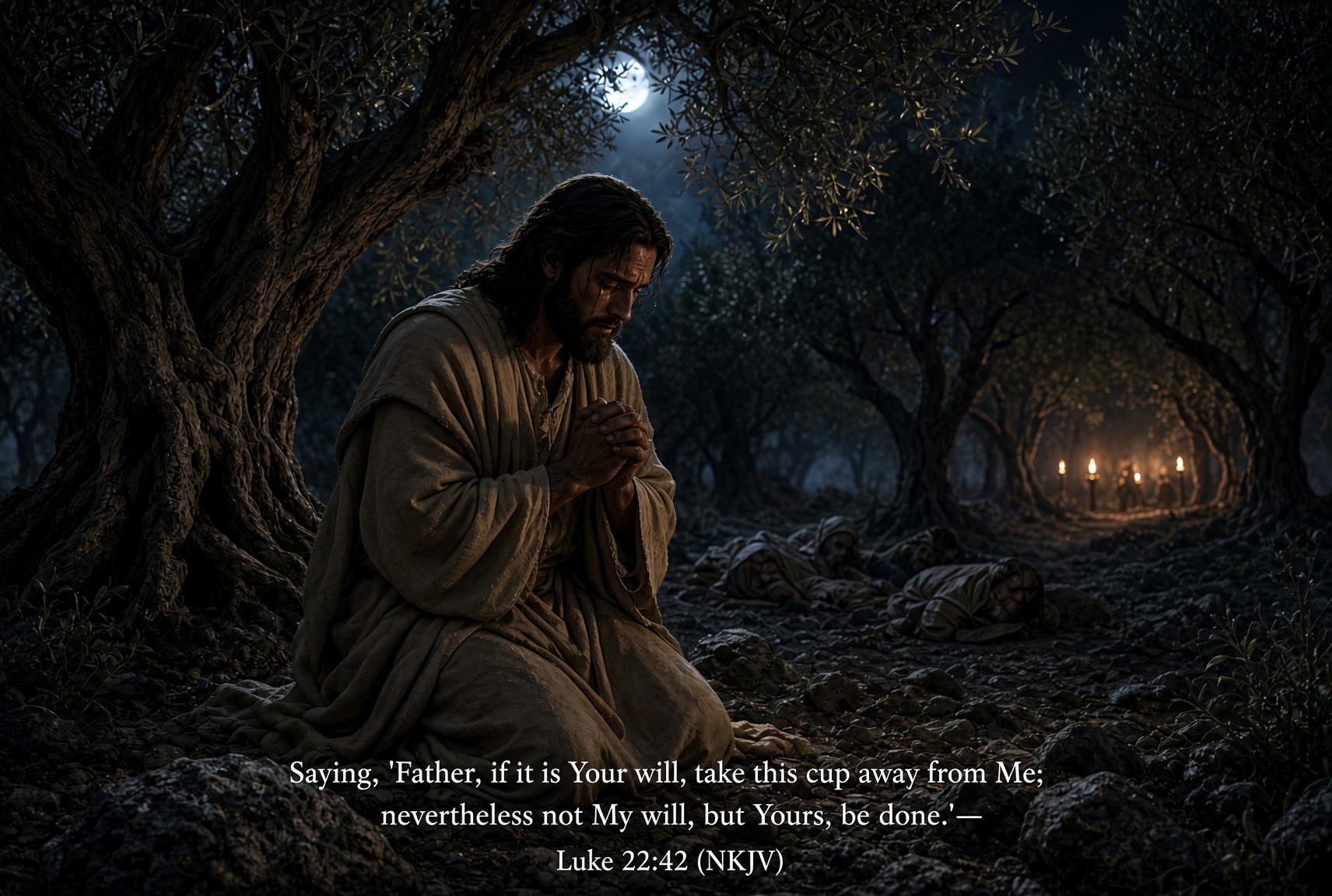
Jesus never resisted the Father’s will. In Gethsemane He prayed:
“Saying, ‘Father, if it is Your will, take this cup away from Me; nevertheless not My will, but Yours, be done.’”—Luke 22:42 (NKJV)
That prayer explains the silence of Isaiah 53:7. Jesus had already surrendered His will to the Father. By the time He stood before His accusers, the battle had already been won in prayer. His silence was the evidence of His complete trust in the Father’s plan.
A Model for Every Believer
Peter points us directly to Christ’s example and calls us to follow His steps.
“Who, when He was reviled, did not revile in return; when He suffered, He did not threaten, but committed Himself to Him who judges righteously.”—1 Peter 2:23 (NKJV)
When Jesus was insulted, He did not retaliate. When He suffered injustice, He did not seek revenge. Instead, He entrusted Himself to God. That is one of the hardest lessons for believers to learn. When we are hurt, we want immediate vindication. When we are criticized, we want to defend ourselves. When we are misunderstood, we want everyone to know our side of the story.
Yet sometimes God calls us to trust Him with our reputation, our circumstances, and our future. Jesus spoke when it served God’s purpose. But He never spoke out of self-preservation, pride, or revenge. The question for us is not whether we can defend ourselves. The question is whether we trust God enough when we don’t.
The Power of Holy Submission
The silence of Christ teaches us that genuine strength is found in surrender to God’s will.
“I was mute, I did not open my mouth, Because it was You who did it.”—Psalm 39:9 (NKJV)
That voluntary quiet and submission is what removes the scandal of the cross. He could have avoided it. By power He could have stopped it. But the Scriptures had to be fulfilled, and He had received this commandment from His Father. So He went forward as the Lamb of God—willing, unresisting, and fully submitted.
Prayer
Abba Father, thank You for the silence of Jesus. When everything in me wants to explain, defend, or fight back, remind me of the Lamb who opened not His mouth. Teach me to lie still under Your hand, trusting that You are good even when the shearing feels close. Give me the same quiet confidence He had—the kind that rests in Your will and knows You are still in control. In the mighty name of Jesus, Amen.
Key Takeaways
- Jesus’ silence was voluntary, not forced. He had the power to stop His suffering but willingly submitted to the Father’s plan.
- He was the innocent Lamb of God. Every accusation against Him was false, yet He bore our sins without complaint.
- His silence demonstrated perfect obedience. Christ fully surrendered to the Father’s will, even unto death.
- Jesus entrusted Himself to God’s justice. He did not retaliate or seek revenge but committed His cause to the Father.
- His example teaches us trust and humility. We are called to respond to suffering and injustice with faith rather than self-defense and bitterness.
- The cross was an act of willing love. Jesus was not trapped by circumstances; He chose the cross to redeem us.

Proverb for Today
He who earnestly seeks good finds favor, But trouble will come to him who seeks evil. He who trusts in his riches will fall, But the righteous will flourish like foliage. Proverbs 11:27-28 NKJV.
Daily Scripture
Is this not the fast that I have chosen: To loose the bonds of wickedness, To undo the heavy burdens, To let the oppressed go free, And that you break every yoke? Is it not to share your bread with the hungry, And that you bring to your house the poor who are cast out; When you see the naked, that you cover him, And not hide yourself from your own flesh? Then your light shall break forth like the morning, Your healing shall spring forth speedily, And your righteousness shall go before you; The glory of the Lord shall be your rear guard. Then you shall call, and the Lord will answer; You shall cry, and He will say, ‘Here I am.’“If you take away the yoke from your midst, The pointing of the finger, and speaking wickedness, If you extend your soul to the hungry And satisfy the afflicted soul, Then your light shall dawn in the darkness, And your darkness shall be as the noonday. The Lord will guide you continually, And satisfy your soul in drought, And strengthen your bones; You shall be like a watered garden, And like a spring of water, whose waters do not fail. Isaiah 58:6-11 NKJV
Closing

“The Lord bless you and keep you; The Lord make His face shine upon you, And be gracious to you; The Lord lift up His countenance upon you, And give you peace.” Numbers 6:24-26 NKJV
Grace be with you. Amen.
Please enter your email and click subscribe to be notified whenever I submit a new post.

Commentaries:
Charles Spurgeon
“Oh, the majesty of his silence! Never was eloquence equal to this: ‘He opened not his mouth.’”
“His was indeed golden silence. Oh, the wondrous eloquence of that patient speechlessness when he stood before Herod and Pilate, and did not answer them a word!
He could have spoken with such authority as to call legions of angels from heaven for his protection, or a single word of his could have destroyed his enemies… but he opened not his mouth.”
“Oh, the eloquence of that silence! Truly it was golden. Omnipotence restrained omnipotence. Christ held himself in as with bit and bridle.”
“The sin laid upon him was none of his, and he might have repudiated it; but he did not; and even when the bitter result of sin came to him, and He was oppressed, and he was afflicted, yet he opened not his mouth.”
“He never pleaded for himself. At the earthly judgment seat, he said not a word for himself, so that even Pilate marveled greatly.
“When a word could have released him, he would not speak it.”
May the perfect example of the Lamb of God teach us a holy submissiveness to the will of God!
______________________________________________________
John Gill
He was oppressed, and he was afflicted,…. He was injuriously treated by the Jews; they used him very ill, and handled him very roughly; he was oppressed and afflicted, both in body and mind, with their blows, and with their reproaches; he was afflicted, indeed, both by God and men: or rather it may be rendered, “it was exacted,” required, and demanded, “and he answered”, or “was afflicted”; justice finding the sins of men on him, laid on him by imputation, and voluntarily received by him, as in the preceding verse, demanded satisfaction of him; and he being the surety of his people, was responsible for them, and did answer, and gave the satisfaction demanded: the debt they owed was required, the payment of it was called for, and he accordingly answered, and paid the whole, every farthing, and cancelled the bond; the punishment of the sins of his people was exacted of him, and he submitted to bear it, and did bear it in his own body on the tree; this clearly expresses the doctrine of Christ’s satisfaction:
yet he opened not his mouth; against the oppressor that did him the injury, nor murmured at the affliction that was heavy upon him: or, “and he opened not his mouth”; against the justice of God, and the demand that was made upon him, as the surety of his people; he owned the obligation he had laid himself under; he paid the debt, and bore the punishment without any dispute or hesitation: “he is brought as a lamb to the slaughter, and as a sheep before her shearers is dumb”; or, “as a sheep to the slaughter, and as an ewe before her shearer”; these figurative phrases are expressive, not only of the harmlessness and innocence of Christ, as considered in himself, but of his meekness and patience in suffering, and of his readiness and willingness to be sacrificed in the room and stead of his people; he went to the cross without any reluctance, which; when there was any in the sacrifice, it was reckoned a bad omen among the Heathens, yea, such were not admitted to be offered; but Christ went as willingly to be sacrificed as a lamb goes to the slaughter house, and was as silent under his sufferings as a sheep while under the hands of its shearers; he was willing to be stripped of all he had, as a shorn sheep, and to be slaughtered and sacrificed as a lamb, for the sins of his people:
so he opened not his mouth: not against his enemies, by way of threatening or complaint; nor even in his own defense; nor against the justice of God, as bearing hard upon him, not sparing him, but demanding and having full satisfaction; nor against his people and their sins, for whom he suffered; see 1 Peter 2:23.
______________________________________________________
Matthew Henry
He was wronged and abused (v. 7): He was oppressed, injuriously treated and hardly dealt with. That was laid to his charge which he was perfectly innocent of, that laid upon him which he did not deserve, and in both he was oppressed and injured. He was afflicted both in mind and body; being oppressed, he laid it to heart, and, though, he was patient, was not stupid under it, but mingled his tears with those of the oppressed, that have no comforter, because on the side of the oppressors there is power, Eccl. 4:1. Oppression is a sore affliction; it has made many a wise man mad (Eccl. 7:7); but our Lord Jesus, though, when he was oppressed, he was afflicted, kept possession of his own soul.
He conducted himself under his sufferings so as to make it appear that he did not suffer as an evil-doer; for, though he was oppressed and afflicted, yet he opened not his mouth (v. 7), no, not so much as to plead his own innocency, but freely offered himself to suffer and die for us, and objected nothing against it. This takes away the scandal of the cross, that he voluntarily submitted to it, for great and holy ends. By his wisdom he could have evaded the sentence, and by his power have resisted the execution; but thus it was written, and thus it behoved him to suffer. This commandment he received from his Father, and therefore he was led as a lamb to the slaughter, without any difficulty or reluctance (he is the Lamb of God); and as a sheep is dumb before the shearers, nay, before the butchers, so he opened not his mouth, which denotes not only his exemplary patience under affliction (Ps. 39:9), and his meekness under reproach (Ps. 38:13), but his cheerful compliance with his Father’s will. Not my will, but thine be done. Lo, I come. By this will we are sanctified, his making his own soul, his own life, an offering for our sin.
He undertook to do it. God laid upon him our iniquity; but did he consent to it? Yes, he did; for some think that the true reading of the next words (v. 7) is, It was exacted, and he answered; divine justice demanded satisfaction for our sins, and he engaged to make the satisfaction. He became our surety, not as originally bound with us, but as bail to the action: “Upon me be the curse, my Father.” And therefore, when he was seized, he stipulated with those into whose hands he surrendered himself that that should be his disciples’ discharge: If you seek me, let these go their way, Jn. 18:8. By his own voluntary undertaking he made himself responsible for our debt, and it is well for us that he was responsible. Thus he restored that which he took not away.
______________________________________________________
Calvin’s Commentary
He was punished. Here the Prophet applauds the obedience of Christ in suffering death; for if his death had not been voluntary, he would not have been regarded as having satisfied for our disobedience. “As by one man’s disobedience,” says Paul, “all became sinners, so by one man’s obedience many were made righteous. (Romans 5:19) And elsewhere, “He became obedient unto death, even the death of the cross.” (Philippians 2:8) This was the reason of his silence at the judgment seat of Pilate, though he had a just defense to offer; for, having become answerable for our guilt, he wished to submit silently to the sentence, that we might loudly glory in the righteousness of faith obtained through free grace.
As a lamb shall he be led to the slaughter. We are here exhorted to patience and meekness, that, following the example of Christ, we may be ready to endure reproaches and cruel assaults, distress and torture. In this sense Peter quotes this passage, showing that we ought to become like Christ our Head, that we may imitate his patience and submissiveness. (1 Peter 2:23) In the word lamb there is probably an allusion to the sacrifices under the Law; and in this sense he is elsewhere called “the Lamb of God.” (John 1:29)

- Exploring the Beauty of Psalms: Insights and Commentaries
- Monthly Breakdown of Our Blog Content
- Psalms Commentary: Faith and Inspiration
Leave a Reply