Isaiah 53:5 NKJV
But He was wounded for our transgressions,
He was bruised for our iniquities;
The chastisement for our peace was upon Him,
And by His stripes we are healed.
The Heart of the Gospel

This chapter gives us a warm look ahead at the Messiah’s journey—why he chose to give his life and the wonderful blessings that come to all of us from that moment. It’s a summary of the ideas that make Christianity so special. Today, we’re in the fifth post of a 12-part series exploring Isaiah 53!
Two wonderful truths were shared by the Spirit of Christ through the Old Testament prophets: the suffering of Christ and the glory that would follow (1 Peter 1:11). When Jesus explained Moses and the prophets, he showed that the main point was that Christ had to suffer and then enter his glory (Luke 24:26–27). Yet nowhere in the Old Testament are these two themes expressed so clearly and fully as in this chapter, which the New Testament often quotes and applies to Christ. This chapter overflows with the amazing riches of Christ—so much so that we might call it Isaiah’s gospel rather than just his prophecy. By blending faith with this chapter, we can grow closer to Jesus Christ—both crucified and glorified—dying for our sins and rising again to bring us right with God.
MY NOTES
But He was wounded for our transgressions, He was bruised for our iniquities; The chastisement for our peace was upon Him, And by His stripes we are healed.—Isaiah 53:5 NKJV
Isaiah 53:5 is one of the most powerful verses in Scripture because it explains the heart of the gospel in just a few phrases. Written centuries before Jesus was born, Isaiah saw a coming Savior who would suffer not for His own sins, but for ours. Spurgeon once said that Milton, Shakespeare, Cowper, and every other poet put together couldn’t match them. He was right. There’s more weight, more honesty, and more relief packed into those words than most of us manage in a lifetime of trying to explain ourselves.
Notice the repeated word throughout the verse: our.
Jesus was wounded for our transgressions. He was bruised for our iniquities. The punishment that brought our peace was placed upon Him. Isaiah wants us to understand that Christ’s suffering was substitutionary. He took our place.
who was delivered up because of our offenses, and was raised because of our justification. —Romans 4:25
When we talk about “transgressions,” it’s a gentle way of saying we’ve all stepped outside the lines God set and followed our own path. “Iniquities” reminds us that our hearts can get pretty tangled up—we’re not just making mistakes; we’re people who truly need a fresh start. But instead of letting us carry that weight alone, God lovingly sent His Son to take it on for us.
and by Him to reconcile all things to Himself, by Him, whether things on earth or things in heaven, having made peace through the blood of His cross. —Colossians 1:20
Jesus didn’t just end up on the cross by chance—He chose it with love. Every mark and every moment was part of God’s beautiful plan to save us. He took the consequences we deserved so we could be forgiven, brought close to God, and find real peace.
For He made Him who knew no sin to be sin for us, that we might become the righteousness of God in Him. —2 Corinthians 5:21
The phrase, “the chastisement for our peace was upon Him,” reminds us that peace with God is not something we earn. It was purchased by Christ. Because of His finished work, believers no longer stand condemned before God. The hostility created by sin has been removed through the cross.
Isaiah then declares, “by His stripes we are healed.” This healing includes the deepest need of every human soul: forgiveness and restoration. Sin is portrayed in Scripture as a disease that affects every part of our lives. Christ is the Great Physician who cures what no one else can.
Some people take the past-tense language and claim it means every believer should be perfectly healthy right now, and any sickness means we haven’t claimed the promise hard enough. That reading doesn’t fit the rest of Scripture or the actual lives of people who walked with God.
For by grace you have been saved through faith, and that not of yourselves; it is the gift of God, —Ephesians 2:8.
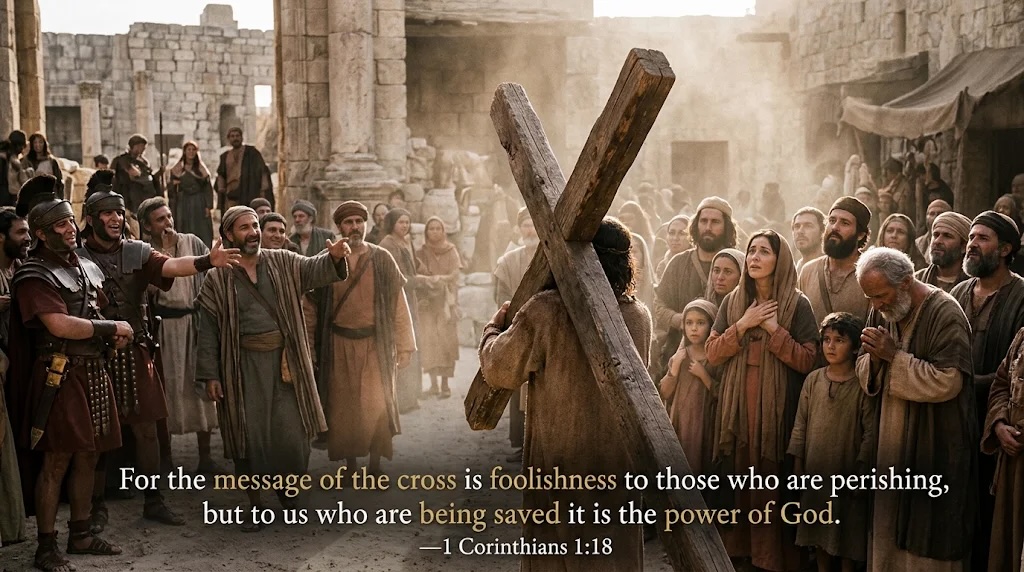
For the message of the cross is foolishness to those who are perishing, but to us who are being saved it is the power of God. —1 Corinthians 1:18.
We will be saved. The same pattern holds for healing. Perfect, complete restoration is secured by what Jesus did. It’s already ours in the deepest sense. But the full experience of it—body and soul completely free from every effect of the fall—waits for the resurrection. The healings we see now are real gifts, yet they’re also previews. They point forward. They don’t rewrite the present order of things.
who Himself bore our sins in His own body on the tree, that we, having died to sins, might live for righteousness—by whose stripes you were healed.—1 Peter 2:24
What we do have right now is peace with God and a progressive healing from the disease of sin. Christ took the chastisement so the hostility between us and God could end. He made peace through the blood of His cross. We can come near without the old fear, but in awe. And the same cross that paid for our pardon also breaks sin’s grip. We still fight, but we fight as people who have already been healed at the root.
Jesus carried what we could never carry so that we might receive what we could never earn.
Prayer
Abba Father, thank You that Jesus took what we deserved so we could have what we never could have earned. We’re not pretending we don’t still struggle. Some days the old disease feels closer than it should. But we come back to these wounds because that’s where the healing is. Keep teaching us to rest in what He already finished, to live like people who really are at peace with You, and to wait with real hope for the day when every last effect of sin is gone. In Jesus’ name, Amen.
Key Takeaways
- The entire burden of our sin was carried by Jesus, not by us. That is the heart of the gospel.
- Healing from the disease of sin is real, complete in its foundation, and ongoing in its experience.
- Peace with God is not something we earn after the fact. It was purchased by the chastisement that fell on Him.
- Ultimate physical restoration is promised, but it arrives fully in the resurrection, not on our preferred timetable.
- Our confidence rests on His stripes alone, not on our feelings, vows, or performance.

Proverb for Today
I love those who love me, And those who seek me diligently will find me. Proverbs 8:17 NKJV
Daily Scripture
When Jesus saw their faith, He said to the paralytic, “Son, your sins are forgiven you.” Mark 2:5 NKJV
Closing

“The Lord bless you and keep you; The Lord make His face shine upon you, And be gracious to you; The Lord lift up His countenance upon you, And give you peace.” Numbers 6:24-26 NKJV
Grace be with you. Amen.
Please enter your email and click subscribe to be notified whenever I submit a new post.

Commentaries:
Charles Spurgeon
Charles Spurgeon frequently preached and wrote on Isaiah 53:5, treating it as a core expression of the gospel centered on Christ’s substitutionary atonement.
If this does not teach the doctrine of a vicarious atonement, what does it teach? If Christ’s sufferings were not endured in our place, as our substitute, what do these words mean? … It is substitution, you see, all through—Christ suffering instead of us—the Innocent dying for the guilty—the Lord of glory bearing the sin of rebellious men. … The whole gospel in a nutshell lies in this verse.
Milton, Shakespeare, Cowper, and all the poets who ever were or are now, all put together, could not write four sentences like those in this verse. There is more meaning, more deep philosophy, more music, more to charm and satisfy the human heart, in those four sentences, than in the sweetest of merely human language.
Below are excerpts from
(No. 1068)
A SERMON DELIVERED ON LORD’S-DAY MORNING, SEPTEMBER 1, 1872,
BY C. H. SPURGEON,
AT THE METROPOLITAN TABERNACLE, NEWINGTON.
“With His stripes we are healed.” Isaiah 53:5.
Everywhere, at this present hour, we meet with some form or other of sickness. No place, however healthful, is free from disease. As for moral disease, it is all around us and we are thankful to add that the remedy is everywhere within reach. The Beloved Physician has prepared a healing medicine which can be reached by all classes which is available in every climate, at every hour, under every circumstance and is effectual in every case wherever it is received. Of that Medicine we shall speak this morning, praying that we may have God’s help in so doing. It is a great mercy for us who have to preach, as well as for you who have to hear, that the Gospel healing is so very simple—our text describes it— “With His stripes we are healed.”
“With His stripes we are healed.” I find that the word here used is in the singular and not as the translation would lead you to suppose. I hardly know how to fully translate the word. It is read by some as “weal,” “bruise,” or “wound,” meaning the mark or print of blows on the skin. But Alexander says the word denotes the tumor raised in flesh by scourging. It is elsewhere translated, “blueness,” “hurt,” and “spots,” and evidently refers to the black and blue marks of the scourge. The use of a singular noun may have been intended to set forth that our Lord was, as it were, reduced to a mass of bruising and was made one great bruise. By the suffering which that condition indicated we are saved.
There is another joy in the text—joy in the honor which it brings to Christ. The stripes, let us lament them. The healing, let us rejoice in it! And then, the Physician, let us honor Him. “With His stripes we are healed.” Jesus Christ works real cures. We are healed, effectually healed. We were healed when we first believed; we are still healed. Abiding cure we have, for still to His wounds we fly. An eternal cure we have, for never man was healed by Christ and then relapsed and died. “With His stripes we are healed”—by nothing else—by no mixture of something else with those stripes. Not by priestcraft, not by sacraments, not by our own prayers, not by our own good works. “With His stripes we are healed”—healed of all sin of every kind—of sins past, of sins present and sins to come! We are healed, completely healed of all, and that in a moment—not through long years of waiting and of gradually growing better but—”With His stripes we are healed,” completely healed, even now. Blessed be His name!
Now, child of God, if you would give glory to God, declare that you are healed this morning! Be not always saying, “I hope I am saved.” The man who he says hopes he is cured does not greatly recommend the physician. But the man who knows he is, he is the man who brings him honor. Let us speak positively—we can do so. Let us speak out in the face of all mankind and not be ashamed. Let us say, “As surely as we were diseased, so surely are we healed through the stripes of our Lord Jesus Christ.” Let us give Jesus all glory! Let us magnify Him to the utmost.
______________________________________________________
Enduring Word
But He was wounded for our transgressions, He was bruised for our iniquities; the chastisement for our peace was upon Him: Yes, the Messiah was stricken, smitten by God, and afflicted. But now, the prophet explains why. It was for us – for our transgressions…for our iniquities. It was in our place that the Messiah suffered. (Guzik)
i. Wounded is literally “pierced through.” (Guzik)
And by His stripes we are healed: Here, the prophet sees through the centuries to know that the Messiah would be beaten with many stripes (Mark 15:15). More so, the prophet announces that provision for healing is found in the suffering of Jesus, so by His stripes we are healed. (Guzik)
i. There has been much debate as to if Isaiah had in mind spiritual healing or physical healing. As this passage is quoted in the New Testament, we see some more of the thought. In Matthew 8:16-17, the view seems to be of physical healing. In 1 Peter 2:24-25, the view seems to be of spiritual healing. We can safely say that God has both aspects of healing in view, and both our physical and spiritual healing is provided for by the suffering of Jesus. (Guzik)
ii. However, some have taken this to mean that every believer has the right – the promise – to perfect health right now, and if there is any lack of health, it is simply because this promise has not been claimed in faith. In this thinking, great stress is laid upon the past tense of this phrase – by His stripes we are healed. The idea is that since it is in the past tense, perfect health is God’s promise and provision for every Christian at this very moment, even as the believer has the promise to perfect forgiveness and salvation at this moment. (Guzik)
iii. The problem of this view – not even counting how it terribly contradicts the personal experience of saints in the Bible and through history – is that it misunderstands the “verb tense” of both salvation and healing. We can say without reservation that perfect, total, complete healing is God’s promise to every believer in Jesus Christ, paid for by His stripes and the totality of His work for us. But we must also say that it is not promised to every believer right now, just as the totality of our salvation is not promised to us right now. The Bible says that we have been saved (Ephesians 2:8), that we are being saved (1 Corinthians 1:18), and that we will be saved (1 Corinthians 3:15). Even so, there is a sense in which we have been healed, are being healed, and one day will be healed. God’s ultimate healing is called “resurrection,” and it is a glorious promise to every believer. Every “patch-up” healing in this present age simply anticipates the ultimate healing that will come. (Guzik)
iv. What Christians must not do is foolishly “claim” to be healed, despite “mere symptoms” that say otherwise, and believe they are standing on the promise of Isaiah 53:5. What Christians must do is pray boldly and trust God’s goodness and mercy in granting gifts of healing now, even before the ultimate healing of resurrection. (Guzik)
v. “‘With his stripes we are healed.’ Will you notice that fact? The healing of a sinner does not lie in himself, nor in what he is, nor in what he feels, nor in what he does, nor in what he vows, nor in what he promises. It is not in himself at all; but there, at Gabbatha, where the pavement is stained with the blood of the Son of God, and there, at Golgotha, where the place of a skull beholds the agonies of Christ. It is in his stripes that the healing lies. I beseech thee, do not scourge thyself: ‘With his stripes we are healed.’” (Spurgeon)
______________________________________________________
Albert Barnes
But he was wounded — Margin, ‘Tormented.’ Jerome and the Septuagint also render this, ‘He was wounded.’ Junius and Tremellius, ‘He was affected with grief.’ The Chaldee has given a singular paraphrase of it, showing how confused was the view of the whole passage in the mind of that interpreter. ‘And he shall build the house of the sanctuary which was defiled on account of our sins, and which was delivered on account of our iniquities. And in his doctrine, peace shall be multiplied to us. And when we obey his words, our sins shall be remitted to us.’ The Syriac renders it in a remarkable manner, ‘He is slain on account of our sins,’ thus showing that it was a common belief that the Messiah would be violently put to death. The word rendered ‘wounded’ (מחלל mecholâl), is a Pual participle, from חלל châlal, to bore through, to perforate, to pierce; hence, to wound 1Sa 31:3; 1 Chronicles 10:3; Ezekiel 28:9. There is probably the idea of painful piercing, and it refers to some infliction of positive wounds on the body, and not to mere mental sorrows, or to general humiliation.
For our transgressions — The prophet here places himself among the people for whom the Messiah suffered these things, and says that he was not suffering for his own sins, but on account of theirs. The preposition ‘for’ (מן min) here answers to the Greek διά dia, on account of, and denotes the cause for which he suffered and means, even according to Gesenius (Lex.), here, ‘the ground or motive on account of, or because of which anything is done.’ Compare Deuteronomy 7:7; Judges 5:11; Esther 5:9; Psalms 68:30; Song of Solomon 3:8. It is strikingly parallel to the passage in Romans 4:25 : ‘Who was delivered for (διά dia) our offences.’ Compare 2 Corinthians 5:21; Heb 9:28; 1 Peter 2:24. Here the sense is, that the reason why he thus suffered was, that we were transgressors. All along the prophet keeps up the idea that it was not on account of any sin of which he was guilty that he thus suffered, but it was for the sins of others – an idea which is everywhere exhibited in the New Testament.
______________________________________________________
John Gill
But he was wounded for our transgressions,…. Not for any sins of his own, but for ours, for our rebellions against God, and transgressions of his law, in order to make atonement and satisfaction for them; these were the procuring and meritorious causes of his sufferings and death, as they were taken upon him by him to answer for them to divine justice, which are meant by his being wounded; for not merely the wounds he received in his hands, feet, and side, made by the nails and spear, are meant, but the whole of his sufferings, and especially his being wounded to death, and which was occasionally by bearing the sins of his people; and hereby he removed the guilt from them, and freed them from the punishment due unto them:
he was bruised for our iniquities; as bread corn is bruised by threshing it, or by its being ground in the mill, as the manna was; or as spice is bruised in a mortar, he being broken and crushed to pieces under the weight of sin, and the punishment of it. The ancient Jews understood this of the Messiah; in one place they say, “chastisements are divided into three parts, one to David and the fathers, one to our generation, and one to the King Messiah; as it is written, “he was wounded for our transgressions; and bruised for our iniquities”:” and in another place, “at that time they shall declare to the Messiah the troubles of Israel in captivity, and the wicked which are among them, that do not mind to know the Lord; he shall lift up his voice, and weep over the wicked among them; as it is said, “he was wounded for our transgressions,” &c.”
the chastisement of our peace was upon him; that is, the punishment of our sins was inflicted on him, whereby our peace and reconciliation with God was made by him; for chastisement here does not design the chastisement of a father, and in love, such as the Lord chastises his people with; but an act of vindictive justice, and in wrath, taking vengeance on our sins, of our surety, whereby divine wrath is appeased, justice is satisfied, and peace is made:
and with his stripes we are healed; or “by his stripe”, or “bruise”: properly the black and blue mark of it, so called from the gathering and settling of the blood where the blow is given. Sin is a disease belonging to all men, a natural, hereditary, nauseous, and incurable one, but by the blood of Christ; forgiving sin is a healing of this disease; and this is to be had, and in no other way, than through the stripes and wounds, the blood and sacrifice, of the Son of God. Christ is a wonderful physician; he heals by taking the sicknesses of his people upon himself, by bearing their sins, and being wounded and bruised for them, and by his enduring blows, and suffering death itself for them. The Targum is, “when we obey his words, our sins will be forgiven us;” but forgiveness is not through our obedience, but the blood of Christ.
______________________________________________________
Matthew Henry
Hereby we have peace: The chastisement of our peace was upon him; he, by submitting to these chastisements, slew the enmity, and settled an amity, between God and man; he made peace by the blood of his cross. Whereas by sin we had become odious to God’s holiness and obnoxious to his justice, through Christ God is reconciled to us, and not only forgives our sins and saves us from ruin, but takes us into friendship and fellowship with himself, and thereby peace (that is, all good) comes unto us, Col. 1:20. He is our peace, Eph. 2:14. Christ was in pain that we might be at ease; he gave satisfaction to the justice of God that we might have satisfaction in our own minds, might be of good cheer, knowing that through him our sins are forgiven us.
Hereby we have healing; for by his stripes we are healed. Sin is not only a crime, for which we were condemned to die and which Christ purchased for us the pardon of, but it is a disease, which tends directly to the death of our souls and which Christ provided for the cure of. By his stripes (that is, the sufferings he underwent) he purchased for us the Spirit and grace of God to mortify our corruptions, which are the distempers of our souls, and to put our souls in a good state of health, that they may be fit to serve God and prepared to enjoy him. And by the doctrine of Christ’s cross, and the powerful arguments it furnishes us with against sin, the dominion of sin is broken in us and we are fortified against that which feeds the disease.

- Exploring the Beauty of Psalms: Insights and Commentaries
- Monthly Breakdown of Our Blog Content
- Psalms Commentary: Faith and Inspiration
Leave a Reply