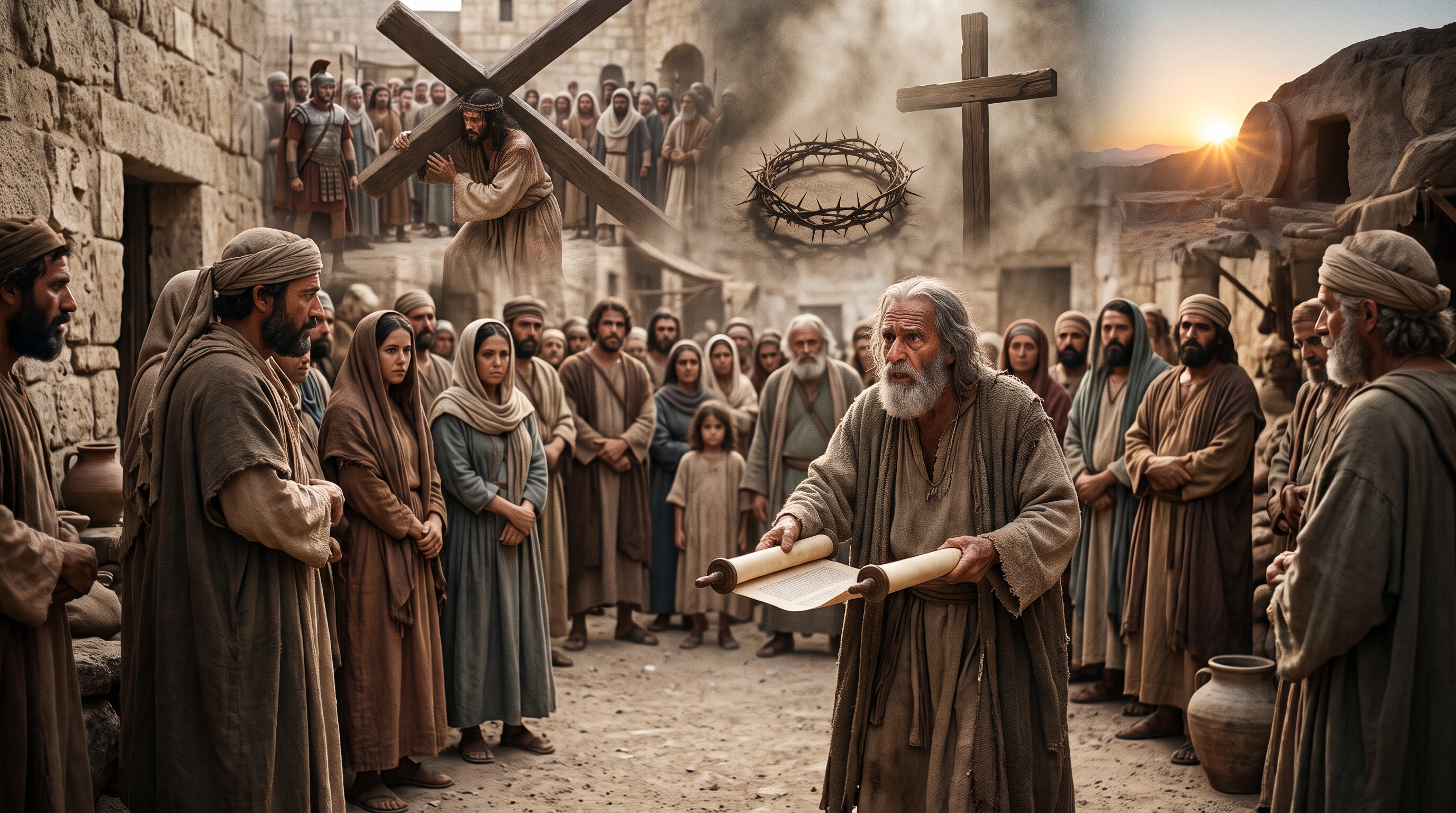
Isaiah 53:4 NKJV
Surely He has borne our griefs
And carried our sorrows;
Yet we esteemed Him stricken,
Smitten by God, and afflicted.
The Astonishing Love of the Suffering Savior

This chapter gives us a warm look ahead at the Messiah’s journey—why he chose to give his life and the wonderful blessings that come to all of us from that moment. It’s a summary of the ideas that make Christianity so special. Today, we’re in the fourth post of a 12-part series exploring Isaiah 53!
Two wonderful truths were shared by the Spirit of Christ through the Old Testament prophets: the suffering of Christ and the glory that would follow (1 Peter 1:11). When Jesus explained Moses and the prophets, he showed that the main point was that Christ had to suffer and then enter his glory (Luke 24:26–27). Yet nowhere in the Old Testament are these two themes expressed so clearly and fully as in this chapter, which the New Testament often quotes and applies to Christ. This chapter overflows with the amazing riches of Christ—so much so that we might call it Isaiah’s gospel rather than just his prophecy. By blending faith with this chapter, we can grow closer to Jesus Christ—both crucified and glorified—dying for our sins and rising again to bring us right with God.
My Notes
Surely He has borne our griefs, And carried our sorrows; Yet we esteemed Him stricken, Smitten by God, and afflicted. Isaiah 53:4 (NKJV)
There are few chapters in all of Scripture that reveal the heart of Jesus more clearly than Isaiah 53. Written centuries before Christ was born in Bethlehem, this prophecy paints a vivid picture of His rejection, suffering, sacrifice, and ultimate victory.
Isaiah 53:4 begins with a word of certainty:
“Surely.”
This is not a possibility. It is not a theory. It is not religious speculation. It is divine truth.
Isaiah seems overwhelmed by what he sees. Under the inspiration of the Holy Spirit, he beholds the coming Messiah and suddenly understands something astonishing: the sufferings of Christ were not for His own sins but for ours.
The prophet declares:
“Surely He has borne our griefs And carried our sorrows.”— Isaiah 53:4a (NKJV)
What an incredible statement! The Son of God willingly took upon Himself the burden of fallen humanity. He entered our broken world and carried what was ours.
Jesus did not simply observe our pain from heaven. He stepped into it.
He experienced hunger, thirst, weariness, rejection, betrayal, grief, anguish, and ultimately death. Yet His suffering was far more than physical. On the cross, He bore the weight of human sin and its consequences.
The griefs and sorrows Isaiah speaks of reach beyond emotional suffering. They point to the entire burden brought into the world through sin. Christ came to carry what humanity could never remove on its own.
But He was wounded for our transgressions, He was bruised for our iniquities; The chastisement for our peace was upon Him, And by His stripes we are healed. —Isaiah 53:5
When evening had come, they brought to Him many who were demon-possessed. And He cast out the spirits with a word, and healed all who were sick, that it might be fulfilled which was spoken by Isaiah the prophet, saying: “He Himself took our infirmities and bore our sicknesses.”—Matthew 8:16-17
Spurgeon called it a discovery that still amazes the heart. The prophet seems almost startled as he writes it. Surely? Can it really be that the perfect One took what belonged to us? Yes. No other explanation fits the sufferings of Jesus. He was not paying for anything He had done. He carried the grief and sorrow our sin earned. That is not a small thing. It is the best news a heavy heart can hear.
Isaiah continues:
“Yet we esteemed Him stricken, Smitten by God, and afflicted.” — Isaiah 53:4b (NKJV)
The second half of the verse is just as honest. “Yet we esteemed Him stricken, smitten by God, and afflicted.” People looked at Jesus and reached the wrong conclusion. They saw the suffering and assumed God was punishing Him for His own faults. They were right that He was stricken and smitten by God. They were wrong about the reason. They saw the wounds but missed the purpose. The prophet has to stop and explain: He was wounded for our transgressions. The chastisement that brought our peace was upon Him. He stood in our place.
who Himself bore our sins in His own body on the tree, that we, having died to sins, might live for righteousness—by whose stripes you were healed. —1 Peter 2:24
But God demonstrates His own love toward us, in that while we were still sinners, Christ died for us.—Romans 5:8
For He made Him who knew no sin to be sin for us, that we might become the righteousness of God in Him. —2 Corinthians 5:21
‘Yet we esteemed Him stricken, smitten by God, and afflicted.’ Ironically, the crowd’s observation was factually correct, but spiritually blind. They saw Jesus suffering, bruised, and hanging on a tree, and they assumed God was punishing Him for His own crimes. Like Job’s comforters, they looked at outward misery and assumed inward guilt. They completely missed the divine purpose operating beneath the surface.
That is the heart of this verse. The One we misjudged was actually bearing what we should have carried. The grief that presses on us today is not unknown to Him. He has already taken it. The sorrow that feels too big for us is not too big for the One who carried it all the way to the cross.
Prayer
Abba Father, thank You that Jesus has truly borne my griefs and carried my sorrows. Forgive me for the times I have looked at His suffering and missed the love behind it. Help me to stop trying to carry alone what He has already taken. When the weight feels too heavy, remind me that the Man of Sorrows has already shouldered it. Let the truth of this verse quiet my heart and strengthen my trust. In Jesus’ name I pray, Amen.
Key Takeaways
- “Surely He has borne our griefs” is not poetry—it explains why the perfect Son of God suffered.
- People correctly saw that Jesus was stricken and smitten by God, but they completely missed the reason: He was carrying what belonged to us.
- The griefs and sorrows He bore include both the penalty of our sin and the weight of human suffering.
- We are invited to move from misjudging Him to personally trusting that He has borne our griefs.

Proverb for Today
“Now therefore, listen to me, my children, For blessed are those who keep my ways. Hear instruction and be wise, And do not disdain it. Blessed is the man who listens to me, Watching daily at my gates, Waiting at the posts of my doors. For whoever finds me finds life, And obtains favor from the Lord; But he who sins against me wrongs his own soul; All those who hate me love death.” Proverbs 8:32-36 NKJV
Daily Scripture
But you, O man of God, flee these things and pursue righteousness, godliness, faith, love, patience, gentleness. Fight the good fight of faith, lay hold on eternal life, to which you were also called and have confessed the good confession in the presence of many witnesses. I urge you in the sight of God who gives life to all things, and before Christ Jesus who witnessed the good confession before Pontius Pilate, that you keep this commandment without spot, blameless until our Lord Jesus Christ’s appearing, which He will manifest in His own time, He who is the blessed and only Potentate, the King of kings and Lord of lords, who alone has immortality, dwelling in unapproachable light, whom no man has seen or can see, to whom be honor and everlasting power. Amen. 1 Timothy 6:11-16 NKJV
Closing

“The Lord bless you and keep you; The Lord make His face shine upon you, And be gracious to you; The Lord lift up His countenance upon you, And give you peace.” Numbers 6:24-26 NKJV
Grace be with you. Amen.
Please enter your email and click subscribe to be notified whenever I submit a new post.

Commentaries:
Charles Spurgeon
Listen, ye sad ones, ye sorrowful ones! Let this sweet note charm you into joy: ‘He hath borne our griefs, and carried our sorrows.’
What a discovery this Truth of God seems to be! How it bursts upon the Prophet and his hearers and amazes them! ‘Surely,’ they say, ‘can it be really so, that, “He has borne our grief and carried our sorrows”?’ Yes, it is indeed so. There is no accounting for the sufferings of the perfect Christ except by this explanation—that He was bearing our grief and carrying the sorrows that we ought to have carried for our own sin.
Can all of you say this? Can every one of us unite in the reading of this sentence, ‘Surely, He has borne our griefs’? If you have truly learned that He bore your griefs, you may indeed bless His name, for it is the best news that ever reached your ears!
______________________________________________________
Enduring Word
Surely He has borne our griefs and carried our sorrows: At this point, the prophet does not have in mind the way the Messiah took our guilt and God’s wrath upon Himself. Here, he has in view how the Messiah took our pain upon Himself. He made our griefs His own, and our sorrows as if they were His. The image is that He loaded them up and carried them on His back, so we wouldn’t have to.
i. How many people carry around pain – griefs and sorrows – that Jesus really carried for them? He took them from us, but for it to do us any good, we must release them.
Yet we esteemed Him stricken, smitten by God, and afflicted: Curiously, this estimation was accurate. Certainly, the Messiah was stricken. He was smitten by God. He was afflicted. The problem was not in seeing these things, but in only seeing these things. Man saw the suffering Jesus but didn’t understand the reasons why.
But He was wounded for our transgressions, He was bruised for our iniquities; the chastisement for our peace was upon Him: Yes, the Messiah was stricken, smitten by God, and afflicted. But now, the prophet explains why. It was for us – for our transgressions…for our iniquities. It was in our place that the Messiah suffered.
i. Wounded is literally “pierced through.”
(David Guzik)
______________________________________________________
Albert Barnes
Surely — This is an exceedingly important verse, and is one that is attended with considerable difficulty, from the manner in which it is quoted in the New Testament. The general sense, as it stands in the Hebrew, is not indeed difficult. It is immediately connected in signification with the previous verse. The meaning is, that those who had despised and rejected the Messiah, had greatly erred in condemning him on account of his sufferings and humiliation. ‘We turned away from him in horror and contempt. We supposed that he was suffering on account of some great sin of his own. But in this we erred. It was not for his sins but for ours. It was not that he Was smitten of God for his own sins – as if he had been among the worst of mortals – but it was because he had taken our sins, and was suffering for them. The very thing therefore that gave offense to us, and which made us turn away from him, constituted the most important part of his work, and was really the occasion of highest gratitude. It is an acknowledgment that they had erred, and a confession of that portion of the nation which would be made sensible of their error, that they had judged improperly of the character of the sufferer. The word rendered ‘surely’ (אכן ‘âkēn, Vulgate, vere), is sometimes a particle strongly affirming, meaning truly, of a certain truth Genesis 28:16; Exodus 2:14; Jeremiah 8:8. Sometimes it is an adversative particle, meaning but yet Psalms 31:23; Isaiah 49:24. It is probably used in that sense here, meaning, that though he was despised by them, yet he was worthy of their esteem and confidence, for he had borne their griefs. He was not suffering for any sins of his own, but in a cause which, so far from rendering him an object of contempt, made him worthy of their highest regard.
Our griefs — The word used here (חלי chăliy) means properly sickness, disease, anxiety, affliction. It does not refer to sins, but to sufferings. It is translated ‘sickness’ Deuteronomy 28:61; Deu 7:15; 2 Chronicles 21:15; 1 Kings 17:17; ‘disease’ Ecclesiastes 6:2; 2 Chronicles 21:18; 2 Chronicles 16:12; Exodus 15:26; ‘grief’ (Isaiah 53:3-4; compare Jeremiah 16:4). It is never in our version rendered sin, and never Used to denote sin. ‘In ninety-three instances,’ says Dr. Magee (On atonement and Sacrifice, p. 229, New York Ed. 1813), ‘in which the word here translated (by the Septuagint) ἀμαρτίας hamartias, or its kindred verb, is found in the Old Testament in any sense that is not entirely foreign from the passage before us, there occurs but this one in which the word is so rendered; it being in all other cases expressed by ἀσθένεια astheneia, μαλακία malakia, or some word denoting bodily disease.’ ‘That the Jews,’ he adds, ‘considered this passage as referring to bodily diseases, appears from Whitby, and Lightfoot. Hor. Heb. on Matthew 8:17.’ It is rendered in the Vulgate, Languores – ‘Our infirmities.’ In the Chaldee, ‘He prayed for our sins.’ Castellio renders it, Morbos – ‘Diseases;’ and so Junius and Tremellius. The Septuagint has rendered it in this place: Ἁμαρτίας Hamartias – ‘Sins;’ though, from what Dr. Kennicott has advanced in his Diss. Gen. Section 79, Dr. Magee thinks there can be no doubt that this is a corruption which has crept into the later copies of the Greek. A few Greek manuscripts of the Septuagint also read it ἀσθενείας astheneias, and one copy reads μαλακίας malakias.
Matthew Matthew 8:17 has rendered it, ἀσθενείας astheneias – ‘infirmities,’ and intended no doubt to apply it to the fact that the Lord Jesus healed diseases, and there can be no doubt that Matthew has used the passage, not by way of accommodation, but in the true sense in which it is used by Isaiah; and that it means that the Messiah would take upon himself the infirmities of people, and would remove their sources of grief. It does not refer here to the fact that he would take their sins. That is stated in other places Isaiah 53:6, Isaiah 53:12. But it means that he was so afflicted, that he seemed to have taken upon himself the sicknesses and sorrows of the world; and taking them upon himself he would bear them away. I understand this, therefore, as expressing the twofold idea that he became deeply afflicted for us, and that. being thus afflicted for us, he was able to carry away our sorrows. In part this would be done by his miraculous power in healing diseases, as mentioned by Matthew; in part by the influence of his religion, in enabling people to bear calamity, and in drying up the fountains of sorrow. Matthew, then, it is believed, has quoted this passage exactly in the sense in which it was used by Isaiah; and if so, it should not be adduced to prove that he bore the sins of men – true as is that doctrine, and certainly as it has been affirmed in other parts of this chapter.
And carried — Hebrew, (סבל sābal). This word means properly to carry, as a burden; to be laden with, etc. Isaiah 46:4, Isaiah 46:7; Genesis 49:15. It is applied to carrying burdens 1 Kings 5:15; 2 Chronicles 2:2; Nehemiah 4:10, Nehemiah 4:17; Ecclesiastes 12:5. The verb with its derivative noun occurs in twenty-six places in the Old Testament, twenty-three of which relate to carrying burdens, two others relate to sins, and the other Lamentations 5:7 is rendered, ‘We have borne their iniquities.’ The primary idea is undoubtedly that of carrying a burden; lifting it, and bearing it in this manner.
Our sorrows — The word used here (מכאב make‘ob, from כאב kâ’ab, “to have pain, sorrow, to grieve, or be sad”), means properly “pain, sorrow, grief.” In the Old Testament it is rendered ‘sorrow’ and ‘sorrows’ Ecclesiastes 1:18; Lamentations 1:12-18; Isaiah 65:14; Jeremiah 45:3; Jeremiah 30:15; ‘grief’ Job 16:6; Psalms 69:26; 2 Chronicles 6:29; ‘pain’ Job 33:19; Jeremiah 15:18; Jeremiah 51:8. Perhaps the proper difference between this word and the word translated griefs is, that this refers to pains of the mind, that of the body; this to anguish, anxiety, or trouble of the soul; that to bodily infirmity and disease. Kennicott affirms that the word here used is to be regarded as applicable to griefs and distresses of the mind. ‘It is evidently so interpreted,’ says Dr. Magee (p. 220), ‘in Psalms 32:10, ‘Many sorrows shall be to the wicked;’ and again, Psalms 69:29, ‘But I am poor and sorrowful;’ and again, Proverbs 14:13, ‘The heart is sorrowful;’ and Ecclesiastes 1:18, ‘He that increaseth knowledge increaseth sorrow;’ and so Ecclesiastes 2:18; Isaiah 65:14; Jeremiah 30:15.’ Agreeably to this, the word is translated by Lowth, in our common version, and most of the early English versions, ‘Sorrows.’ The Vulgate renders it, Dolores: the Septuagint, ‘For us he is in sorrow’ (ὀδυνᾶται odunatai), that is, is deeply grieved, or afflicted.
The phrase, therefore, properly seems to mean that he took upon himself the mental sorrows of people. He not only took their diseases, and bore them away, but he also took or bore their mental griefs. That is, he subjected himself to the kind of mental sorrow which was needful in order to remove them. The word which is used by Matthew Matthew 8:17, in the translation of this, is νόσου nosou. This word( νόσος nosos) means properly sickness, disease Matthew 4:23-24; Matthew 9:35; but it is also used in a metaphorical sense for pain, sorrow, evil (Rob. Lex.) In this sense it is probable that it was designed to be used by Matthew. He refers to the general subject of human ills; to the sicknesses, sorrows, pains, and trials of life; and he evidently means, in accordance with Isaiah, that he took them on himself. He was afflicted for them. He undertook the work of removing them. Part he removed by direct miracle – as sickness; part he removed by removing the cause – by taking away sin by the sacrifice of himself – thus removing the source of all ills; and in regard to all, he furnished the means of removing them by his own example and instructions, and by the great truths which he revealed as topics of consolation and support. On this important passage, see Magee, On atonement and Sacrifice, pp. 227-262.
Yet we did esteem him stricken — Lowth, ‘Yet we thought him judicially stricken.’ Noyes, ‘We esteemed him stricken from above.’ Jerome (the Vulgate), ‘We thought him to be a leper.’ The Septuagint renders it, ‘We considered him being in trouble (or in labor, ἐν πόνῳ en poiō) and under a stroke (or in a plague or divine judgment, ἐν πληγή en plēgē), and in affliction.’ Chaldee, ‘We thought him wounded, smitten from the presence of God, and afflicted.’ The general idea is, that they thought he was subjected to great and severe punishment by God for his sins or regarded him as an object of divine disapprobation. They inferred that one who was so abject and so despised; who suffered so much and so long, must have been abandoned by God to judicial sufferings, and that he was experiencing the proper result and effect of his own sins. The word rendered ‘stricken,’ (נגוע nâgû‛a) means properly “struck,” or “smitten.”
It is applied sometimes to the plague, or the leprosy, as an act by which God smites suddenly, and destroys people Genesis 12:17; Exodus 11:1; Leviticus 13:3, Leviticus 13:9, Leviticus 13:20; 1 Samuel 6:9; Job 19:21; Psalms 73:5, and very often elsewhere. Jerome explains it here by the word leprous; and many of the ancient Jews derived from this word the idea that the Messiah would be afflicted with the leprosy. Probably the idea which the word would convey to those who were accustomed to read the Old Testament in Hebrew would be, that he was afflicted or smitten in some way corresponding to the plague or the leprosy; and as these were regarded as special and direct divine judgments, the idea would be that he would be smitten judicially by God. or be exposed to his displeasure and his curse. It is to be particularly observed here that the prophet does not say that he would thus be in fact smitten, accursed, and abandoned by God; but only that he would be thus esteemed, or thought, namely, by the Jews who rejected him and put him to death. It is not here said that he was such. Indeed, it is very strongly implied that he was not, since the prophet here is introducing them as confessing their error, and saying that they were mistaken. He was, say they, bearing our sorrows, not suffering for his own sins.
Smitten of God — Not that he was actually smitten of God, but we esteemed him so. We treated him as one whom we regarded as being under the divine malediction, and we therefore rejected him. We esteemed him to be smitten by God, and we acted as if such an one should be rejected and contemned. The word used here (נכה nâkâh) means “to smite, to strike,” and is sometimes employed to denote divine judgment, as it is here. Thus it means to smite with blindness Genesis 19:11; with the pestilence Numbers 14:12; with emerods 1 Samuel 5:6; with destruction, spoken of a land Malachi 4:6; of the river Exodus 7:25 when he turned it into blood. In all such instances, it means that Yahweh had inflicted a curse. And this is the idea here. They regarded him as under the judicial inflictions of God, and as suffering what his sins deserved. The foundation of this opinion was laid in the belief so common among the Jews, that great sufferings always argued and supposed great guilt, and were proof of the divine displeasure. This question constitutes the inquiry in the Book of Job, and was the point in dispute between Job and friends.
And afflicted — We esteemed him to be punished by God. In each of these clauses the words, ‘For his own sins,’ are to be understood. We regarded him as subjected to these calamities on account of his own sins. It did not occur to us that he could be suffering thus for the sins of others. The fact that the Jews attempted to prove that Jesus was a blasphemer, and deserved to die, shows the fulfillment of this, and the estimate which they formed of him (see Luke 23:34; John 16:3; Acts 3:17; 1 Corinthians 2:8).
______________________________________________________
John Gill
Surely he hath borne our griefs, and carried our sorrows,…. Or “nevertheless,” as Gussetius; notwithstanding the above usage of him; though it is a certain and undoubted truth, that Christ not only assumed a true human nature, capable of sorrow and grief, but he took all the natural sinless infirmities of it; or his human nature was subject to such, as hunger, thirst, weariness, &c.; and to all the sorrow and pain arising from them; the same sorrows and griefs he was liable to as we are, and therefore called ours and hence he had a sympathy with men under affliction and trouble; and, to show his sympathizing spirit, he healed all sorts of bodily diseases; and also, to show his power, he healed the diseases of the soul, by bearing the sins of his people, and making satisfaction for them; since he that could do the one could do the other; wherefore the evangelist applies this passage to the healing of bodily diseases, Matthew 8:17, though the principal meaning of the words may be, that all the sorrows and griefs which Christ bore were not for any sins of his own, but for the sins of his people; wherefore these griefs and sorrows signify the punishment of sin, and are put for sins, the cause of them and so the apostle interprets them of Christ’s bearing our sins in his own body on the tree, 1 Peter 2:24, and the Septuagint and Arabic versions render the words here, “he bears our sins”; and the Targum is, “wherefore he will entreat for our sins;” these being laid upon him, as is afterwards said, were bore by him as the surety of his people; and satisfaction being made for them by his sufferings and death, they are carried and taken away, never to be seen any more:
yet we did esteem him stricken, smitten of God, and afflicted; so indeed he was by the sword of divine justice, which was awaked against him, and with which he was stricken and smitten, as standing in the room of his people; but then it was not for any sin of his own, as the Jews imagined, but for the sins of those for whom he was a substitute; they looked upon all his sorrows and troubles in life, and at death, as the just judgment of God upon him for some gross enormities he had been guilty of; but in this they were mistaken. The Vulgate Latin version is, “we esteemed him as a leprous person”; and so Aquila and Symmachus render the word; and from hence the Jews call the Messiah a leper; they say, “a leper of the house of Rabbi is his name” as it is said, “surely he hath borne our griefs,” &c.; which shows that the ancient Jews understood this prophecy of the Messiah, though produced to prove a wrong character of him; and so it is applied unto him in other ancient writings of theirs; See Gill on “Mt 8:17.” The words are by some rendered, “and we reckoned him the stricken, smitten of God”, and “humbled”; which version of the words proved the conversion of several Jews in Africa, as Andradius and others relate; by which they perceived the passage is to be understood not of a mere man, but of God made man, and of his humiliation and sufferings in human nature.
______________________________________________________
Matthew Henry
A full account of the meaning of his sufferings. It was a very great mystery that so excellent a person should suffer such hard things; and it is natural to ask with amazement, “How came it about? What evil had he done?” His enemies indeed looked upon him as suffering justly for his crimes; and, though they could lay nothing to his charge, they esteemed him stricken, smitten of God, and afflicted, v. 4. Because they hated him, and persecuted him, they thought that God did, that he was his enemy and fought against him; and therefore they were the more enraged against him, saying, God has forsaken him; persecute and take him, Ps. 71:11. Those that are justly smitten are smitten of God, for by him princes decree justice; and so they looked upon him to be smitten, justly put to death as a blasphemer, a deceiver, and an enemy to Caesar. Those that saw him hanging on the cross enquired not into the merits of his cause, but took it for granted that he was guilty of every thing laid to his charge and that therefore vengeance suffered him not to live. Thus Job’s friends esteemed him smitten of God, because there was something uncommon in his sufferings. It is true he was smitten of God, v. 10 (or, as some read it, he was God’s smitten and afflicted, the Son of God, though smitten and afflicted), but not in the sense in which they meant it; for, though he suffered all these things,
______________________________________________________
Calvin’s Commentary
Surely he carried our sicknesses. The particle אכן (aken) is not only a strong affirmation, but is likewise equivalent to for, and assigns a reason of something which went before, and which might have been thought new and strange; for it is a monstrous thing that he to whom God has given supreme authority over all the creatures should be thus trampled on and scorned; and if the reason were not assigned, it would have been universally pronounced to be ridiculous. The reason, therefore, of the weakness, pains, and shame of Christ is, that “he carried our sicknesses.”
Matthew quotes this prediction, after having related that Christ cured various diseases; though it is certain that he was appointed not to cure bodies, but rather to cure souls; for it is of spiritual disease that the Prophet intends to speak. But in the miracles which Christ performed in curing bodies, he gave a proof of the salvation which he brings to our souls. That healing had therefore a more extensive reference than to bodies, because he was appointed to be the physician of souls; and accordingly Matthew applies to the outward sign what belonged to the truth and reality.
We thought him to be smitten, wounded by God, and afflicted. In this second clause he shows how great was the ingratitude and wickedness of the people, who did not know why Christ was so severely afflicted, but imagined that God smote him on account of his own sins, though they knew that he was perfectly innocent, and his innocence was attested even by his judge. (Matthew 27:24; Luke 23:4; John 18:38) Since therefore they know that an innocent man is punished for sins which he did not commit, why do they not think that it indicated some extraordinary excellence to exist in him? But because they see him wounded and despised, they do not inquire about the cause, and from the event alone, as fools are wont to do, they pronounce judgment. Accordingly, Isaiah complains of the wicked judgment of men, in not considering the cause of Christ’s heavy afflictions; and especially he deplores the dullness of his own nation, because they thought that God was a deadly enemy of Christ, and took no account of their own sins, which were to be expiated in this manner.

- Exploring the Beauty of Psalms: Insights and Commentaries
- Monthly Breakdown of Our Blog Content
- Psalms Commentary: Faith and Inspiration
Leave a Reply