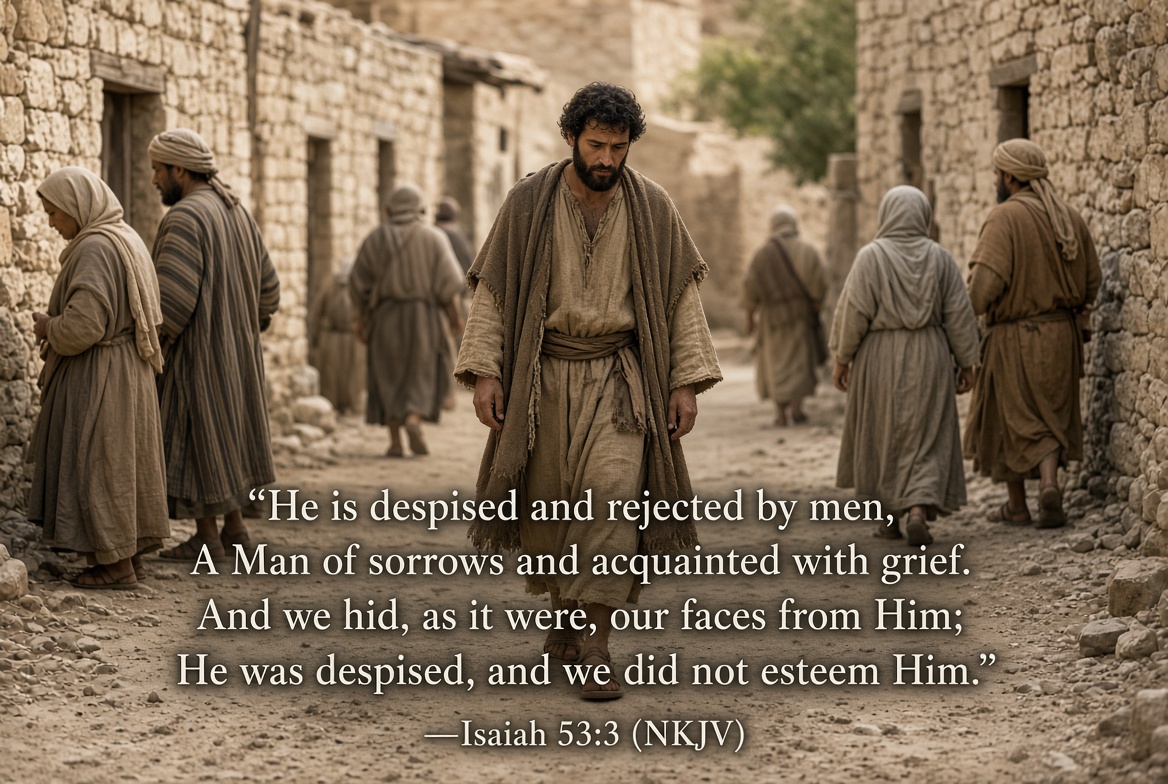
Isaiah 53:3 NKJV
He is despised and rejected by men,
A Man of sorrows and acquainted with grief.
And we hid, as it were, our faces from Him;
He was despised, and we did not esteem Him.
The Man of Sorrows

This chapter gives us a warm look ahead at the Messiah’s journey—why he chose to give his life and the wonderful blessings that come to all of us from that moment. It’s a summary of the ideas that make Christianity so special. Today, we’re in the third post of a 12-part series exploring Isaiah 53!
Two wonderful truths were shared by the Spirit of Christ through the Old Testament prophets: the suffering of Christ and the glory that would follow (1 Peter 1:11). When Jesus explained Moses and the prophets, he showed that the main point was that Christ had to suffer and then enter his glory (Luke 24:26–27). Yet nowhere in the Old Testament are these two themes expressed so clearly and fully as in this chapter, which the New Testament often quotes and applies to Christ. This chapter overflows with the amazing riches of Christ—so much so that we might call it Isaiah’s gospel rather than just his prophecy. By blending faith with this chapter, we can grow closer to Jesus Christ—both crucified and glorified—dying for our sins and rising again to bring us right with God.
MY NOTES
He is despised and rejected by men, A Man of sorrows and acquainted with grief. And we hid, as it were, our faces from Him; He was despised, and we did not esteem Him.—Isaiah 53:3 (NKJV)
At first glance, Isaiah 53 can feel heavy. It draws us into the suffering of Christ and forces us to look honestly at humanity’s response to Him. Yet this is not a passage of despair. It is a passage of redemption. The sorrow of Christ is not the end of the story. The cross led to the resurrection. The suffering ended in victory. The victory is won. We look back on the Man of sorrows with a kind of sacred triumph, because those sorrows accomplished something nothing else could.
The verse is painfully honest about how people treated Him. He was despised. He was rejected. Few stood with Him. Some who followed later betrayed Him. Most simply turned away. He met resistance almost everywhere He went, and still He came. Heaven was large enough for Him. He didn’t need to leave it. But His pity for us was stronger than His right to stay. He laid aside the robes of glory and put on the clothes of ordinary human life so He could carry what we could not.
He wasn’t just a man who suffered occasionally. He was a Man of sorrows—sorrows in the plural. Body and soul, high and low, active and passive, personal and shared—He knew them all. He had nowhere to lay His head. He faced the contradiction of sinners. He felt the weight of other people’s grief and the deeper weight of divine justice. Grief was not a visitor; it was an acquaintance that stayed close from the cradle to the cross.
From His infancy, sorrow seemed to follow Him. Herod sought His life. Throughout His ministry, He faced opposition and hostility. He had no permanent earthly home.
“And Jesus said to him, ‘Foxes have holes and birds of the air have nests, but the Son of Man has nowhere to lay His head.’” Matthew 8:20 (NKJV)
His heart was deeply moved by the suffering around Him. He wept at the tomb of Lazarus.
“Jesus wept.” John 11:35 (NKJV)
He wept over Jerusalem because the people refused the peace He offered.
“Now as He drew near, He saw the city and wept over it.” Luke 19:41 (NKJV)
In Gethsemane, His sorrow became overwhelming as He prepared to bear the judgment our sins deserved.
“Then He said to them, ‘My soul is exceedingly sorrowful, even to death. Stay here and watch with Me.’” Matthew 26:38 (NKJV)
That is the wonder of the gospel. Jesus was not rejected because He failed. He was rejected because He chose to stand in the place of sinners. He became our Substitute. He bore the shame that belonged to us so that we could receive the righteousness that belongs to Him. Every insult, every betrayal, every sorrow, every wound, and every moment of rejection was part of God’s redemptive plan. The Man of Sorrows was accomplishing the work of salvation.
The world saw a defeated man hanging on a cross. Heaven saw the Lamb of God taking away the sin of the world.
“For He made Him who knew no sin to be sin for us, that we might become the righteousness of God in Him.” 2 Corinthians 5:21 (NKJV)
Yet perhaps one of the saddest statements in Isaiah 53 is not about Christ’s suffering. It is about our response to Him:
“We hid, as it were, our faces from Him.”
Humanity looked away from the very One who came to save them. People judged Him by outward appearance rather than by the beauty of His holiness. They saw weakness where there was divine strength. They saw shame where there was sacrificial love. They saw a crucified man and failed to recognize the King of Glory.
The truth is that every believer must admit that, at one time, this was our story too. Spurgeon said “it is the confession of the whole human race, including those who later became saints”.
Before the Holy Spirit opened our eyes, we did not esteem Christ as we should have. We valued other things more highly. We pursued our own desires. We failed to see His worth.
Yet even when we rejected Him, He continued moving toward the cross.
“But God demonstrates His own love toward us, in that while we were still sinners, Christ died for us.” Romans 5:8 (NKJV)
That isn’t only ancient history. Before grace opened our eyes, we too looked past Him. We measured by appearance, by status, by what made sense to us, and we found nothing worth desiring. We hid our faces. We esteemed Him not.
Yet that same rejected One is the One who heals. The One we turned from is the One who turned toward us. The Man of sorrows became the source of our comfort. What looked like defeat became the way God restored righteousness and brought peace.
Prayer
Abba, thank You that Jesus willingly became the Man of sorrows. Thank You that He was despised and rejected so that we would never have to face ultimate rejection. Forgive us for the times we have looked past Him, measured Him by outward appearance, and failed to esteem Him. Open our eyes again to the beauty that is hidden in His suffering and the victory that followed it. Help us to look to Him, to trust Him, and to find comfort in the One who has already carried our griefs. In Jesus’ name, Amen.
Key Takeaways
- Jesus was truly despised and rejected; the prophecy matches the way people treated Him in real life.
- He was a Man of sorrows in the fullest sense—He entered every kind of human grief, not just physical pain.
- “We esteemed Him not” is not only the story of first-century crowds; it describes the natural human heart before grace.
- He came on an errand of love when He had every right to stay in glory.
- The finished work of the Man of sorrows is now the ground of our comfort and healing.

Proverb for Today
My son, keep my words, And treasure my commands within you. Keep my commands and live, And my law as the apple of your eye. Bind them on your fingers; Write them on the tablet of your heart. Say to wisdom, “You are my sister,” And call understanding your nearest kin, Proverbs 7:1-4 NKJV
Daily Scripture
Then the eleven disciples went away into Galilee, to the mountain which Jesus had appointed for them. When they saw Him, they worshiped Him; but some doubted. And Jesus came and spoke to them, saying, “All authority has been given to Me in heaven and on earth. Go therefore and make disciples of all the nations, baptizing them in the name of the Father and of the Son and of the Holy Spirit, teaching them to observe all things that I have commanded you; and lo, I am with you always, even to the end of the age.” Amen. Matthew 28:16-20 NKJV
Closing

“The Lord bless you and keep you; The Lord make His face shine upon you, And be gracious to you; The Lord lift up His countenance upon you, And give you peace.” Numbers 6:24-26 NKJV
Grace be with you. Amen.
Please enter your email and click subscribe to be notified whenever I submit a new post.

Commentaries:
Charles Spurgeon
In his well-known sermon The Man of Sorrows (preached March 2, 1873), Spurgeon said:
“Possibly a murmur will pass round the congregation, ‘This is a dreary subject and a mournful theme.’ But, O beloved, it is not so, for great as were the woes of our Redeemer, they are all over now, and are to be looked back upon with sacred triumph. However severe the struggle, the victory has been won.”
Spurgeon preached another sermon titled Why Christ Is Not Esteemed on the words “We esteemed Him not.”
“This must be the universal confession of the human race… even the holiest of God’s saints… even they once ‘esteemed Him not.’”
“It was so with Jesus when he was here. He was the greatest of all sufferers: there were few that followed him; some of those who did betrayed him. There were few who would stand up for him; he met everywhere with a repulse, and yet he came on an errand of love. He needed not to have come at all. Heaven surely was large enough for him; but such was his pity for the dying sons of men that he must needs strip off his royal robes and put on the robes of our mortal flesh.”
He was also ‘a man of sorrows,’ for the variety of his woes; he was a man not of sorrow only, but of ‘sorrows.’ All the sufferings of the body and of the soul were known to him; the sorrows of the man who actively struggles to obey; the sorrows of the man who sits still, and passively endures. The sorrows of the lofty he knew, for he was the King of Israel; the sorrows of the poor he knew, for he ‘had not where to lay his head.’ Sorrows relative, and sorrows personal; sorrows mental, and sorrows spiritual; sorrows of all kinds and degrees assailed him. Affliction emptied his quiver upon him, making his heart the target for all conceivable woes.
______________________________________________________
Enduring Word
He is despised and rejected by men, a Man of sorrows and acquainted with grief: Jesus was not a “life of the party” man. It would be wrong to think of Him as perpetually sad and morose; indeed, He certainly showed great joy (such as in Luke 10:21). Yet He knew sorrow and grief so intimately that He could be called a Man of sorrows. This, among other reasons, made Him despised and rejected by men. (Guzik)
i. Most of our sorrow is really just self-pity. It is feeling sorry for ourselves. Jesus never once felt sorry for Himself. His sorrow was for others, and for the fallen, desperate condition of humanity. (Guzik)
ii. In 1 Timothy 3, one of the requirements for leaders in the church is that they be soberminded. This word describes the person who is able to think clearly and with clarity. They do not constantly joke but know how to deal with serious subjects in a serious way. It doesn’t mean solemn and somber, but it does mean an appropriate seriousness. (Guzik)
And we hid, as it were, our faces from Him; He was despised, and we did not esteem Him: Because there was nothing outwardly beautiful or charismatic about the Messiah, mankind’s reaction was to withdraw from Him, to despise Him, and hold Him in low esteem. This shows that men value physical beauty and charisma far more than God does, and when we don’t see it, we can reject the ones God accepts. (Guzik)
______________________________________________________
Albert Barnes
He is despised — This requires no explanation; and it needs no comment to show that it was fulfilled. The Redeemer was eminently the object of contempt and scorn alike by the Pharisees, the Sadducees, and the Romans. In his life on earth it was so; in his death it was still so; and since then, his name and person have been extensively the object of contempt. Nothing is a more striking fulfillment of this than the conduct of the Jews at the present day. The very name of Jesus of Nazareth excites contempt; and they join with their fathers who rejected him in heaping on him every term indicative of scorn.
Rejected of men — This phrase is full of meaning, and in three words states the whole history of man in regard to his treatment of the Redeemer. The name ‘The Rejected of Men,’ will express all the melancholy history; rejected by the Jews; by the rich; the great and the learned; by the mass of people of every grade, and age, and rank. No prophecy was ever more strikingly fulfilled; none could condense more significancy into few words. In regard to the exact sense of the phrase, interpreters have varied. Jerome renders it, Novissium virorum – ‘The last of men;’ that is, the most abject and contemptible of mankind. The Septuagint, ‘His appearance is dishonored (ἄτιμον atimon) and defective (ἐκλειπον ekleipon) more than the sons of men.’ The Chaldee, ‘He is indeed despised, but he shall take away the glory of all kings; they are infirm and sad, as if exposed to all calamities and sorrows.’ Some render it, ‘Most abject of men,’ and they refer to Job 19:14, where the same word is used to denote those friends who forsake the unfortunate.
The word חדל châdêl used here, is derived from the verb חדל châdal, which means “to cease, to leave off, to desist”; derived, says Gesenius (Lexicon), from the idea of becoming languid, flaccid; and thence transferred to the act of ceasing from labor. It means usually, to cease, to desist from, to leave, to let alone (see 1 Kings 22:6-15; Job 7:15; Job 10:20; Isaiah 2:22). According to Gesenius, the word here means to be left, to be destitute, or forsaken; and the idea is, that be was forsaken by people. According to Hengstenberg (Christol.) it means ‘the most abject of men,’ he who ceases from men, who ceases to belong to the number of men; that is, who is the most abject of men. Castellio renders it, Minus quash homo – ‘Less than a man.’ Junius and Tremellius, Abjectissimus virorum – ‘The most abject of men.’ Grotius, ‘Rejected of men.’ Symmachus, Ἐλάχιστος ἀνδρῶν Elachistos andrōn – ‘the least of men.’ The idea is, undoubtedly, somehow that of ceasing from human beings, or from being regarded as belonging to mankind.
There was a ceasing, or a withdrawing of that which usually pertains to man, and which belongs to him. And the thought probably is, that he was not only ‘despised,’ but that there was an advance on that – there was a ceasing to treat him as if he had human feelings, and was in any way entitled to human fellowship and sympathy. It does not refer, therefore, so much to the active means employed to reject him, as to the fact that he was regarded as cut off from man; and the idea is not essentially different from this, that he was the most abject and vile of mortals in the estimation of others; so vile as not to be deemed worthy of the treatment due to the lowest of men. This idea has been substantially expressed in the Syriac translation.
A man of sorrows — What a beautiful expression! A man who was so sad and sorrowful; whose life was so full of sufferings, that it might be said that that was the characteristic of the man. A similar phraseology occurs in Proverbs 29:1, ‘He that being often reproved,’ in the margin, ‘a man of reproofs;’ in the Hebrew, ‘A man of chastisements,’ that is, a man who is often chastised. Compare Daniel 10:11 : ‘O Daniel, a man greatly beloved,’ Margin, as in Hebrew, ‘A man of desires; that is, a man greatly desired. Here, the expression means that his life was characterized by sorrows. How remarkably this was fulfilled in the life of the Redeemer, it is not necessary to attempt to show.
And acquainted with grief — Hebrew, חלי וידוע viydûa‛ choliy – ‘And knowing grief.’ The word rendered ‘grief’ means usually sickness, disease Deuteronomy 7:15; Deuteronomy 28:61; Isaiah 1:5; but it also means anxiety, affliction Ecclesiastes 5:16; and then any evil or calamity Ecclesiastes 6:2. Many of the old interpreters explain it as meaning, that he was known or distinguished by disease; that is, affected by it in a remarkable manner. So Symm. Γνωστός νόσῳ Gnōstos nosō. Jerome (the Vulgate) renders it, Scientem infirmitatem. The Septuagint renders the whole clause, ‘A man in affliction (ἐν πληγῇ en plēgē), and knowing to bear languor, or disease’ (εἰδὼ; φέρειν μαλακίαν eidōs pherein malakian). But if the word here means disease, it is only a figurative designation of severe sufferings both of body and of soul. Hengstenberg, Koppe, and Ammon, suppose that the figure is taken from the leprosy, which was not only one of the most severe of all diseases, but was in a special manner regarded as a divine judgment. They suppose that many of the expressions which follow may be explained with reference to this (compare Hebrews 4:15). The idea is, that he was familiar with sorrow and calamity. It does not mean, as it seems to me, that he was to be himself sick and diseased; but that he was to be subject to various kinds of calamity, and that it was to be a characteristic of his life that he was familiar with it. He was intimate with it. He knew it personally; he knew it in others. He lived in the midst of scenes of sorrow, and be became intimately acquainted with its various forms, and with its evils. There is no evidence that the Redeemer was himself sick at any time – which is remarkable – but there is evidence in abundance that he was familiar with all kinds of sorrow, and that his own life was a life of grief.
And we hid as it were our faces from him — There is here great variety of interpretation and of translation. The margin reads, ‘As an hiding of faces from him,’ or ‘from us,’ or, ‘He hid as it were his face from us.’ The Hebrew is literally, ‘And as the hiding of faces from him, or from it;’ and Hengstenberg explains it as meaning, ‘He was as an hiding of the face before it.’ that is, as a thing or person before whom a man covers his face, because he cannot bear the disgusting sight. Jerome (the Vulgate) renders it, ‘His face was as it were hidden and despised.’ The Septuagint, ‘For his countenance was turned away’ (ἀπέστρυπταὶ apestraptai). The Chaldee, ‘And when he took away his countenance of majesty from us, we were despised and reputed as nothing.’ Interpreters have explained it in various ways.
- ‘He was as one who hides his face before us;’ alluding, as they suppose, to the Mosaic law, which required lepers to cover their faces Leviticus 13:45, or to the custom of covering the face in mourning, or for shame.
- Others explain it as meaning, ‘as one before whom is the covering of the face, that is, before whom a man covers the face from shame or disgust. So Gesenius.
- Others, ‘He was as one causing to conceal the face,’ that is, he induced others to cover the face before him. His sufferings were so terrible as to induce them to turn away. So John H. Michaelis.
The idea seems to be, that he was as one from whom people hide their faces, or turn away. This might either arise from a sight of his sufferings, as being so offensive that they would turn away in pain – as in the case of a leper; or it might be, that he was so much an object of contempt, and so unlike what they expected, that they would hide their faces and turn away in scorn. This latter I suppose to be the meaning; and that the idea is, that he was so unlike what they had expected, that they hid their faces in affected or real contempt.
And we esteemed him not — That is, we esteemed him as nothing; we set no value on him. In order to give greater energy to a declaration, the Hebrews frequently express a thing positively and then negatively. The prophet had said that they held him in positive contempt; he here says that they did not regard him as worthy of their notice. He here speaks in the name of his nation – as one of the Jewish people. ‘We, the Jews, the nation to whom he was sent, did not esteem him as the Messiah, or as worthy of our affection or regard.’
______________________________________________________
John Gill
He is despised, and rejected of men,…. Or, “ceaseth from men”; was not admitted into the company and conversation of men, especially of figure; or ceased from the class of men, in the opinion of others; he was not reckoned among men, was accounted a worm, and no man; or, if a man, yet not in his senses, a madman, nay, one that had a devil: or “deficient of men”; he had none about him of any rank or figure in life, only some few fishermen, and some women, and publicans, and harlots. The Vulgate Latin version renders it, “the last of men,” the most abject and contemptible of mankind; despised, because of the meanness of his birth, and parentage, and education, and of his outward appearance in public life; because of his apostles and audience; because of his doctrines, not agreeably to carnal reason, and his works, some of them being done on the sabbath day, and, as they maliciously suggested, by the help of Satan; and especially because of his ignominious sufferings and death:
a man of sorrows, and acquainted with grief: or “known by grief”; he was known by his troubles, notorious for them; these were his constant companions, his familiar acquaintance, with whom he was always conversant; his life was one continued series of sorrow, from the cradle to the cross; in his infancy his life was sought for by Herod, and he was obliged to be taken by his parents, and flee into Egypt; he ate his bread in sorrow, and with the sweat of his brow; he met with much sorrow from the hardness and unbelief of men’s hearts, and from the contradiction of sinners against himself, and even much from the frowardness of his own disciples; much from the temptations of Satan, and more from the wrath and justice of God, as the surety of his people; he was exceeding sorrowful in the garden, when his sweat was as it were great drops of blood; and when on the cross, under the hidings of his Father’s face, under a sense of divine displeasure for the sins of his people, and enduring the pains and agonies of a shameful and an accursed death; he was made up of sorrows, and grief was familiar to him. Some render it, “broken with infirmity,” or “grief”:
and we hid as it were our faces from him; as one loathsome and abominable as having an aversion to him, and abhorrence of him, as scorning to look at him, being unworthy of any notice. Some render it, “he hid as it were his face from us”; as conscious of his deformity and loathsomeness, and of his being a disagreeable object, as they said; but the former is best:
he was despised, and we esteemed him not; which is repeated to show the great contempt cast upon him, and the disesteem he was had in by all sorts of persons; professors and profane, high and low, rich poor, rulers and common people, priests, Scribes, and Pharisees; no set or order of men had any value for him; and all this disgrace and dishonor he was to undergo, to repair the loss of honor the Lord sustained by the sin of man, whose surety Christ became.
______________________________________________________
Matthew Henry
It was expected that he should live a pleasant life, and have a full enjoyment of all the delights of the sons and daughters of men, which would have invited all sorts to him; but, on the contrary, he was a man of sorrows and acquainted with grief. It was not only his last scene that was tragical, but his whole life was so, not only mean, but miserable.
Thus, being made sin for us, he underwent the sentence sin had subjected us to, that we should eat in sorrow all the days of our life (Gen. 3:17), and thereby relaxed much of the rigor and extremity of the sentence as to us. His condition was, upon many accounts, sorrowful. He was unsettled, had not where to lay his head, lived upon alms, was opposed and menaced, and endured the contradiction of sinners against himself. His spirit was tender, and he admitted the impressions of sorrow. We never read that he laughed, but often that he wept. Lentulus, in his epistle to the Roman senate concerning Jesus, says, “he was never seen to laugh;” and so worn and macerated was he with continual grief that when he was but a little above thirty years of age he was taken to be nearly fifty, Jn. 8:57. Grief was his intimate acquaintance; for he acquainted himself with the grievances of others, and sympathized with them, and he never set his own at a distance; for in his transfiguration he talked of his own decease, and in his triumph he wept over Jerusalem. Let us look unto him and mourn.
The low opinion that men had of him, upon this account. Being generally apt to judge of persons and things by the sight of the eye, and according to outward appearance, they saw no beauty in him that they should desire him. There was a great deal of true beauty in him, the beauty of holiness and the beauty of goodness, enough to render him the desire of all nations; but the far greater part of those among whom he lived, and conversed, saw none of this beauty, for it was spiritually discerned. Carnal hearts see no excellency in the Lord Jesus, nothing that should induce them to desire an acquaintance with him or interest in him. Nay, he is not only not desired, but he is despised and rejected, abandoned and abhorred, a reproach of men, an abject, one that men were shy of keeping company with and had not any esteem for, a worm and no man. He was despised as a mean man, rejected as a bad man. He was the stone which the builders refused; they would not have him to reign over them. Men, who should have had so much reason as to understand things better, so much tenderness as not to trample upon a man in misery-men whom he came to seek and save rejected him: “We hid as it were our faces from him, looked another way, and his sufferings were as nothing to us; though never sorrow was like unto his sorrow. Nay, we not only behaved as having no concern for him, but as loathing him, and having him in detestation.” It may be read, He hid as it were his face from us, concealed the glory of his majesty, and drew a veil over it, and therefore he was despised and we esteemed him not, because we could not see through that veil. Christ having undertaken to make satisfaction to the justice of God for the injury man had done him in his honor by sin (and God cannot be injured except in his honor), he did it not only by divesting himself of the glories due to an incarnate deity, but by submitting himself to the disgraces due to the worst of men and malefactors; and thus by vilifying himself he glorified his Father: but this is a good reason why we should esteem him highly, and study to do him honor; let him be received by us whom men rejected.

- Exploring the Beauty of Psalms: Insights and Commentaries
- Monthly Breakdown of Our Blog Content
- Psalms Commentary: Faith and Inspiration
Leave a Reply