Isaiah 53:2 NKJV
For He shall grow up before Him as a tender plant,
And as a root out of dry ground.
He has no form or comeliness;
And when we see Him,
There is no beauty that we should desire Him.
The King No One Expected

This chapter gives us a warm look ahead at the Messiah’s journey—why he chose to give his life and the wonderful blessings that come to all of us from that moment. It’s a summary of the ideas that make Christianity so special. Today, we’re in the second post of a 12-part series exploring Isaiah 53!
Two wonderful truths were shared by the Spirit of Christ through the Old Testament prophets: the suffering of Christ and the glory that would follow (1 Peter 1:11). When Jesus explained Moses and the prophets, he showed that the main point was that Christ had to suffer and then enter his glory (Luke 24:26–27). Yet nowhere in the Old Testament are these two themes expressed so clearly and fully as in this chapter, which the New Testament often quotes and applies to Christ. This chapter overflows with the amazing riches of Christ—so much so that we might call it Isaiah’s gospel rather than just his prophecy. By blending faith with this chapter, we can grow closer to Jesus Christ—both crucified and glorified—dying for our sins and rising again to bring us right with God.
My Notes
“For He shall grow up before Him as a tender plant, And as a root out of dry ground. He has no form or comeliness; And when we see Him, There is no beauty that we should desire Him.” — Isaiah 53:2 (NKJV)
One of the most surprising truths about Jesus is that He did not arrive the way anyone expected.
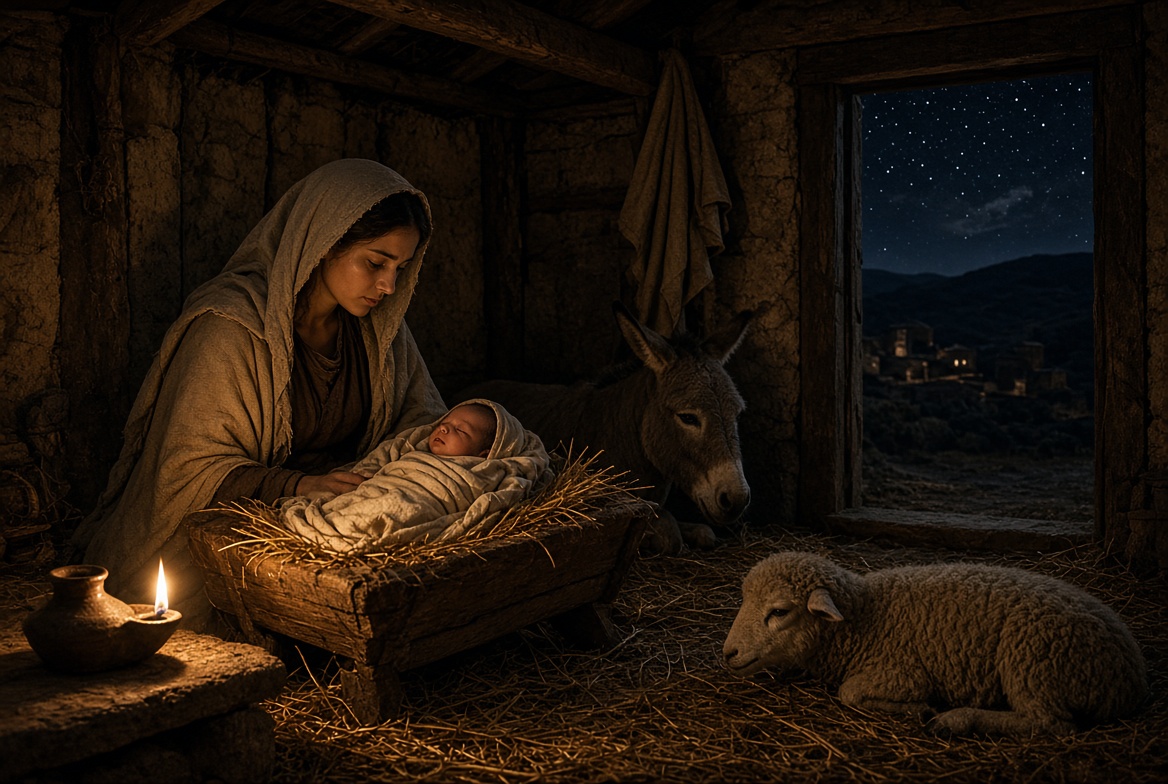
Israel had been waiting for a King. They anticipated a mighty deliverer, a conquering hero, a ruler who would restore the nation’s glory and overthrow its enemies. Instead, God sent His Son into the world as a baby born in a humble stable. The King of kings entered history without fanfare, wealth, status, or outward splendor.
Isaiah saw the same thing centuries before Jesus was born. The house of David had been reduced to almost nothing. The royal line looked finished. And out of that dry, unpromising soil came a tender shoot. Not a mighty oak with banners and trumpets. Just a small, fragile-looking plant that most people walked right past. A tender shoot is fragile, easily overlooked, and seemingly insignificant. Dry ground is not where anyone expects life to flourish. Yet God delights in bringing life where no one expects it.
There shall come forth a Rod from the stem of Jesse, And a Branch shall grow out of his roots. Isaiah 11:1
That’s how the Messiah arrived. He grew up under the watchful eye of His Father, but ordinary people barely noticed Him. When He finally stepped into public view, He didn’t look like the King they had been waiting for. No royal robes. No glittering crown. No army at His back. He was a poor man who had nowhere to lay His head. A man of sorrows. And the common reaction was exactly what the prophet described: “There is no beauty that we should desire Him.”
but made Himself of no reputation, taking the form of a bondservant, and coming in the likeness of men. And being found in appearance as a man, He humbled Himself and became obedient to the point of death, even the death of the cross. Philippians 2:7-8
For He shall grow up before Him…..
The phrase “before Him” reminds us that although the world failed to recognize Christ’s true identity, the Father never lost sight of Him. Men saw only a peasant from Nazareth. God saw His beloved Son fulfilling His eternal plan of redemption.
We still do the same thing. We look for the impressive, the polished, the ones who already seem to have it together. We measure potential by outward appearance and past success. Jesus arrived the opposite way. He came from a place people dismissed—“Can anything good come out of Nazareth?”—and He came looking ordinary enough that many who heard Him still turned away. The gospel itself started the same way: a tiny seed that looked too small to matter.
And Nathanael said to him, “Can anything good come out of Nazareth?” Philip said to him, “Come and see.” John 1:46
Another parable He put forth to them, saying: “The kingdom of heaven is like a mustard seed, which a man took and sowed in his field, which indeed is the least of all the seeds; but when it is grown it is greater than the herbs and becomes a tree, so that the birds of the air come and nest in its branches.” Matthew 13:31-32
There is another lesson here as well.
The image of a root growing out of dry ground reminds us never to underestimate what God can do in hopeless places. Dry ground is exactly where God specializes in bringing life. Whether it is a resistant heart, a struggling church, a difficult neighborhood, a broken family, or a nation that seems far from God, the Lord is able to cause life to spring forth where everyone else sees barrenness.
And He said, “The kingdom of God is as if a man should scatter seed on the ground, and should sleep by night and rise by day, and the seed should sprout and grow, he himself does not know how.” Mark 4:26-27
That’s actually good news for the dry places. The more unlikely the soil, the more the tender plant of Christ can surprise us. He specializes in growing where nothing else seems to thrive. The very lack of impressive surroundings becomes the backdrop that makes His life and power stand out more clearly. What looks like a dead stump still has life in the root. What looks like barren ground can still produce the Savior.
He grew up before God, not before the crowd. The Father’s eye was on Him the whole time, even when almost no one else was watching. That same quiet, steady attention is still on the places and people that look unpromising to us. The absence of outward beauty or status never stopped Him. It still doesn’t.
Prayer
Abba, thank You that Jesus came as a tender plant from dry ground. When I look at places or people that seem too barren, too far gone, or too ordinary, remind me that this is the soil You have always chosen. Help me stop measuring by outward appearance and start trusting the life that is hidden in the root. Give me patience to keep speaking, serving, and hoping where nothing looks promising yet. Let the same quiet power that raised Jesus from that dry ground work in the dry places around me. In Jesus’ name, Amen.
Key Takeaways
- The Messiah came as a tender plant from dry ground—humble in origin and unimpressive by worldly standards.
- God saw and valued Him fully even when almost no one else did; outward beauty was never the measure.
- Dry, unlikely places are not hopeless; they are exactly the kind of soil where the root of Christ has always grown.
- What looks small and fragile at the beginning can become the very thing that fills the earth.
- We are called to keep sowing and watching even where nothing seems to be happening, because the life is in the root, not in the visible circumstances.

Proverb for Today
My son, keep your father’s command, And do not forsake the law of your mother. Bind them continually upon your heart; Tie them around your neck. When you roam, they will lead you; When you sleep, they will keep you; And when you awake, they will speak with you. For the commandment is a lamp, And the law a light; Reproofs of instruction are the way of life, Proverbs 6:20-23 NKJV
Daily Scripture
No weapon formed against you shall prosper, And every tongue which rises against you in judgment You shall condemn. This is the heritage of the servants of the Lord, And their righteousness is from Me,” Says the Lord. Isaiah 54:17 NKJV
Closing

“The Lord bless you and keep you; The Lord make His face shine upon you, And be gracious to you; The Lord lift up His countenance upon you, And give you peace.” Numbers 6:24-26 NKJV
Grace be with you. Amen.
Please enter your email and click subscribe to be notified whenever I submit a new post.

Commentaries:
Charles Spurgeon
This is Israel’s King, the long-promised Messiah; yet when he comes to Bethlehem, see what a tender plant he is! Look at the house of David, almost extinct; and see what a root out of a dry ground is – The stem of Jesse’s rod. When Jesus comes before the sons of men, dressed in the garb of a peasant, a poor man, a sorrowful man, a man who had not where to lay his head, notice how men say, by their actions, if not in words, There is no beauty that we should desire him.
Do not say, ‘It is useless to preach down there, or to send missionaries to that uncivilized country.’ How do you know? Is it very dry ground? Ah, well, that is hopeful soil; Christ is a ‘root out of a dry ground,’ and the more there is to discourage the more you should be encouraged. Read it the other way. Is it dark? Then all is fair for a grand show of light; the light will never seem so bright as when the night is very very dark.
______________________________________________________
Enduring Word
He shall grow up before Him as a tender plant: Jesus did grow up, as He increased in wisdom and stature, and in favor with God and men (Luke 2:52). But all the while, He was as a tender plant – of seeming weakness and insignificance, not like a mighty tree. (Guzik)
i. A tender plant is weak and vulnerable – unless it is before Him, that is, before the LORD God. In God’s presence, that which seems to be weak is strong. If the plant is before Him, it doesn’t even matter that the ground is dry. God will sustain it with His presence. (Guzik)
As a root out of dry ground: Jesus grew up in the Galilee region of what the Romans occupied and later called Palestine. In respect to spiritual, political, and standard of living matters, it was indeed dry ground. God can bring the most wonderful things out of dry ground. (Guzik)
He has no form or comeliness…no beauty that we should desire Him: Prophetically, Isaiah gives a more compelling description of Jesus than we find anywhere in the gospel accounts. Jesus was not a man of remarkable beauty or physical attractiveness (comeliness). This doesn’t mean that Jesus was ugly, but it does mean that He did not have the “advantage” of good looks. (Guzik)
i. This means that when we try to attract people to Jesus through form or comeliness, or beauty, we are using methods that run counter to the nature of Jesus. “These days it appears that we must dress up the gospel to make it attractive. We have to use the methods of technique which must be smart, well-presented, streamlined. There must be something about the presentation of the gospel that will appeal to people…to what is called ‘the modern mind.’ I wonder if we stop to think that in our efforts to make the gospel message ‘attractive’ we are drawing a curtain across the face of Jesus in His humiliation? The only one who can make Him attractive is the Holy Spirit.” (Redpath)
______________________________________________________
Albert Barnes
For he shall grow up before him — In this verse, the prophet describes the humble appearance of the Messiah, and the fact that there was nothing in his personal aspect that corresponded to the expectations that bad been formed of him; nothing that should lead them to desire him as their expected deliverer, but everything that could induce them to reject him. He would be of so humble an origin, and with so little that was magnificent in his external appearance, that the nation would despise him. The word rendered ‘he shall grow up’ (ויעל vaya‛al, from עלה ‛âlâh), means properly, “to go up, to ascend.” Here it evidently applies to the Redeemer as growing up in the manner of a shoot or sucker that springs out of the earth. It means that he would start, as it were, from a decayed stock or stump, as a shoot springs up from a root that is apparently dead. It does not refer to his manner of life before his entrance on the public work of the ministry; not to the mode and style of his education; but to his starting as it were out of a dry and sterile soil where any growth could not be expected, or from a stump or stock that was apparently dead (see the notes at Isaiah 11:1). The phrase ‘before him’ (לפניו lepânâyv), refers to Yahweh. He would be seen and observed by him, although unknown to the world. The eyes of people would not regard him as the Messiah while he was growing up, but Yahweh would, and his eye would be continually upon him.
As a tender plant — The word used here (יונק yônēq, from ינק yânaq, to suck, Job 3:12; Song of Solomon 8:1; Joel 2:16), may be applied either to a suckling, a sucking child Deuteronomy 32:25; Psalms 8:3, or to a sucker, a sprout, a shoot of a tree Job 8:16; Job 14:7; Job 15:30; Ezekiel 17:22; Hosea 14:7. Jerome here renders it, Virgultum. The Septuagint renders it, Ἀνηγγείλαμεν ὡς παιδίον ἐναντίον αὐτοῦ anēngeilamen hōs paidion enantion autou – ‘We have made proclamation as a child before him.’ But what idea they attached to it, it is impossible now to say; and equally so to determine how they came to make such a translation. The Chaldee also, leaving the idea that it refers to the Messiah, renders it, ‘And the righteous shall be magnified before him as branches which flourish, and as the tree which sends its roots by the fountains of water; thus shall the holy nation be increased in the land.’ The Syriac translates it, ‘He shall grow up before him as an infant.’ The idea in the passage is plain. It is, that the Messiah would spring up as from an ancient and decayed stock, like a tender shoot or sucker. He would be humble and unpretending in his origin, and would be such that they who had expected a splendid prince would be led to overlook and despise him.
And as a root — (וכשׁרשׁ vekashoresh). The word ‘root’ here is evidently used by synecdoche for the sprout that starts up from a root (see the notes at Isaiah 11:10, where the word is used in the same sense).
Out of a dry ground — In a barren waste, or where there is no moisture. Such a sprout or shrub is small, puny, and withered up. Such shrubs spring up in deserts, where they are stinted for want of moisture, and they are most striking objects to represent that which is humble and unattractive in its personal appearance. The idea here is, that the Messiah would spring from an ancient family decayed, but in whose root, so to speak, there would be life, as there is remaining life in the stump of a tree that is fallen down; but that there would be nothing in his external appearance that would attract attention, or meet the expectations of the nation. Even then he would not be like a plant of vigorous growth supplied with abundant rains, and growing in a rich and fertile soil, but he would be like the stinted growth of the sands of the desert. Can anything be more strikingly expressive of the actual appearance of the Redeemer, as compared with the expectation of the Jews? Can there be found anywhere a more striking fulfillment of a prophecy than this? And how will the infidel answer the argument thus furnished for the fact that Isaiah was inspired, and that his record was true?
He hath no form — That is, no beauty. He has not the beautiful form which was anticipated; the external glory which it was supposed he would assume. On the meaning of the word ‘form,’ see the notes at Isaiah 52:14. It is several times used in the sense of beautiful form or figure (Genesis 29:17; Genesis 39:6; Genesis 41:18; Deuteronomy 21:11; Esther 2:17; compare 1 Samuel 16:18). Here it means the same as beautiful form or appearance, and refers to his state of abasement rather than to his own personal beauty. There is no evidence that in person he was in any way deformed, or otherwise than beautiful, except as excessive grief may have changed his natural aspect (see the note at Isaiah 52:14).
Nor comeliness — (הדר hâdâr). This word is translated honor, glory, majesty Deuteronomy 33:17; Psalms 29:4; Psalms 149:9; Daniel 11:20; excellency Isaiah 35:2; beauty Proverbs 20:29; Psalms 110:3; 2 Chronicles 20:21. It may be applied to the countenance, to the general aspect, or to the ornaments or apparel of the person. Here it refers to the appearance of the Messiah, as having nothing that was answerable to their expectations. He had no robes of royalty; no diadem sparkling on his brow; no splendid retinue; no gorgeous array.
And when we shall see him — This should be connected with the previous words, and should be translated, ‘that we should regard him, or attentively look upon him.’ The idea is, that there was in his external appearance no such beauty as to lead them to look with interest and attention upon him; nothing that should attract them, as people are attracted by the dazzling and splendid objects of this world. If they saw him, they immediately looked away from him as if he were unworthy of their regard.
There is no beauty that we should desire him — He does not appear in the form which we had anticipated. He does not come with the regal pomp and splendor which it was supposed he would assume. He is apparently of humble rank; has few attendants, and has disappointed wholly the expectation of the nation. In regard to the personal appearance of the Redeemer, it is remarkable that the New Testament has given us no information. Not a hint is dropped in reference to his height of stature, or his form; respecting the color of his hair, his eyes, or his complexion. In all this, on which biographers are usually so full and particular, the evangelists are wholly silent. There was evidently design in this; and the purpose was probably to prevent any painting, statuary, or figure of the Redeemer, that would have any claim to being regarded as correct or true. As it stands in the New Testament, there is lust the veil of obscurity thrown over this whole subject which is most favorable for the contemplation of the incarnate Deity. We are told flint he was a man; we are told also that he was God. The image to the mind’s eye is as obscure in the one case as the other; and in both, we are directed to his moral beauty, his holiness, and benevolence, as objects of contemplation, rather than to his external appearance or form.
It may be added that there is no authentic information in regard to his appearance that has come down to us by tradition. All the works of sculptors and painters in attempting to depict his form are the mere works of fancy, and are undoubtedly as unlike the glorious reality as they are contrary to the spirit and intention of the Bible. There is, indeed, a letter extant which is claimed by some to have been written by Publius Lentulus, to the Emperor Tiberius, in the time when the Savior lived, and which gives a description of his personal appearance. As this is the only legend of antiquity which even claims to be a description of his person, and as it is often printed, and is regarded as a curiosity, it may not be improper here to present it in a note. This letter is pronounced by Calmer to be spurious, and it has been abundantly proved to be so by Prof. Robinson (see Bib. Rep. vol. ii. pp. 367-393). The main arguments against its authenticity, and which entirely settle the question, are:
- The discrepancies and contradictions which exist in the various copies.
- The fact that in the time of the Savior, when the epistle purports to have been written, it can be demonstrated that no such man as Publius Lentulus was governor of Judea, or had any such office there, as is claimed for him in the inscriptions to the epistle.
- That for fifteen hundred years no such epistle is quoted or referred to by any writer – a fact which could not have occurred if any such epistle had been in existence.
- That the style of the epistle is not such as an enlightened Roman would have used, but is such as an ecclesiastic would have employed.
- That the contents of the epistle are such as a Roman would not have used of one who was a Jew.
See these arguments presented in detail in the place above referred to. It may be added, that this is the only pretended account which bas come down to us respecting the personal appearance of the Savior, except the fable that Christ sent his portrait to Abgar, king of Edessa, in reply to a letter which he had sent requesting him to come and heal him; and the equally fabulous legend, that the impression of his countenance was left upon the handkerchief of the holy Veronica.
______________________________________________________
John Gill
For he shall grow up before him as a tender plant,…. Which springs out of the earth without notice; low in its beginning, slow in its growth, liable to be crushed with the foot, or destroyed with the frost, and no great probability of its coming to any perfection; or rather as a little “sucker,” as the word signifies, which grows out of the root of a tree, at some little distance from it, of which no notice or care is taken, nor anything hoped for from it; and the figure denotes the mean and unpromising appearance of Christ at his incarnation; which is the reason given why the Jews in general disbelieved, rejected, and despised him; for this phrase of “growing up” does not design his exaltation, or rising up from a low to a high estate; but his mean entrance into the world, like that of the springing up of a low and insignificant plant or shrub out of the earth: and the phrase “before him” is to be understood either of God the Father, by whom he was taken notice of, though not by men; and in whose sight he was precious, though despised by men; or his growing up, and the manner of it, or his mean appearance, were all before the Lord, and according to his will: or else it may be understood of Christ himself, and be rendered “before himself,” who was meek and lowly, and was mean and low in his own eyes; or rather it may be interpreted of the unbelieving Jew, of any or everyone of them that did not believe the report concerning him: because before him, in the sight of everyone of them, he sprung up in the manner described; unless it can be thought that it would be better rendered “to his face”; or “to his appearance”; that is, as to his outward appearance, in the external view of him, so he grew up:
and as a root out of a dry ground; or rather, “as a branch from a root out of a dry ground”; agreeably to Isaiah 11:1, meaning not so much the land of Judea, where he was born; or the country of Galilee, where he was brought up; as the family of David, from whence he sprung, which was reduced to a very low condition when he was born of it; his supposed father being a carpenter, and his real mother a poor virgin in Nazareth, though both of the lineage and house of David; from this passage the ancient Jews {d} are said to conclude that the Messiah would be born without a father, or the seed of man:
he hath no form nor comeliness; like a poor plant or shrub just crept out of the ground, in a dry and barren soil, ready to wither away as soon as up; has no strength nor straightness, of body; without verdure, leaves, blossom, and fruit things which make plants comely and beautiful. This regards not the countenance of Christ, which probably was comely, as were his types Moses and David; since he is said to be “fairer than the children of men”; and since his human nature was the immediate produce of the Holy Ghost, and without sin: but his outward circumstances; there was no majesty in him, or signs of it; it did not look probable that he would be a tall cedar, or a prince in Israel, much less the Prince Messiah; he was born of mean parents; brought up in a contemptible part of the country; lived in a town out of which no good is said to come; dwelt in a mean cottage, and worked at a trade:
and when we shall see him: as he grows up, and comes into public life and service, declaring himself, or declared by others, to be the Messiah: here the prophet represents the Jews that would live in Christ’s time, who would see his person, hear his doctrines, and be witnesses of his miracles, and yet say,
there is no beauty, that we should desire him; or “sightliness” in him; nothing that looks grand and majestic, or like a king; they not beholding with an eye of faith his glory, as the glory of the only begotten of the Father; only viewing him in his outward circumstances, and so made their estimate of him; they expected the Messiah as a temporal prince, appearing in great pomp and state, to deliver them from the Roman yoke, and restore their nation to its former splendor and glory; and being disappointed herein was the true reason of their unbelief, before complained of, and why they did not desire him, who is the desire of all nations.
______________________________________________________
Matthew Henry
This seems to come in as a reason why they rejected his doctrine, because they were prejudiced against his person. When he was on earth many that heard him preach, and could not but approve of what they heard, would not give it any regard or entertainment, because it came from one that made so small a figure and had no external advantages to recommend him. Observe here,
The low condition he submitted to, and how he abased and emptied himself. The entry he made into the world, and the character he wore in it, were no way agreeable to the ideas which the Jews had formed of the Messiah and their expectations concerning him, but quite the reverse.
(1.) It was expected that his extraction would be very great and noble. He was to be the Son of David, of a family that had a name like to the names of the great men that were in the earth, 2 Sa. 7:9. But he sprang out of this royal and illustrious family when it was reduced and sunk, and Joseph, that son of David, who was his supposed father, was but a poor carpenter, perhaps a ship-carpenter, for most of his relations were fishermen. This is here meant by his being a root out of a dry ground, his being born of a mean and despicable family, in the north, in Galilee, of a family out of which, like a dry and desert ground, nothing green, nothing great, was expected, in a country of such small repute that it was thought no good thing could come out of it. His mother, being a virgin, was as dry ground, yet from her he sprang who is not only fruit, but root. The seed on the stony ground had no root; but, though Christ grew out of a dry ground, he is both the root and the offspring of David, the root of the good olive.
(2.) It was expected that he should make a public entry, and come in pomp and with observation; but, instead of that, he grew up before God, not before men. God had his eye upon him, but men regarded him not: He grew up as a tender plant, silently and insensibly, and without any noise, as the corn, that tender plant, grows up, we know not how, Mk. 4:27. Christ rose as a tender plant, which, one would have thought, might easily be crushed, or might be nipped in one frosty night. The gospel of Christ, in its beginning, was as a grain of mustard-seed, so inconsiderable did it seem, Mt. 13:31, 32.

- Exploring the Beauty of Psalms: Insights and Commentaries
- Monthly Breakdown of Our Blog Content
- Psalms Commentary: Faith and Inspiration
Leave a Reply