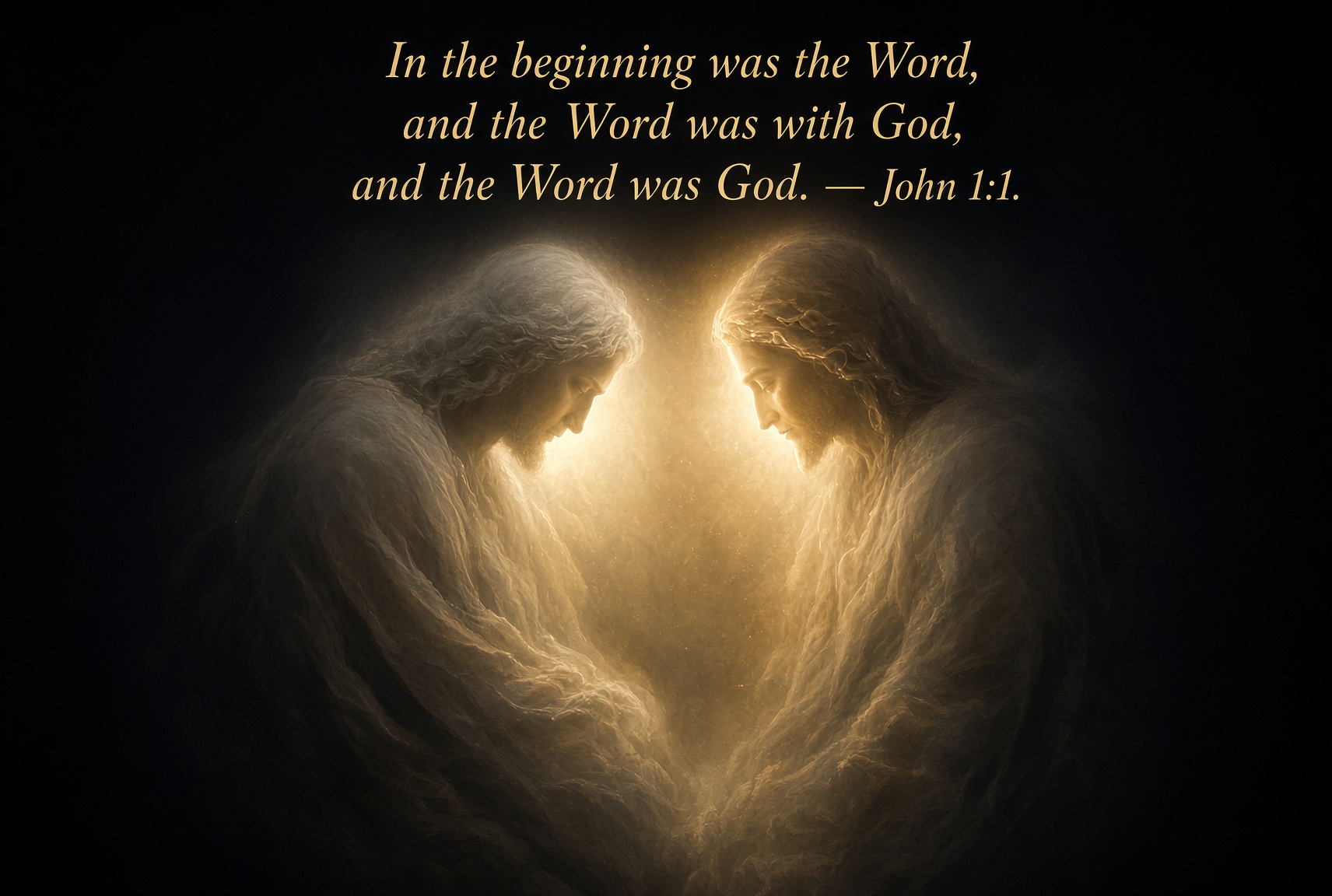
John 1:1 NKJV
In the beginning was the Word, and the Word was with God, and the Word was God.
Before Eternity Began

MY NOTES
“In the beginning was the Word, and the Word was with God, and the Word was God.” — John 1:1
Before the first star flickered, before space expanded, and before time began its relentless march, Jesus was.
When John opens his Gospel, he intentionally echoes the opening words of Genesis: “In the beginning.” But while Genesis describes the moment creation sprang into existence, John points to the One who existed before creation ever took its first breath.
Life often brings unexpected changes, sudden shifts, and seasons of uncertainty. Yet your Savior is not bound by time, nor was He caught by surprise when your world began. He does not have a beginning, and He will never have an end. When you anchor your life in Christ, you are anchoring yourself in the eternal God who holds all of history in His hands.

Genesis 1:1 NKJV
In the beginning God created the heavens and the earth.
Psalm 90:2 NKJV
Before the mountains were brought forth, Or ever You had formed the earth and the world, Even from everlasting to everlasting, You are God.
Reach back as far as a beginning can go, and the Word already was. Not “came to be.” Was. The verbs later in the chapter will talk about things that were made. This one does not. The Word is not part of creation’s furniture. He is already there when creation starts.
That is why John does not give a genealogy. In His humanity, Jesus has one. In His deity, He does not. You cannot trace the family line of the One who never began.
John 8:58 NKJV
Jesus said to them, “Most assuredly, I say to you, before Abraham was, I AM.”
John 17:5 NKJV
And now, O Father, glorify Me together with Yourself, with the glory which I had with You before the world was.
To the Greek mind, the Logos (the Word) was an abstract, impersonal force—the cold logic keeping the universe in order. To the Jewish mind, God’s Word was His powerful self-expression—the dynamic divine utterance that spoke creation into being and carried His law to His people.
John takes this familiar concept and brings it to life: The Word is not an abstract principle; He is a Person.
Jesus is God’s ultimate message to humanity. He came to reveal the Father’s heart in terms we could actually understand. Through His incarnation, the distant God became reachable, the invisible God became visible, and the abstract became personal. God didn’t send a messenger or an abstract philosophy—He sent Himself.
Psalm 33:6 NKJV
By the word of the Lord the heavens were made, And all the host of them by the breath of His mouth.
Hebrews 1:1–2 NKJV
God, who at various times and in various ways spoke in time past to the fathers by the prophets, has in these last days spoken to us by His Son, whom He has appointed heir of all things, through whom also He made the worlds.
In the beginning was the Word:
The word “Logos” comes from the Greek word “λόγος,” meaning “was the Word.” This name was given to the one who later became “flesh” or incarnate (John 1:14, referring to the Messiah). So, whatever “Logos” means, it applies to the Lord Jesus Christ. There have been many theories about why this name was given to the Son of God, and we don’t need to go over them all. The most likely explanation might be:
1. A “word” is how we express our will, thoughts, or commands to others.
2. The Son of God could be called “the Word” because he’s the way God shares His will and gives His commands. See Hebrews 1:1-3.
3. This term was already in use before John’s time.
It was used in the Aramaic translation of the Old Testament, like in Isaiah 45:12, “I have made the earth, and created man upon it,” where it says, “I, ‘by my word,’ have made,” etc. In Isaiah 48:13, it says, “mine hand also hath laid the foundation of the earth,” which is “By my word I have founded the earth.” And you’ll find this in many other places.
In short, John is saying: you have been talking about the Word for centuries. I am telling you His name.
The phrase “the Word was with God“ conveys an eternal, face-to-face intimacy between the Father and the Son. Throughout all eternity, Jesus enjoyed perfect fellowship, joy, and glory in the presence of the Father.
So, the Father and the Son (who here is called the Word) are both equally God, but they’re different in who they are. The Father isn’t the Son, and the Son isn’t the Father. But they’re still equally God, and God the Holy Spirit brings them together, making one God in three Persons.
Yet Philippians 2 tells us that He willingly stepped out of the splendor of heaven, taking on human flesh to walk among us and bear the cross for our sake. He left absolute glory so that we could enter into absolute grace. Because the Son experienced eternal fellowship with the Father, He knows what true love is—and He invites you directly into that sacred relationship. In Christ, you are never isolated, forgotten, or alone.
Philippians 2:6–8 NKJV
who, being in the form of God, did not consider it robbery to be equal with God, but made Himself of no reputation, taking the form of a bondservant, and coming in the likeness of men. And being found in appearance as a man, He humbled Himself and became obedient to the point of death, even the death of the cross.
Then John says the other half. The Word was God. Not a quality of God. Not a messenger who borrowed the title. “And the Word was God.“ John leaves no room for hesitation. Jesus is not merely a wise teacher, a great prophet, or a higher creature. He possesses the full essence and nature of God Almighty.
When you face battles that feel far bigger than your strength, remember who your Savior is. The One who walked the dusty roads of Galilee, who healed the brokenhearted, and who died in your place is the very God who spoke light into darkness. His divinity means His promises are reliable, His authority is absolute, and His power to save you is complete.
Colossians 2:9 NKJV
For in Him dwells all the fullness of the Godhead bodily.
John 1:14 NKJV
And the Word became flesh and dwelt among us, and we beheld His glory, the glory as of the only begotten of the Father, full of grace and truth.
What makes this truth so astonishing is that the eternal Word willingly left heaven’s glory to enter our broken world. The One who created all things became a servant. The One who was worshiped by angels humbled Himself to die on a cross for sinners. The eternal Son became man so that we might become children of God.
John 1:1 invites us not merely to admire Jesus but to worship Him. He is the eternal Creator, the perfect Revelation of the Father, and the sovereign Lord who stepped into history to redeem us.
Prayer
Jesus, thank You for being the eternal Word who was in the beginning, who was with God, and who is God. Thank You for leaving the glory of heaven to become my Savior and reveal Your heart to me. Help me to trust more fully, and worship You more deeply, and follow You more faithfully. Remind me that the One who created all things is also the One who holds my life in His hands. In Jesus’ name, Amen.
Key takeaways
- “Was” means the Word already existed when the beginning began.
- “With God” means the Son is distinct from the Father, in eternal fellowship.
- The One who was God became flesh without ceasing to be God.

Proverb for Today
My son, pay attention to my wisdom; Lend your ear to my understanding, That you may preserve discretion, And your lips may keep knowledge. Proverbs 5:1-2 NKJV
Daily Scripture
These things I have spoken to you, so that in Me you may have peace. In the world you have tribulation, but take courage; I have overcome the world.” John 16:33 NASB1995
Closing

“The Lord bless you and keep you; The Lord make His face shine upon you, And be gracious to you; The Lord lift up His countenance upon you, And give you peace.” Numbers 6:24-26 NKJV
Grace be with you. Amen.
Please enter your email and click subscribe to be notified whenever I submit a new post.

Commentaries:
Enduring Word
In the beginning: This refers to the timeless eternity of Genesis 1:1 (In the beginning, God created the heavens and earth). John essentially wrote, “When the beginning began, the Word was already there.” The idea is that the Word existed before creation or even time. (Guzik)
i. John makes it clear that the Word is not just the beginning, but it is the beginning of the beginning. He was there in the beginning, before anything was. (Guzik)
ii. Was the Word: “Had the Word a beginning? John says, ‘No: for if we reach back to any beginning, there already was in existence the Word.’ At once it is evident to John’s vision ‘The Word’ is no other than God the self-existent.” (Trench)
iii. “This description is given in order that we may at once grasp a continuous history which runs out of an unmeasured past, and the identity of the person who is subject of that history.” (Dods)
In the beginning was the Word: Word translates the ancient Greek word Logos. The idea of the logos had deep and rich roots in both Jewish and Greek thinking. (Guzik)
i. Jewish rabbis often referred to God (especially in His more personal aspects) in terms of His word. They spoke of God Himself as “the word of God.” For example, ancient Hebrew editions of the Old Testament change Exodus 19:17 (Moses brought the people out of the camp to meet God) to “Moses brought the people out of the camp to meet the word of God.” In the mind of the ancient Jews, the phrase “the word of God” could be used to refer to God Himself. (Guzik)
ii. The Greek philosophers saw the logos as the power that puts sense into the world, making the world orderly instead of chaotic. The logos was the power that set the world in perfect order and kept it going in perfect order. They saw the logos as the “Ultimate Reason” that controlled all things. (Dods, Morris, Barclay, Bruce, and others)
iii. Therefore in this opening John said to both Jews and Greeks: “For centuries you’ve been talking, thinking, and writing about the Word (the logos). Now I will tell you who He is.” John met both Jews and Greeks where they were at, and explained Jesus in terms they already understood. (Guzik)
iv. “John was using a term which, with various shades of meaning, was in common use everywhere. He could reckon on all men catching his essential meaning.” (Morris)
v. “The word being thus already in use and aiding thoughtful men in their efforts to conceive God’s connection with the world, John takes it and uses us to denote the Revealer of the incomprehensible and invisible God.” (Dods)
And the Word was with God, and the Word was God: With this brilliant statement, John 1:1 sets forth one of the most basic foundations of our faith – the Trinity. We can follow John’s logic:
· There is a Being known as the Word.
· This Being is God, because He is eternal (In the beginning).
· This Being is God, because He is plainly called God (the Word was God).
· At the same time, this Being does not encompass all that God is. God the Father is a distinct Person from the Word (the Word was with God). (Guzik)
i. So, the Father and the Son (the Son is known here as the Word) are equally God, yet distinct in their Person. The Father is not the Son, and the Son is not the Father. Yet they are equally God, with God the Holy Spirit making one God in three Persons. (Guzik)
ii. The Word was with God: “This preposition implies intercourse and therefore separate personality. As Chrysostom says: ‘Not in God but with God, as person with person, eternally.’” (Dods)
iii. And the Word was God: “This is the true form of the sentence; not ‘God was the Word.’ This is absolutely required by the usage of the Greek language.” (Alford)
iv. “Luther says ‘the Word was God’ is against Arius: ‘the Word was with God’ against Sabellius.” (Dods)
v. And the Word was God: “Everything that can be said about God the Father can be said about God the Son. In Jesus dwells all the wisdom, glory, power, love, holiness, justice, goodness, and truth of the Father. In Him, God the Father is known.” (Boice)
______________________________________________________
Albert Barnes
In the beginning — This expression is used also in Genesis 1:1. John evidently has allusion here to that place, and he means to apply to “the Word” an expression which is there applied “to God.” In both places it clearly means before creation, before the world was made, when as yet there was nothing. The meaning is: that the “Word” had an existence before the world was created. This is not spoken of the man Jesus, but of that which “became” a man, or was incarnate, John 1:14. The Hebrews, by expressions like this, commonly denoted eternity. Thus. the eternity of God is described Psalms 90:2; “Before the mountains were brought forth, etc.;” and eternity is commonly expressed by the phrase, before the foundation of the world.” Whatever is meant by the term “Word,” it is clear that it had an existence before “creation.” It is not, then, a “creature” or created being, and must be, therefore, uncreated and eternal. There is only one Being that is uncreated, and Jesus must be therefore divine. Compare the Savior’s own declarations respecting himself in the following places: John 8:58; John 17:5; John 6:62; John 3:13; John 6:46; John 8:14; John 16:28.
Was the Word — Greek, “was the λόγος Logos.” This name is given to him who afterward became “flesh,” or was incarnate (John 1:14 – that is, to the Messiah. Whatever is meant by it, therefore, is applicable to the Lord Jesus Christ. There have been many opinions about the reason why this name was given to the Son of God. It is unnecessary to repeat those opinions. The opinion which seems most plausible may be expressed as follows:
1. A “word” is that by which we communicate our will; by which we convey our thoughts; or by which we issue commands the medium of communication with others.
2. The Son of God may be called “the Word,” because he is the medium by which God promulgates His will and issues His commandments. See Hebrews 1:1-3.
3. This term was in use before the time of John.
- It was used in the Aramaic translation of the Old Testament, as, “e. g.,” Isaiah 45:12; “I have made the earth, and created man upon it.” In the Aramaic it is, “I, ‘by my word,’ have made,” etc. Isaiah 48:13; “mine hand also hath laid the foundation of the earth.” In the Aramaic, “‘By my word’ I have founded the earth.” And so in many other places.
- This term was used by the Jews as applicable to the Messiah. In their writings he was commonly known by the term “Mimra” – that is, “Word;” and no small part of the interpositions of God in defense of the Jewish nation were declared to be by “the Word of God.” Thus, in their Targum on Deuteronomy 26:17-18, it is said, “Ye have appointed the word of God a king over you this day, that he may be your God.”
- The term was used by the Jews who were scattered among the Gentiles, and especially those who were conversant with the Greek philosophy.
- The term was used by the followers of Plato among the Greeks, to denote the Second Person of the Trinity. The Greek term νοῦς nous or “mind,” was commonly given to this second person, but it was said that this nous was “the word” or “reason” of the First Person of the Trinity. The term was therefore extensively in use among the Jews and Gentiles before John wrote his Gospel, and it was certain that it would be applied to the Second Person of the Trinity by Christians. whether converted from Judaism or Paganism. It was important, therefore, that the meaning of the term should be settled by an inspired man, and accordingly John, in the commencement of his Gospel, is at much pains to state clearly what is the true doctrine respecting the λόγος Logos, or Word. It is possible, also, that the doctrines of the Gnostics had begun to spread in the time of John. They were an Oriental sect, and held that the λόγος Logos or “Word” was one of the “Aeones” that had been created, and that this one had been united to the man Jesus. If that doctrine had begun then to prevail, it was of the more importance for John to settle the truth in regard to the rank of the Logos or Word. This he has done in such a way that there need be no doubt about its meaning.
Was with God — This expression denotes friendship or intimacy. Compare Mark 9:19. John affirms that he was “with God” in the beginning – that is, before the world was made. It implies, therefore, that he was partaker of the divine glory; that he was blessed and happy with God. It proves that he was intimately united with the Father, so as to partake of his glory and to be appropriately called by the name God. He has himself explained it. See John 17:5; “And now, O Father, glorify thou we with thine own self, with the glory which I had with thee before the world was.” See also John 1:18; “No man hath seen God at any time; the only-begotten Son, which is in the bosom of the Father, he hath declared him.” See also John 3:13; “The Son of man, which is in heaven.” Compare Philippians 2:6-7.
Was God — In the previous phrase John had said that the Word was “with God.” Lest it should be supposed that he was a different and inferior being, here John states that “he was God.” There is no more unequivocal declaration in the Bible than this, and there could be no stronger proof that the sacred writer meant to affirm that the Son of God was equal with the Father; because:
- There is no doubt that by the λόγος Logos is meant Jesus Christ.
- This is not an “attribute” or quality of God, but is a real subsistence, for it is said that the λόγος Logos was made flesh σάρξ sarx – that is, became a human being.
- There is no variation here in the manuscripts, and critics have observed that the Greek will bear no other construction than what is expressed in our translation – that the Word “was God.”
- There is no evidence that John intended to use the word “God” in an inferior sense. It is not “the Word was a god,” or “the Word was ‘like God,’” but the Word “was God.” He had just used the word “God” as evidently applicable to Yahweh, the true God; and it is absurd to suppose that he would in the same verse, and without any indication that he was using the word in an inferior sense, employ it to denote a being altogether inferior to the true God.
- The name “God” is elsewhere given to him, showing that he is the supreme God. See Romans 9:5; Hebrews 1:8, Hebrews 1:10, Heb 1:12; 1 John 5:20; John 20:28.
The meaning of this important verse may then be thus summed up:
- The name λόγος Logos, or Word, is given to Christ in reference to his becoming the Teacher or Instructor of mankind; the medium of communication between God and man.
- The name was in use at the time of John, and it was his design to state the correct doctrine respecting the λόγος Logos.
- The “Word,” or λόγος Logos, existed “before creation” – of course was not a “creature,” and must have been, therefore, from eternity.
- He was “with God” – that is, he was united to him in a most intimate and close union before the creation; and, as it could not be said that God was “with himself,” it follows that the λόγος Logos was in some sense distinct from God, or that there was a distinction between the Father and the Son. When we say that one is “with another,” we imply that there is some sort of distinction between them.
- Yet, lest it should be supposed that he was a “different” and “inferior” being – a creature – he affirms that he was God – that is, was equal with the Father.
This is the foundation of the doctrine of the Trinity:
1.That the second person is in some sense “distinct” from the first.
2.That he is intimately united with the first person in essence, so that there are not two or more Gods.
3.That the second person may be called by the same name; has the same attributes; performs the same works; and is entitled to the same honors with the first, and that therefore he is “the same in substance, and equal in power and glory,” with God.
______________________________________________________
Matthew Henry
His existence in the beginning: In the beginning was the Word. This bespeaks his existence, not only before his incarnation, but before all time. The beginning of time, in which all creatures were produced and brought into being, found this eternal Word in being. The world was from the beginning, but the Word was in the beginning. Eternity is usually expressed by being before the foundation of the world. The eternity of God is so described (Ps. 90:2), Before the mountains were brought forth. So Prov. 8:23. The Word had a being before the world had a beginning.
His co-existence with the Father: The Word was with God, and the Word was God. Let none say that when we invite them to Christ we would draw them from God, for Christ is with God and is God; it is repeated in v. 2: the same, the very same that we believe in and preach, was in the beginning with God, that is, he was so from eternity. In the beginning the world was from God, as it was created by him; but the Word was with God, as ever with him. The Word was with God,
In respect of essence and substance; for the Word was God: a distinct person or substance, for he was with God; and yet the same in substance, for he was God, Heb. 1:3.
In respect of complacency and felicity. There was a glory and happiness which Christ had with God before the world was (ch. 17:5), the Son infinitely happy in the enjoyment of his Father’s bosom, and no less the Father’s delight, the Son of his love, Prov. 8:30.
In respect of counsel and design. The mystery of man’s redemption by this Word incarnate was hid in God before all worlds, Eph. 3:9. He that undertook to bring us to God (1 Pt. 3:18) was himself from eternity with God; so that this grand affair of man’s reconciliation to God was concerted between the Father and Son from eternity, and they understand one another perfectly well in it, Zec. 6:13; Mt. 11:27. He was by him as one brought up with him for this service, Prov. 8:30. He was with God, and therefore is said to come forth from the Father.

- Exploring the Beauty of Psalms: Insights and Commentaries
- Monthly Breakdown of Our Blog Content
- Psalms Commentary: Faith and Inspiration
Leave a Reply