
Psalm 9:4 NKJV
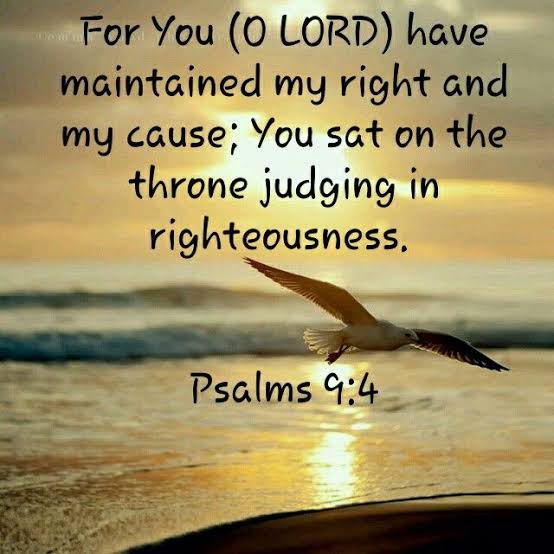
For You have maintained my right and my cause;
You sat on the throne judging in righteousness.
The God Who Defends

MY NOTES
“For You have maintained my right and my cause; You sat on the throne judging in righteousness.”— Psalm 9:4 (NKJV)
Some family crests say, “I will maintain it.” They rely on their own swords, political leverage, or sheer willpower to defend their honor and hold their ground. But the follower of God steps into a much higher, far more humble posture: “Thou hast maintained it.”
Faith ties two things together that we keep trying to separate: God, and what is right. While God lives, a righteous cause is not finally up for a vote. That does not mean every argument we enter is automatically His. It means we had better get on His side by lining ourselves up with His Word, not by putting His name on what we think is right.
David is looking at God at work among the nations, judging the wicked. The past tenses in this part of the psalm feel finished, even when some of the work is still coming. That is the Old Testament’s “prophetic perfect”: so sure it is spoken as already done. The vision is clear enough to thank God in advance.
Picture a courtroom, not a mood. God did not act from impulse, folly, or favoritism. He sat. He heard. He weighed. Then He stepped in because the right was with David and not with the men hunting him. The flight and fall of enemies became the public proof that the cause was just.
There is a throne of grace, where mercy is given. There is also a throne of judgment. David sees both.
Psalm 9:7–8 (NKJV)
“But the Lord shall endure forever; He has prepared His throne for judgment. He shall judge the world in righteousness, And He shall administer judgment for the peoples in uprightness.”
If we spend our strength maintaining the honor of the Lord, we may still be misread. Reproach is not rare. The comfort is this: the One on the throne knows the heart. We are not finally handed over to the verdict of people who do not see what He sees.
So we do not rush to claim, “God is on my side.” We ask the harder question: Am I in His will? David could call God a righteous Judge because he believed God was doing what God always does—defending good causes, not inflating proud ones. If we want His help, we had better fight where He is already standing.
When a just cause is deserted by everyone else, it is not deserted by Him. He pleads it with jealousy. He will not let it be run into the ground forever.
Romans 12:19 (NKJV)
“Beloved, do not avenge yourselves, but rather give place to wrath; for it is written, ‘Vengeance is Mine, I will repay,’ says the Lord.”
That is why we can refuse the panic of self-vindication. Vengeance belongs to Him. Judgment belongs to Him. If providence looks uneven today, that is not a reason to doubt His justice. It is a reason to believe the day that will set the record straight.
Abraham asked the question that still steadies the soul:
Genesis 18:25 (NKJV)
“Far be it from You to do such a thing as this, to slay the righteous with the wicked, so that the righteous should be as the wicked; far be it from You! Shall not the Judge of all the earth do right?”
Even when human justice fails in the present moment, the believer does not despair. If there seems to be an irregularity in how things play out right now, it simply points to the great Judgment Day to come, where every wrong will be set right, every lie silenced, and every hidden act brought to light.
Christ Himself faced the most unjust trial in human history, keeping silent before His accusers because He “committed Himself to Him who judges righteously” (1 Peter 2:23). And because He did, God raised Him up, vindicated Him, and set Him above every name.
When you belong to Christ, your ultimate vindication is already secured.
Prayer
Abba, You sit upon the throne judging in truth and equity. Forgive me for the times I have tried to take matters into my own hands, striving to defend my reputation or prove myself to my critics out of pride and fear. Search my heart today. Search my motives, clean my hands, and show me where I need to conform my life to Your Word. I lay my grievances, my reputation, and my misunderstandings at Your feet. Give me the grace to keep silent when misunderstood, to keep doing good when falsely accused, and to trust that You will maintain my cause in Your perfect time. In the righteous name of Jesus, Amen.
Key takeaways
- The Christian motto is not “I will maintain it,” but “You have maintained it.”
- God’s throne decides controversies; our job is to stand where His Word already stands.
- Claiming God is on our side is cheap; conforming to His side is the work.
- Misrepresentation hurts, but it is not the last court.
- Delayed justice is not denied justice. The prophetic perfect still stands.
- Leave vengeance with God and keep your cause clean.

Proverb for Today
My son, keep my words, And treasure my commands within you. Keep my commands and live, And my law as the apple of your eye. Bind them on your fingers; Write them on the tablet of your heart. Say to wisdom, “You are my sister,” And call understanding your nearest kin, Proverbs 7:1-4 NKJV
Daily Scripture
For I know that my Redeemer lives, And He shall stand at last on the earth; And after my skin is destroyed, this I know, That in my flesh I shall see God, Whom I shall see for myself, And my eyes shall behold, and not another. How my heart yearns within me! Job 19:25-27 NKJV
Closing

“The Lord bless you and keep you; The Lord make His face shine upon you, And be gracious to you; The Lord lift up His countenance upon you, And give you peace.” Numbers 6:24-26 NKJV
Grace be with you. Amen.
Please enter your email and click subscribe to be notified whenever I submit a new post.

Commentaries:
Charles Spurgeon
One of our nobility has for his motto, “I will maintain it;” but the Christian has a better and more humble one, “Thou hast maintained it.” “God and my right” are united by my faith: while God lives, my right shall never be taken from me. If we seek to maintain the cause and honour of our Lord, we may suffer reproach and misrepresentation, but it is a rich comfort to remember that he who sits on the throne knows our hearts, and will not leave us to the ignorant and ungenerous judgment of erring man.
______________________________________________________
Enduring Word
For You have maintained my right and my cause: David saw God move against his enemies by defending him on the principle of right and wrong in his conflict. (Guzik)
i. This shows us that the God of David – that is, the God of the Bible – is not dispassionate regarding right and wrong among men; He is not always neutral in human conflict. It is entirely true that men may think God is on their side when He is not, and that it may be that God is against both parties in a dispute. Nevertheless, under inspiration of the Holy Spirit, David could say, “For You have maintained my right and my cause.” (Guzik)
ii. Understanding this should not make us automatically claim that God is on our side in our battles or disputes; it should rather make us endeavor to be on God’s side, by rigorously conforming ourselves to His word.(Guzik)
You sat on the throne…You have rebuked the nations…You have blotted out their name forever and ever: David saw God in action among the nations, righteously judging the wicked. (Guzik)
i. By implication, we see that David also justified and defended the righteous – that is, himself, in the present situation. (Guzik)
ii. “The past tenses of verses 5-8 are ‘prophetic perfects,’ a feature of the Old Testament: they describe coming events as if they have already happened, so certain is their fulfillment and so clear the vision.” (Kidner)
______________________________________________________
Albert Barnes
For thou hast maintained my right and my cause — My righteous cause; that is, when he was unequally attacked. When his enemies came upon him in an unprovoked and cruel manner, God had interposed and had defended his cause. This shows that the psalmist refers to something that had occurred in the past; also that he regarded his cause as right – for the interposition of God in his behalf had confirmed him in this belief.
Thou satest in the throne judging right — As if he had been seated on a bench of justice, and bad decided on the merits of his cause before he interfered in his behalf. It was not the result of impulse, folly, partiality, or favoritism; it was because he had, as a judge, considered the matter, and had decided that the right was with the author of the psalm, and not with his enemies. As the result of that determination of the case, he had interposed to vindicate him, and to overthrow his adversaries. Compare Psalms 8:3-8.
______________________________________________________
John Gill
For thou hast maintained my right and my cause,…. Or vindicated and established his righteous cause; God had pleaded and defended it, and by the flight, fall, and ruin of his enemies, had clearly made it appear that his cause was just and good;
thou sittest in the throne judging right; God has not only a throne of grace on which he sits, and from whence he distributes grace and mercy to his people, but he has a throne of judgment, and which is prepared for it, as in Psalm 9:7; where he sits as the Judge of all the earth, and will do right; nor can he do otherwise, though his judgments are not always manifest in the present state of things; and the vindication of the psalmist’s innocence and uprightness is another reason of his joy and gladness.
______________________________________________________
Matthew Henry
He gives to God the glory of his righteousness, in his appearing on his behalf (v. 4): “Thou hast maintained my right and my cause, that is, my righteous cause; when that came on, thou satest in the throne, judging right.” Observe,
1. God sits in the throne of judgment. To him it belongs to decide controversies, to determine appeals, to avenge the injured, and to punish the injurious; for he has said, Vengeance is mine.
2. We are sure that the judgment of God is according to truth and that with him there is no unrighteousness. Far be it from God that he should pervert justice. If there seem to us to be some irregularity in the present decisions of Providence, yet these, instead of shaking our belief of God’s justice, may serve to strengthen our belief of the judgment to come, which will set all to-rights.
3. Whoever disown and desert a just and injured cause, we may be sure that the righteous God will maintain it and plead it with jealousy, and will never suffer it to be run down.
______________________________________________________
Calvin’s Commentary
The Psalmist proceeds a step farther in the 4th verse, declaring that God stretched forth his hand to give him succor, because he was unrighteously afflicted by his enemies. And surely if we desire to be favored with the assistance of God, we ought to see to it that we fight under his standard. David, therefore, calls him a judge of righteousness, or, which is the same thing, a righteous judge; as if he had said, God has acted towards me according to his ordinary manner and constant principle of acting, for it is his usual way to undertake the defense of good causes. I am more inclined to render the words, Thou sittest a just judge, than to render them, O just judge, thou sittest, because the form of expression, according to the first reading, is more emphatic. The import of it is this: God at length has assumed the character of judge, and is gone up into his judgment-seat to execute the office of judge. On this account he glories in having law and right on his side, and declares that God was the maintainer of his right and cause.
- Exploring the Beauty of Psalms: Insights and Commentaries
- Monthly Breakdown of Our Blog Content
- Psalms Commentary: Faith and Inspiration
Leave a Reply