Psalm 8:2 NKJV
Out of the mouth of babes and nursing infants
You have ordained strength,
Because of Your enemies,
That You may silence the enemy and the avenger.
When the Smallest Voices Shake the World

MY NOTES
Out of the mouth of babes and nursing infants You have ordained strength, Because of Your enemies, That You may silence the enemy and the avenger. Psalm 8:2 NKJV
Psalm 8 starts in the high places. Glory above the heavens—the most excellent name in all the earth. Then David drops us to the floor of the nursery. The same God who outruns the stars has ordained strength in a baby’s mouth. God delights in taking the smallest, most vulnerable, and seemingly helpless things to bring the proud and mighty to their knees.
It is hard to think of anything weaker than a nursing child. God likes that contrast. He has always liked it. He uses small things to shut large mouths.
1 Corinthians 1:27–28 NKJV
But God has chosen the foolish things of the world to put to shame the wise, and God has chosen the weak things of the world to put to shame the things which are mighty; and the base things of the world and the things which are despised God has chosen, and the things which are not, to bring to nothing the things that are.
Look around the story of God, and you keep meeting that pattern. A shepherd boy against a giant. Fishermen against a temple system. Children in the courts while the scholars sneer.
This isn’t just poetry; it’s how God operates in the real world. Think about David himself—a young teenage shepherd boy standing in a valley facing Goliath, a terrifying giant demanding blood. To the Philistine army, David was a mere “babe” in warfare. Yet through that young boy’s simple trust, God brought down the ultimate enemy and avenger.
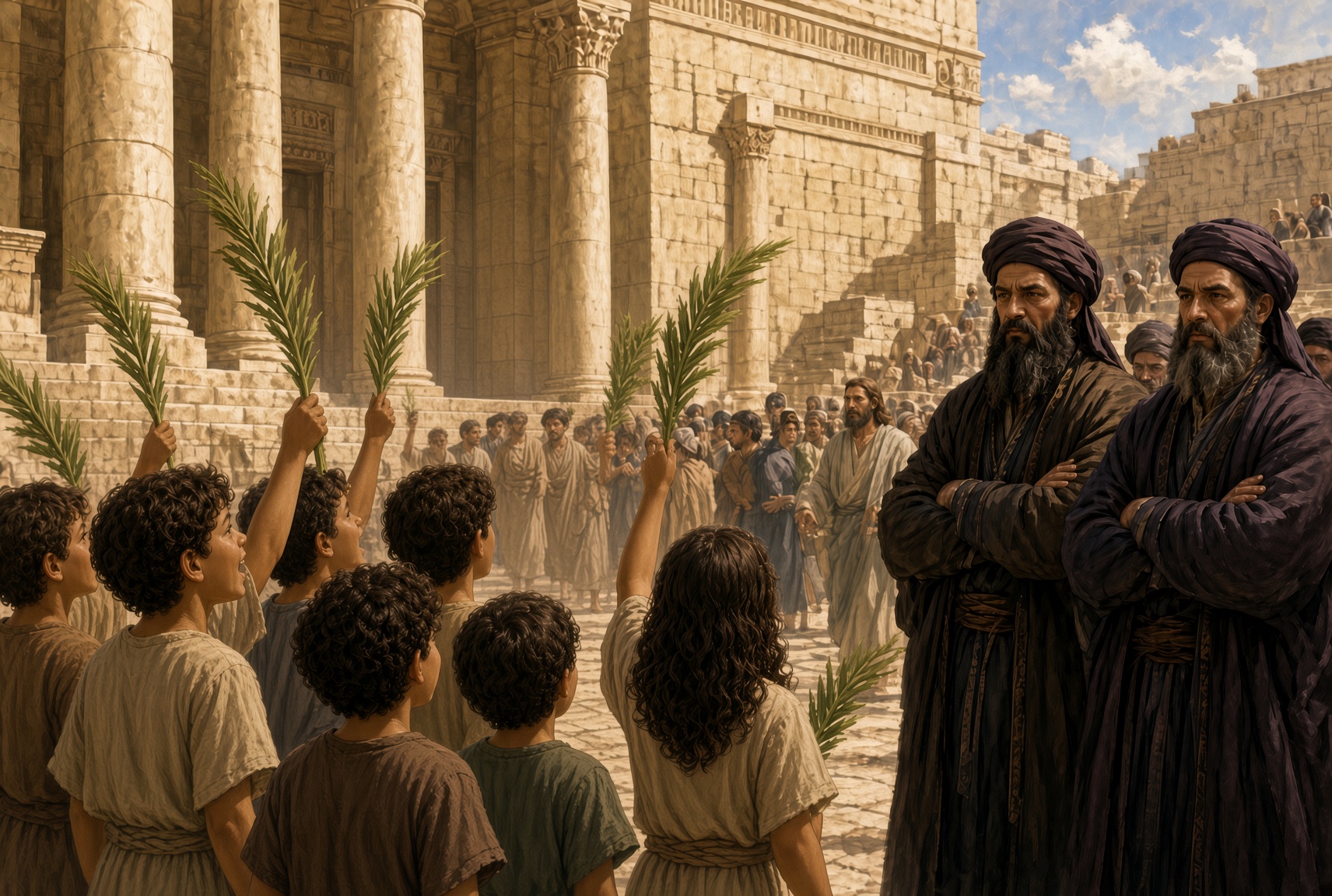
Jesus did not treat this verse as decoration. After He cleansed the temple, children were shouting in the house of God.
Matthew 21:15–16 NKJV
But when the chief priests and scribes saw the wonderful things that He did, and the children crying out in the temple and saying, “Hosanna to the Son of David!” they were indignant and said to Him, “Do You hear what these are saying?” And Jesus said to them, “Yes. Have you never read, ‘Out of the mouth of babes and nursing infants You have perfected praise’?”
Hosanna started as a cry for help. It comes from Hebrew hoshia-na (or hoshi‘ah-na) in Psalm 118:25—literally “Save now, please” or “Save, we pray.”
When Jesus rode into Jerusalem, the powerful Pharisees stood by with folded arms, sneering in contempt. But the temple courts weren’t quiet—they were filled with the loud, ringing cheers of young children shouting, “Hosanna to the Son of David!” Originally, “Hosanna” was a desperate plea for rescue—“Save now, we pray!”—but in the mouths of those young ones, it became a shout of victory.
”Psalm 118:25 NKJV
Save now, I pray, O Lord; O Lord, I pray, send now prosperity.
By the time those children yelled it, the plea had become praise. Salvation was standing in front of them. The priests had the training. The children had the song. God used the song to still the enemy.
Church history is crowded with the same testimony:
- George Wishart, a Scottish martyr, was accused by a religious court officer of being possessed by a devil. A child standing nearby cut through the noise, calling out, “A devil cannot speak such words as yonder man speaketh.”
- George Whitefield recalled preaching outdoors in London while mobs pelted him with dirt and stones. Surrounding his makeshift pulpit were young boys and girls who refused to run. They sat with tear-filled eyes, shielding him as best as they could, crying out to God to protect the preacher.
The gospel itself came that way. Not out of philosophers and statesmen first, but out of men the council called uneducated.
Acts 4:13 NKJV
Now when they saw the boldness of Peter and John, and perceived that they were uneducated and untrained men, they marveled. And they realized that they had been with Jesus.
God ordained strength there too—the rod of His strength, the power of God unto salvation—so that the devil’s noise would have to go quiet. The enemy and the avenger still talk. They do not get the last word.
When you feel like a helpless infant against a wall of opposition, remember who holds you. The God who set His glory above the heavens is not waiting for you to sound impressive. He has already decided to work through weak mouths. Children can tell the truth adults have talked themselves out of. Simple faith can refute a proud argument. A cry of “save us” can become a shout of praise.
Do not despise the small voice—in a child, in a new believer, in your own thin prayer. God has a habit of silencing giants with it.
Prayer
Abba, You have ordained strength out of the mouths of babes. I am not impressive, and I do not need to be. Silence the enemy and the avenger—not by my loudness, but by Your strength in weak places. Give me a child’s honesty and a saint’s courage. Let Hosanna be more than a word I sing. Let it be the cry that becomes praise because You save. I pray for this Abba in Jesus’ name, Amen.
Key Takeaways
- God displays strength through weakness on purpose, not by accident.
- A child’s praise can still what a scholar’s contempt cannot.
- Hosanna is both a plea and a shout: save us, and salvation is here.
- You do not need a large platform to be a true witness. You need a true mouth.
- The enemy talks loudly. God has already chosen how He will quiet him.
Proverb for Today
The proverbs of Solomon the son of David, king of Israel: To know wisdom and instruction, To perceive the words of understanding, To receive the instruction of wisdom, Justice, judgment, and equity; To give prudence to the simple, To the young man knowledge and discretion— A wise man will hear and increase learning, And a man of understanding will attain wise counsel, To understand a proverb and an enigma, The words of the wise and their riddles. The fear of the Lord is the beginning of knowledge, But fools despise wisdom and instruction. Proverbs 1:1-7 NKJV
Daily Scripture
But why do you judge your brother? Or why do you show contempt for your brother? For we shall all stand before the judgment seat of Christ. For it is written: “As I live, says the Lord, Every knee shall bow to Me, And every tongue shall confess to God.” Romans 14:10-11 NKJV
Closing
“The Lord bless you and keep you; The Lord make His face shine upon you, And be gracious to you; The Lord lift up His countenance upon you, And give you peace.” Numbers 6:24-26 NKJV

Grace be with you. Amen.
Please enter your email and click subscribe to be notified whenever I submit a new post.

Summary of Commentaries:
God has a habit of using the smallest voices to shut the loudest critics. You see it all through Scripture and the church’s story. He builds real strength out of weak tools. Children shouting “Hosanna” in the temple. Ordinary fishermen carrying the gospel. Simple, honest faith that makes pride look foolish and takes the fight out of arrogance. When you feel helpless, remember this: God’s power is not measured by how much leverage you have. It shows up clearest where you have none.
Commentaries:
Charles Spurgeon
Nor only in the heavens above is the Lord seen, but the earth beneath is telling forth his majesty. In the sky, the massive orbs, rolling in their stupendous grandeur, are witnesses of his power in great things, while here below, the lisping utterances of babes are the manifestations of his strength in little ones. How often will children tell us of a God whom we have forgotten! How doth their simple prattle refute those learned fools who deny the being of God! Many men have been made to hold their tongues, while sucklings have borne witness to the glory of the God of heaven. It is singular how clearly the history of the church expounds this verse. Did not the children cry “Hosannah!” in the temple, when proud Pharisees were silent and contemptuous? and did not the Savior quote these very words as a justification of their infantile cries? Early church history records many amazing instances of the testimony of children for the truth of God, but perhaps more modern instances will be the most interesting. Fox tells us, in the Book of Martyrs, that when Mr. Lawrence was burnt in Colchester, he was carried to the fire in a chair, because through the cruelty of the Papists, he could not stand upright, several young children came about the fire, and cried as well as they could speak, “Lord, strengthen thy servant, and keep thy promise.” God answered their prayer, for Mr. Lawrence died as firmly and calmly as anyone could wish to breathe his last. When one of the Popish chaplains told Mr. Wishart, the great Scotch martyr, that he had a devil in him, a child that stood by cried out, “A devil cannot speak such words as yonder man speaketh.” One more instance is still nearer to our time. In a postscript to one of his letters, in which he details his persecution when first preaching in Moorfields, Whitfield says, “I cannot help adding that several little boys and girls, who were fond of sitting round me on the pulpit while I preached, and handed to me people’s notes—though they were often pelted with eggs, dirt, and thrown at me—never once gave way; but on the contrary, every time I was struck, turned up their little weeping eyes, and seemed to wish they could receive the blows for me. God make them, in their growing years, great and living martyrs for him who, out of the mouths of babes and sucklings, perfects praise!” He who delights in the songs of angels is pleased to honor himself in the eyes of his enemies by the praises of little children. What a contrast between the glory above the heavens, and the mouths of babes and sucklings! Yet by both the name of God is made excellent.
______________________________________________________
Enduring Word
Out of the mouth of babes and nursing infants You have ordained strength: In the first verse, David considered the greatness of God by His evident power and glory in creation, both across the earth and in the heavens. Now, he considers that the power and glory of God can be seen in small children – babes and nursing infants – as God’s strength is evident in them. (Guzik)
i. David here touched on a familiar theme in the Bible: the idea that God uses otherwise weak things to display His glory and strength. 1 Corinthians 1:27 is an example of this idea: But God has chosen the foolish things of the world to put to shame the wise, and God has chosen the weak things of the world to put to shame the things which are mighty. (Guzik)
ii. It is hard to think of anything more weak and helpless than a baby; yet the same God who can ordain strength out of the mouth of babes and nursing infants can give strength and support to me in the midst of my weakness. (Guzik)
iii. “The word here rather means a strength…that, out of such frail material as children’s speech, God builds a tower of strength, which, like some border castle, will bridle and still the restless enemy.” (Maclaren)
iv. “The praises of the Messiah, celebrated in the church by his children, have in them a strength and power which nothing can withstand; they can abash infidelity, when at its greatest height, and strike hell itself silent.” (Horne)
v. Significantly, Jesus quoted this passage to His indignant accusers in Matthew 21:16, as Jesus did wonderful miracles in the temple area, and as He received the praise of children who cried out Hosanna to the Son of David! (Matthew 21:15). (Guzik)
______________________________________________________
Albert Barnes
Nor does it refer merely to praise as proceeding from children, as being that by which the effect referred to is accomplished. It is true that this idea is in the translation by the Septuagint, and true that it is so quoted in Matthew 21:16, and true, also, that, as quoted by the Saviour, and as originally applied, it was adapted to the end which the Saviour had in view – to silence the chief priests and Scribes, who objected to the praises and hosannas of the children in the temple, for the psalm, on any interpretation, originally meant that God would accomplish good effects by those who were feeble and weak as children, and this principle was applicable to the praises of the children in the temple. But it does not appear that it originally referred to praise, either of children or others. It was to some manifested strength or prowess, by which some enemy, or someone who was seeking revenge, was overcome by the instrumentality of those who might be compared with children on account of their feebleness. From this the psalmist takes occasion to make his reflections on the exalted honor conferred in general on a creature so weak and feeble as man, especially in the wide dominion granted him over the inferior creation.
This was, not improbably, some enemy of the author of the psalm; but who it was is not mentioned. David was often, however, in the course of his life, in such circumstances as are here supposed. Might it not refer to Goliath of Gath – a mighty giant, and a formidable enemy of the people of God, overcome by David, quite a stripling – a child? Would not the language of the psalm agree with that? Was it not true that he was an “enemy” and an “avenger,” or one seeking revenge? And was it not true that God had, from one who was a mere child, “ordained strength” to subdue him?
______________________________________________________
John Gill
hast thou ordained strength: by which is meant the Gospel, the rod of Christ’s strength, and the power of God unto salvation; and which being made useful for the conversion of souls, is the cause of much praise and thanksgiving to God: this, by the mouths and means of the apostles and first ministers of the word, God ordained, or “founded”, settled and established in the world, notwithstanding all the opposition made unto it; so that the gates of hell cannot prevail against it, to root it out of the world; but it will continue the everlasting Gospel;
that thou mightest still the enemy and the avenger; These words are applied by Christ to the children in the temple, crying Hosanna to the son of David, out of whose mouths God perfected the praise of the Messiah; and by which, and Christ’s defense of them, the Scribes and Pharisees, the mortal enemies of Christ, and who wanted to revenge themselves on him, were silenced and stilled, Matthew 21:15.
______________________________________________________
Matthew Henry
Out of the mouth of babes and sucklings hast thou ordained strength, or perfected praise, the praise of thy strength, Mt. 21:16. This intimates the glory of God,
In the kingdom of nature. The care God takes of little children (when they first come into the world the most helpless of all animals), the special protection they are under, and the provision nature has made for them, ought to be acknowledged by every one of us, to the glory of God, as a great instance of his power and goodness, and the more sensibly because we have all had the benefit of it, for to this we owe it that we died not from the womb, that the knees then prevented us, and the breasts, that we should suck.
In the kingdom of grace, the kingdom of the Messiah. It is here foretold that by the apostles, who were looked upon but as babes, unlearned and ignorant men (Acts 4:13), mean and despicable, and by the foolishness of their preaching, the devil’s kingdom should be thrown down as Jericho’s walls were by the sound of rams’ horns. The gospel is called the arm of the Lord and the rod of his strength; this was ordained to work wonders, not out of the mouth of philosophers or orators, politicians or statesmen, but of a company of poor fishermen, who lay under the greatest external disadvantages; yea, we hear children crying, Hosanna to the Son of David, when the chief priests and Pharisees owned him not, but despised and rejected him; to that therefore our Saviour applied this (Mt. 21:16) and by it stilled the enemy. Sometimes the grace of God appears wonderfully in young children, and he teaches those knowledge, and makes those to understand doctrine, who are but newly weaned from the milk and drawn from the breasts, Isa. 28:9. Sometimes the power of God brings to pass great things in his church by very weak and unlikely instruments, and confounds the noble, wise, and mighty, by the base, and weak, and foolish things of the world, that no flesh may glory in his presence, but the excellency of the power may the more evidently appear to be of God, and not of man, 1 Co. 1:27, 28. This he does because of his enemies, because they are insolent and haughty, that he may still them, may put them to silence, and put them to shame, and so be justly avenged on the avengers; see Acts 4:14; 6:10. The devil is the great enemy and avenger, and by the preaching of the gospel he was in a great measure stilled, his oracles were silenced, the advocates of his cause were confounded, and unclean spirits themselves were not suffered to speak.

- Exploring the Beauty of Psalms: Insights and Commentaries
- Monthly Breakdown of Our Blog Content
- Psalms Commentary: Faith and Inspiration

Leave a Reply