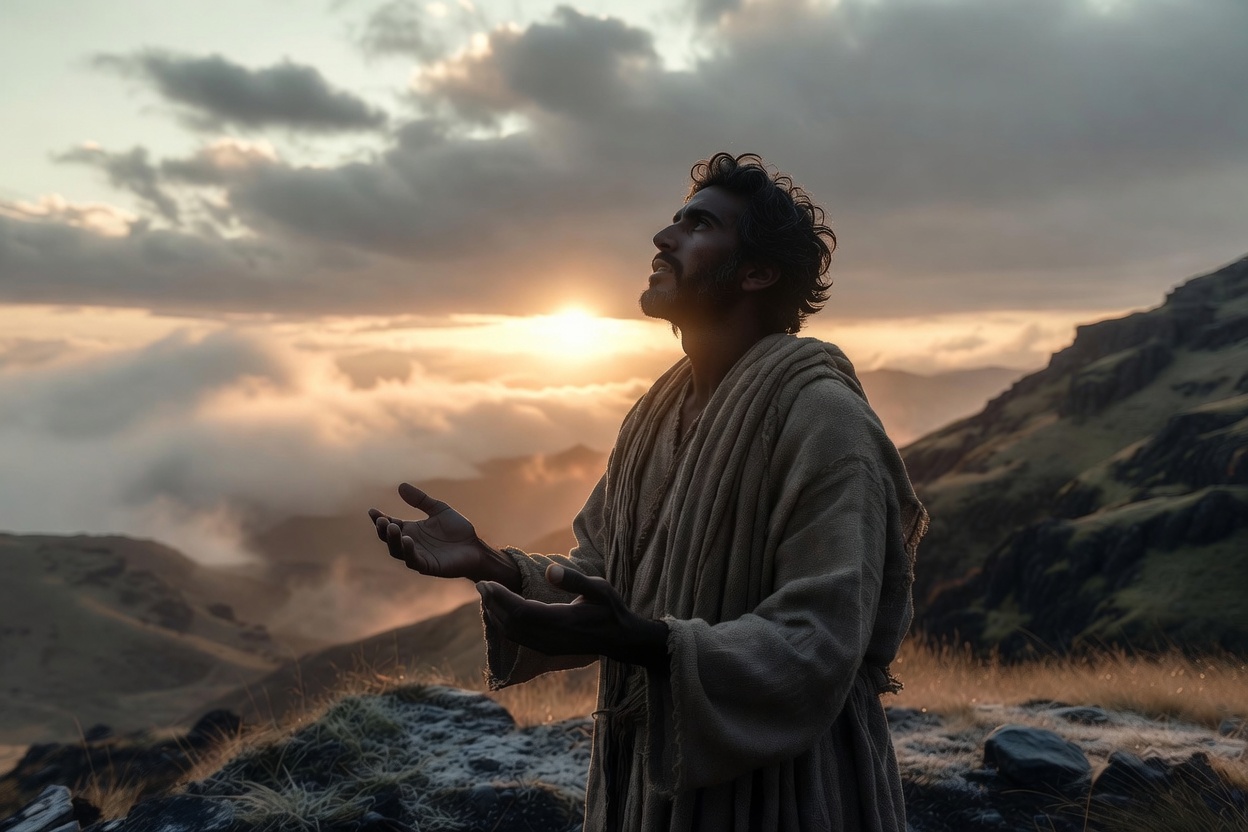
Psalm 7:1-2 NKJV
O Lord my God, in You I put my trust; Save me from all those who persecute me; And deliver me, Lest they tear me like a lion, Rending me in pieces, while there is none to deliver.
Trusting God

MY NOTES
I’ve been in seasons where it felt like the accusations and pressure were closing in from every side. People talking, suspicions rising, and no one stepping in to set the record straight. That’s the place David finds himself in Psalm 7. He opens with these words:
“O Lord my God, in You I put my trust; Save me from all those who persecute me; And deliver me, Lest they tear me like a lion, Rending me in pieces, while there is none to deliver.” —Psalm 7:1-2 (NKJV)
Right from the start, David anchors himself. “O Lord my God.” Not just “God,” but my God. He claims the relationship. Then he declares his trust—present tense. Not “I used to trust You” or “I will try to trust You.” He is trusting Him right now, in the middle of the storm.
That’s a good place to begin any prayer. Before we pour out the details of our trouble, we remind our own hearts who we’re talking to and where our safety really lies. David flees to God like a man running for shelter. He knows the only safe place is under the Lord’s protection.
His request is clear and urgent: “Save me… deliver me.” He doesn’t ask for a little relief. He asks to be completely rescued from every persecutor. There’s a particular intensity in the picture he paints—a lion tearing its prey apart with no one around to stop it. David had been a shepherd. He knew what a lion could do to a defenseless lamb. That image captures the helplessness he feels. If God doesn’t step in, there is no one else who can.
We’ve all felt that same sense of vulnerability. When the attack is on your character or your peace, it can feel like something is being torn apart inside you. Slander especially cuts deep. A physical wound can heal, but a damaged reputation or a false accusation often leaves a longer scar. David understands that danger well.
Yet he doesn’t stay in the fear. He brings it to God. He trusts that the Lord sees the whole situation and is able to rescue him completely. That’s the quiet confidence running through these verses: God is both willing and able to deliver His people when no one else will.
Prayer
O Lord my God, I put my trust in You today. You are my refuge when the pressure feels overwhelming, and the accusations or opposition seem relentless. Save me from every source of persecution and attack. Deliver me completely. When it feels like I am about to be torn apart and there is no one else to step in, remind me that You are enough. Be my shelter. Clear my name where it needs clearing, protect my heart where it needs protecting, and let me rest in the safety of belonging to You. Thank You that I am never without a Deliverer. In Jesus’ name I pray, Amen.
Key Takeaways
- True prayer often begins with a fresh declaration of trust in God as our God.
- We can (and should) ask God to save us from all the sources of pressure and persecution, not just the most obvious ones.
- Feeling completely exposed and defenseless is not a sign of weak faith—it is often the very place where we learn to depend on the Lord alone.
- God is the only reliable Deliverer when human help fails.
Cross References (NKJV)
Psalm 57:1
Be merciful to me, O God, be merciful to me! For my soul trusts in You; And in the shadow of Your wings I will make my refuge, Until these calamities have passed by.
Psalm 61:4
I will abide in Your tabernacle forever; I will trust in the shelter of Your wings. Selah
2 Corinthians 1:10
…who delivered us from so great a death, and does deliver us; in whom we trust that He will still deliver us.
2 Timothy 4:18
And the Lord will deliver me from every evil work and preserve me for His heavenly kingdom. To Him be glory forever and ever. Amen!1
Peter 5:8
Be sober, be vigilant; because your adversary the devil walks about like a roaring lion, seeking whom he may devour.
Psalm 31:1-2
In You, O Lord, I put my trust; Let me never be ashamed; Deliver me in Your righteousness. Bow down Your ear to me, Deliver me speedily; Be my rock of refuge, A fortress of defense to save me.
Proverb for Today
Do not exalt yourself in the presence of the king, And do not stand in the place of the great; For it is better that he say to you, “Come up here,” Than that you should be put lower in the presence of the prince, Whom your eyes have seen. Proverbs 25:6-7 NKJV
Daily Scripture
I call heaven and earth as witnesses today against you, that I have set before you life and death, blessing and cursing; therefore choose life, that both you and your descendants may live; that you may love the Lord your God, that you may obey His voice, and that you may cling to Him, for He is your life and the length of your days; and that you may dwell in the land which the Lord swore to your fathers, to Abraham, Isaac, and Jacob, to give them.” Deuteronomy 30:19-20 NKJV
Closing
“The Lord bless you and keep you; The Lord make His face shine upon you, And be gracious to you; The Lord lift up His countenance upon you, And give you peace.” Numbers 6:24-26 NKJV

Grace be with you. Amen.
Please enter your email and click subscribe to be notified whenever I submit a new post.

Summary of Commentaries:
In the commentaries below, David opens Psalm 7 under heavy attack from a slanderer named Cush. With nowhere else to turn, he runs straight to God and stakes everything on one clear claim: “O Lord my God, in You I put my trust.” He asks to be saved from every persecutor before they tear him apart like a lion with no one left to rescue him. Slander cuts deeper than any sword, yet David shows us the right response—trust God fully and cry out for complete deliverance.
Commentaries:
Charles Spurgeon
From the title we learn the occasion of the composition of this song. It appears probable that Cush the Benjamite had accused David to Saul of treasonable conspiracy against his royal authority. This the king would be ready enough to credit, both from his jealousy of David, and from the relation which most probably existed between himself, the son of Kish, and this Cush, or Kish, the Benjamite. He who is near the throne can do more injury to a subject than an ordinary slanderer.
David appears before God to plead with him against the Accuser, who had charged him with treason and treachery. The case is here opened with an avowal of confidence in God. Whatever may be the emergency of our condition we shall never find it amiss to retain our reliance upon our God. “O Lord my God,” mine by a special covenant, sealed by Jesus’ blood, and ratified in my own soul by a sense of union to thee; “in thee,” and in thee only, “do I put my trust,” even now in my sore distress. I shake, but my rock moves not. It is never right to distrust God, and never vain to trust him. And now, with both divine relationship and holy trust to strengthen him, David utters the burden of his desire—“save me from all them that persecute me.” His pursuers were very many, and any one of them cruel enough to devour him; he cries, therefore, for salvation from them all. We should never think our prayers complete until we ask for preservation from all sin, and all enemies. “And deliver me,” extricate me from their snares, acquit me of their accusations, give a true and just deliverance in this trial of my injured character. See how clearly his case is stated; let us see to it, that we know what we would have when we are come to the throne of mercy. Pause a little while before you pray, that you may not offer the sacrifice of fools. Get a distinct idea of your need, and then you can pray with the more fluency of fervency.
“Lest he tear my soul.” Here is the plea of fear co-working with the plea of faith. There was one among David’s foes mightier that the rest, who had both dignity, strength, and ferocity, and was, therefore, “like a lion.” From this foe he urgently seeks deliverance. Perhaps this was Saul, his royal enemy; but in our own case there is one who goes about like a lion, seeking whom he may devour, concerning whom we should ever cry, “Deliver us from the Evil One.” Notice the vigor of the description—“rending it in pieces, while there is none to deliver.” It is a picture from the shepherd-life of David. When the fierce lion had pounced upon the defenseless lamb, and had made it his prey, he would rend the victim in pieces, break all the bones, and devour all, because no shepherd was near to protect the lamb or rescue it from the ravenous beast. This is a soul-moving portrait of a saint delivered over to the will of Satan. This will make the bowels of Jehovah yearn. A father cannot be silent when a child is in such peril. No, he will not endure the thought of his darling in the jaws of a lion, he will arise and deliver his persecuted one. Our God is very pitiful, and he will surely rescue his people from so desperate a destruction. It will be well for us here to remember that this is a description of the danger to which the Psalmist was exposed from slanderous tongues. Verily this is not an overdrawn picture, for the wounds of a sword will heal, but the wounds of the tongue cut deeper than the flesh, and are not soon cured. Slander leaves a slur, even if it be wholly disproved. Common fame, although notoriously a common liar, has very many believers. Once let an ill word get into men’s mouths, and it is not easy to get it fully out again. The Italians say that good repute is like the cypress, once cut it never puts forth leaf again; this is not true if our character be cut by a stranger’s hand, but even then it will not soon regain its former verdure. Oh, ’tis a meanness most detestable to stab a good man in his reputation, but diabolical hatred observes no nobility in its mode of warfare. We must be ready for this trial, for it will surely come upon us. If God was slandered in Eden, we shall surely be maligned in this land of sinners. Gird up your loins, ye children of the resurrection, for this fiery trial awaits you all.
______________________________________________________
Enduring Word
In You I put my trust: When David was under attack from Cush the Benjamite, all he could trust was God. Every other support was gone, but he needed no other support.(Guzik)
“Nothing is known of Cush; but from Absalom’s rebellion it emerged that Benjamin, Saul’s tribe, held some bitter enemies of David (2 Samuel 16:5ff; 20:1ff).” (Kidner)
“It is easy to understand how the slander described in the psalm could have emerged from the smoldering hostility of this tribe.” (Boice)
Some believe that this Cush was really Saul or Shimei. “Cush has been supposed to be Shimei or Saul himself, and to have been so called because of his swarthy complexion (Cush meaning African) or as a jest, because of his personal beauty.” (Maclaren)
And deliver me: To be slandered is a severe trial. “It appears probable that Cush the Benjamite had accused David to Saul of treasonable conspiracy against his royal authority. This the king would be ready enough to credit, both from his jealousy of David, and from the relation which most probably existed between himself, the son of Kish, and this Cush, or Kish, the Benjamite…. This may be called the SONG OF THE SLANDERED SAINT.” (Spurgeon)
Lest they tear me like a lion: This understanding gave David urgency in prayer. God sometimes allows difficult circumstances, so they will awaken this urgency in us. (Guzik)
“It will be well for us here to remember that this is a description of the danger to which the Psalmist was exposed from slanderous tongues. Verily this is not an overdrawn picture, for the wounds of a sword will heal, but the wounds of the tongue cut deeper than the flesh, and are not soon cured.” (Spurgeon)
David also knew what it was like to overcome a lion. “The metaphor of the lion is common in the psalms attributed to David, and is, at all events, natural in the mouth of a shepherd king, who had taken a lion by the beard.” (Maclaren)
______________________________________________________
Albert Barnes
O Lord my God, in thee do I put my trust — The psalm opens with an expression of strong confidence in God. The psalmist addresses Yahweh as his God, and says that in him he trusts or confides. The word rendered trust – חסה châsâh – means “to flee;” to flee to a place; to take shelter; and is applied to taking shelter under the shadow or protection of one Judges 9:15; Isaiah 30:2; Psalms 57:1; Psalms 61:4. The idea here is, that in his troubles he fled to God as a refuge, and felt safe under his protection.
______________________________________________________
John Gill
O Lord my God, in thee do I put my trust,…. The psalmist expresses his interest in God as his covenant God, and his trust and confidence in him; and with these he sets out as the stay of his soul, and his bulwark against the fears of his enemies; and he does not say that he had trusted in God, or would for the future trust in him; but that he did trust in him, and continued to do so. And God is to be trusted in at all times; in times of affliction, temptation, and desertion; and these the psalmist premises to his petition, which follows, as an encouragement to him to hope for success, since God was his God, and none that ever trusted in him were confounded;
save me from all them that persecute me, and deliver me; persecution is no new thing to the people of God; David had his persecutors, and many of them; the Church, in Jeremiah’s time, had hers; the saints, in the times of the apostles, and in all ages since, have had theirs. Every one that will live godly in Christ Jesus must expect persecution in one shape or another; and there is none can save and deliver from it but God, and he can and will in his own time, 2 Corinthians 1:10.
Lest he tear my soul like a lion,.… That is, one of his persecutors, the chief of them; it may be Saul, whom the psalmist compares to a lion for his majesty and greatness, the lion being the king among beasts; and for his authority, power, and might, and for his wrath and cruelty, which he feared; and which, should it be exerted on him, would tear his soul, or himself, in pieces; would rend his soul from his body, and dispatch his life; see Proverbs 19:12. So the Apostle Paul calls the Roman governor, before whom he was, and from whose hands he was delivered, a lion, for his power and fierceness, 2 Timothy 4:17. And so our adversary the devil, the chief of all persecutors, and who instigates others against the saints, is by Peter said to go about like a roaring lion, 1 Peter 5:8;
rending [it] in pieces, as the lion does his prey when hungry. So Homer {s} compares Polyphemus to a mountain lion, which devours and leaves nothing, neither the intestines, nor flesh, nor bones; and represents {t} it first taking hold of the creature with its strong teeth, and breaking its neck, and drawing out its blood and all its inwards; see Isaiah 38:13;
while [there is] none to deliver; no savior, no deliverer: for if God does not save and deliver his people out of the hands of their persecutors, none can; especially out of the hands of such an one as is here described tearing and rending in pieces. As there is no God besides the Lord, there is no savior besides him: there is no temporal nor spiritual savior but he: salvation is not to be expected from any other; and were it not for him, saints must fall a prey to their enemies.
______________________________________________________
Matthew Henry
He puts himself under God’s protection and flies to him for succor and shelter (v. 1): “Lord, save me, and deliver me from the power and malice of all those that persecute me, that they may not have their will against me.” He pleads,
1. His relation to God. “Thou art my God, and therefore whither else should I go but to thee? Thou art my God, and therefore my shield (Gen. 15:1), my God, and therefore I am one of thy servants, who may expect to be protected.”
2. His confidence in God: “Lord, save me, for I depend upon thee: In thee do I put my trust, and not in any arm of flesh.” Men of honor will not fail those that repose a trust in them, especially if they themselves have encouraged them to do so, which is our case.
3. The rage and malice of his enemies, and the imminent danger he was in of being swallowed up by them: “Lord, save me, or I am gone; he will tear my soul like a lion tearing his prey,” with so much pride, and pleasure, and power, so easily, so cruelly. St. Paul compares Nero to a lion (2 Tim. 4:17), as David here compares Saul.
4. The failure of all other helpers: “Lord, be thou pleased to deliver me, for otherwise there is none to deliver,” v. 2. It is the glory of God to help the helpless.
______________________________________________________
Calvin’s Commentary
There is great emphasis in these words which he uses in the beginning of the Psalms O Jehovah my Godly in thee do I trust. The verb, it is true, is in the past tense in the Hebrew; and, therefore, if literally translated, the reading would be, In thee have I trusted; but as the Hebrews often take one tense for another, I prefer to translate it in the present, In thee I do trust, especially since it is abundantly evident that a continued act, as it is termed, is denoted. David does not boast of a confidence in God, from which he had now fallen, but of a confidence which he constantly entertained in his afflictions. And this is a genuine and an undoubted proof of our faith, when, being visited with adversity, we, notwithstanding, persevere in cherishing and exercising hope in God. From this passage, we also learn that the gate of mercy is shut against our prayers if the key of faith do not open it for us. Nor does he use superfluous language when he calls Jehovah his own God; for by setting up this as a bulwark before him, he beats back the waves of temptations, that they may not overwhelm his faith. In the second verses by the figure of a lion, he represents in a stronger light the cruelty of Saul, as an argument to induce God to grant him assistance, even as he ascribes it to Him as his peculiar province to rescue his poor sheep from the jaws of wolves.
______________________________________________________
Miscellaneous Comments
O Lord, my God, in thee do I put my trust.” This is the first instance in the Psalms where David addresses the Almighty by the united names Jehovah and my God. No more suitable words can be placed at the beginning of any act of prayer or praise. These names show the ground of the confidence afterward expressed. They “denote at once supreme reverence and the most endearing confidence. They convey a recognition of God’s infinite perfections, and of his covenanted and gracious relations.”
—William S. Plumer.
“Lest he tear my soul like a lion,” etc. It is reported of tigers, that they enter into a rage upon the scent of fragrant spices; so do ungodly men at the blessed savour of godliness. I have read of some barbarous nations, who, when the sun shines hot upon them, they shoot up their arrows against it; so do wicked men at the light and heat of godliness. There is a natural antipathy between the spirits of godly men and the wicked. Genesis 3:15. “I will put enmity between thy seed and her seed.”
—Jeremiah Burroughs, 1660.

- Exploring the Beauty of Psalms: Insights and Commentaries
- Monthly Breakdown of Our Blog Content
- Psalms Commentary: Faith and Inspiration
Leave a Reply