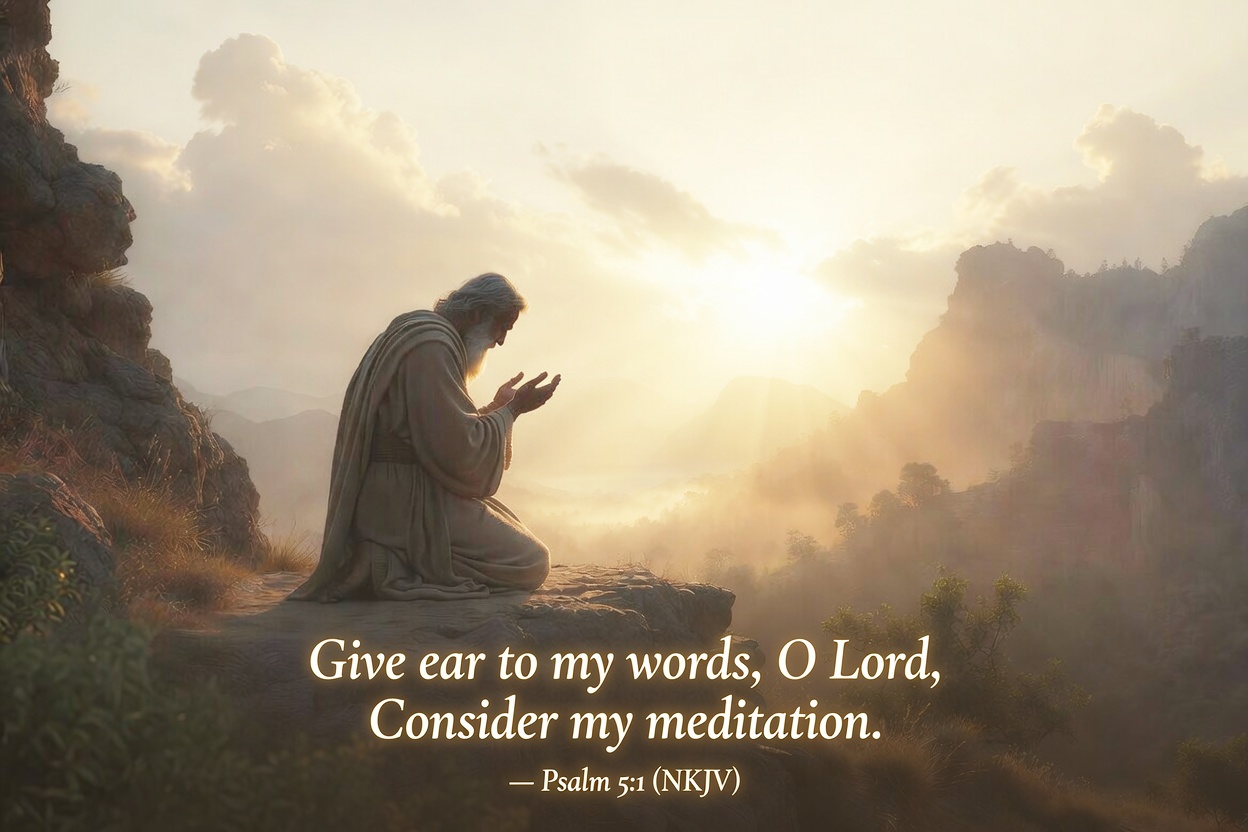
Psalm 5:1 NKJV
Give ear to my words, O Lord,
Consider my meditation.
Baring Your Soul to the One Who Listens

My Notes
“Give ear to my words, O Lord, Consider my meditation.”— Psalm 5:1 (NKJV)
Have you ever sat down to pray and found yourself completely at a loss for what to say? Perhaps the weight of a situation was so heavy, or your grief so deep, that proper, articulated sentences simply refused to form.
In Psalm 5:1, David gives us permission to breathe a sigh of relief. He approaches God using two distinct expressions of prayer: his words and his meditation. David prays with a vivid awareness that God is near, attentive, and listening. Not distant. Not distracted. Not indifferent. He believes God bends His ear toward His people.
Words, as Charles Spurgeon once noted, are not the core of prayer—they are merely its garments. Sometimes our prayers are clear, eloquent, and bold. We express our needs, declare God’s promises, and pour out our hearts in spoken phrases. But at other times, our prayers are raw, unformed, and quiet. They exist as a whisper, a musing, or an aching groan deep within the soul—what the Hebrew word for meditation (hagig) captures as an inward murmur or sigh.
David asks God to do two things with these two expressions:
- “Give ear to my words…” David says, “Lord, hear my words… and understand my meditation.” In other words: “Listen to what I say, and listen even more closely to what I mean.” That’s comforting. God doesn’t just hear the prayer we manage to speak—He hears the prayer beneath the prayer.
- “Consider my meditation…” When David asks God to “consider my meditation,” the original Hebrew word (hagig) points to something deeply intimate: a whisper, a sigh, a secret groan, or an inner fire burning in the soul. It is the confused muttering of a heavy heart—like King Hezekiah chattering like a swallow in his sickness (Isaiah 38:14), or Moses crying out to God at the Red Sea without uttering a single vocal word (Exodus 14:15).
David isn’t trying to impress God with fluent words. He’s asking God to lean in close, to hear not only the sentences he can form but also the longings he can’t articulate. Sometimes our deepest prayers are sighs, groans, or quiet thoughts that never become full sentences. Scripture tells us the Spirit Himself intercedes with “groanings which cannot be uttered.” God understands the language of the heart.
Through Christ, our Mediator, even our weakest sighs are translated before the throne of grace. So, begin praying in your heart before you even kneel down, and carry that quiet conversation with Him throughout your day.
The Lord hears both the spoken petition and the unspoken moan of your heart.
Prayer
Abba, thank You that You do not require polished speeches or perfect words when I come into Your presence. You know the burdens I carry, the joy I feel, and the silent longings that I cannot put into words. Incline Your ear to the words I speak today, and look deeply into the meditations of my heart. Where my words fall short, let the Holy Spirit intercede for me. Help me to live today in continuous, conscious awareness of Your presence, knowing that You hear every whisper and every sigh. I ask for this in the precious name of Jesus, Amen.
Key Takeaways
- Prayer is both spoken and silent: the Lord hears words and also the unuttered cries of the heart.
- God Inclines His Ear to You: Our Father in heaven isn’t distant or distracted. He attentively bends down to listen to every believer who approaches Him in faith.
- The Heart Behind the Meditation: True prayer begins in the heart before we kneel and continues long after we stand up. God interprets the hidden motives, groanings, and needs we cannot put into words.
- Jesus Our Mediator Completes Our Prayers: When we bring our imperfect words and raw meditations to God, our great High Priest takes them, refines them, and presents them perfectly before the Father.
Cross References (NKJV)
Romans 8:26–27
“Likewise the Spirit also helps in our weaknesses. For we do not know what we should pray for as we ought, but the Spirit Himself makes intercession for us with groanings which cannot be uttered. Now He who searches the hearts knows what the mind of the Spirit is, because He makes intercession for the saints according to the will of God.”
Psalm 19:14
“Let the words of my mouth and the meditation of my heart Be acceptable in Your sight, O Lord, my strength and my Redeemer.”
Isaiah 38:14
“Like a crane or a swallow, so I chattered; I mourned like a dove; My eyes fail from looking upward. O Lord, I am oppressed; Undertake for me!”
Hebrews 4:15–16
“For we do not have a High Priest who cannot sympathize with our weaknesses, but was in all points tempted as we are, yet without sin. Let us therefore come boldly to the throne of grace, that we may obtain mercy and find grace to help in time of need.”
Things to Think About:
- What is a burden or situation in your life right now that feels too complex or emotional to put easily into words? Practice presenting it to God in quiet stillness.
- How does knowing that God considers your “silent meditations” change the pressure you might feel to pray “correctly” or “eloquently”?
- Reflect on a time when you felt a deep, unspoken connection with God. How can you cultivate that continuous “spirit of prayer” in the middle of your everyday tasks today?
Proverb for Today
A man’s pride will bring him low, But the humble in spirit will retain honor. Proverbs 29:23 NKJV
Daily Scripture
But from there you will seek the Lord your God, and you will find Him if you seek Him with all your heart and with all your soul. When you are in distress, and all these things come upon you in the latter days, when you turn to the Lord your God and obey His voice (for the Lord your God is a merciful God), He will not forsake you nor destroy you, nor forget the covenant of your fathers which He swore to them. Deuteronomy 4:29-31 NKJV
Closing
“The Lord bless you and keep you; The Lord make His face shine upon you, And be gracious to you; The Lord lift up His countenance upon you, And give you peace.” Numbers 6:24-26 NKJV
Grace be with you. Amen.
Please enter your email and click subscribe to be notified whenever I submit a new post.

Summary of Commentaries:
These commentaries emphasize that Psalm 5:1 addresses two forms of prayer: spoken words and silent, internal longings. Scholars explain that while vocal prayers express distinct petitions, “meditation” captures the deep, unutterable groans and fervent desires of the heart. True prayer requires a conscious approach to a listening God, who perceives both articulate requests and silent sighs. Ultimately, God weighs the believer’s sincerity, fully understanding and answering the hidden longings of the soul.
Commentaries:
Charles Spurgeon
There are two sorts of prayers—those expressed in words, and the unuttered longings which abide as silent meditations. Words are not the essence but the garments of prayer. Moses at the Red Sea cried to God, though he said nothing. Yet the use of language may prevent distraction of mind, may assist the powers of the soul, and may excite devotion. David, we observe, uses both modes of prayer, and craves for the one a hearing, and for the other a consideration.
What an expressive word! “Consider my meditation.” If I have asked that which is right, give it to me; if I have omitted to ask that which I most needed, fill up the vacancy in my prayer. “Consider my meditation.” Let thy holy soul consider it as presented through my all-glorious Mediator: then regard thou it in thy wisdom, weigh it in the scales, judge thou of my sincerity, and of the true state of my necessities, and answer me in due time for thy mercy’s sake! There may be prevailing intercession where there are no words; and alas! there may be words where there is no true supplication. Let us cultivate the spirit of prayer which is even better than the habit of prayer. There may be seeming prayer where there is little devotion. We should begin to pray before we kneel down, and we should not cease when we rise up.
______________________________________________________
Enduring Word
“Very much of so-called prayer, both public and private, is not unto God. In order that a prayer should be really unto God, there must be a definite and conscious approach to God when we pray; we must have a definite and vivid realization that God is bending over us and listening as we pray.” (Torrey, How to Pray)
______________________________________________________
Albert Barnes
Give ear to my words, O Lord — We naturally incline the ear toward anyone when we wish to hear distinctly what he says, and we turn away the ear when we do not. The meaning here is, David prayed that God would be attentive to or would regard his prayer. This form of the petition is, that he would attend to his “words” – to what he was about to “express” as his desire. He intended to express only what he wished to be granted.
Consider my meditation — Understand; perceive, for so the word rendered “consider” properly means. He desired that he would regard the real import of what is here called his “meditation;” that is, he wished him not merely to attend to his “words,” but to the secret and unexpressed desires of the soul. The idea seems to be that while his words would be sincere and truthful, yet they could not express “all” his meaning. There were desires of the soul which no language could convey – deep, unuttered “groanings” (compare Romans 8:26-27), which could not be uttered in language. There is a difference, however, in rendering the word translated “meditation.” Most interpreters regard it as derived from הגה hâgâh, to meditate (see the notes at Psalms 1:2) – and as thus denoting “thought,” or “meditation.” Gesenius and some others regard it as derived from הגג hāgag, obsolete root – meaning to set on fire, to kindle; and hence, that it means here “heat,” fervor of the mind; and then, fervent cry, or prayer. See “Rosenmuiller” also in “loc.” DeWette concurs with Gesenius, and supposes that it should be rendered “sigh” or complaint. Prof. Alexander renders it “thought.” Horsley renders it, “my sighing,” but says he is in doubt whether it refers to an “internal desire of the mind,” in opposition to “words” in the former part of the verse, or to a “prayer uttered sotto voce, like the private prayer usually said by every person before he takes his seat in the church” – the “internal motion of the mind toward God.” It is not easy to determine the true meaning, but the probability is that it refers to an internal emotion – a fervent, ardent feeling – perhaps finding partial expression in sighs Romans 8:26, but which does not find expression in words, and which words could not convey. He prayed that God would attend to the “whole” desires of the soul – whether expressed or unexpressed.
______________________________________________________
John Gill
Give ear to my words, O Lord,…. Meaning not his words in common conversation, but in prayer; the words which came out of his mouth, and were audibly expressed by him at the throne of grace, and design vocal prayer; and so stand distinguished from the meditation of his heart, sacred ejaculations, or mental prayer; see Psalm 54:2; and words in prayer to God ought to be few, at least not repeated, Ecclesiastes 5:2; and these should be a man’s own words, as were the psalmist’s; not what were suggested by another, or written in a book before him, but what were of his own composing and putting together, under the direction of the Spirit of God; who put words into his mouth, and furnished him both with words and matter, and which he freely uttered before the Lord: and this is the “parrhesia,” boldness, freedom of speech, which the Scriptures speak of, Hebrews 4:16; and the saints are allowed to use in prayer before God; when they may pour out their souls unto him, and freely tell him all their mind, as the psalmist now did; to which he entreats the Lord to “give ear”; not that God has a corporeal ear as man has, but he that made the ear has the power of hearing: this is an anthropopathy, and is spoken after the manner of men; such as are of kind and benevolent dispositions do not turn away, but stop and hear what a poor miserable object has to say to them, to whom they listen and return an answer; and so this phrase is expressive of the kind regard God has to the prayers of the destitute, which he does not despise but delight in; and of his bowing and inclining his ear, or of the strict and close attention he gives to them; and of the full and suitable answer he returns, in his own time and way; and is what the psalmist most earnestly entreats. He adds,
consider my meditation; the prayer he had meditated: for meditation is requisite to prayer, and should go before it; which is necessary in order to pray with the understanding; nor should men utter anything rashly and hastily before the Lord: it may design mental prayer, in distinction from vocal prayer, signified by his words before, such as that of Moses at the Red sea, and of Hannah before Eli, Exodus 14:15, 1 Samuel 1:13. The word also signifies inward mourning, and groans; the root from whence this is derived to mourn, and is so rendered in Isaiah 38:14; where Hezekiah compares his prayers to the chattering of a crane and swallow, and the mourning of a dove; and are the same with the unutterable groanings with which the Spirit of God sometimes makes intercession for the saints, Romans 8:26; and which are not hid from God, Psalm 38:9; but are well known to him: he understands the language of a sigh or groan; and so the words may be rendered “understand my moan” {c}.
______________________________________________________
Matthew Henry
That God will take cognizance of our case, the representation we make of it and the requests we make upon it; for so he prays here: Give ear to my words, O Lord! Though God is in heaven, he has an ear open to his people’s prayers, and it is not heavy that he cannot hear. Men perhaps will not or cannot hear us; our enemies are so haughty that they will not, our friends at such a distance that they cannot; but God, though high, though in heaven, can, and will.
That he will take it into his wise and compassionate consideration, and will not slight it, or turn it off with a cursory answer; for so he prays: Consider my meditation. David’s prayers were not his words only, but his meditations; as meditation is the best preparative for prayer, so prayer is the best issue of meditation. Meditation and prayer should go together, Ps. 19:14. It is when we thus consider our prayers, and then only, that we may expect that God will consider them, and take that to his heart which comes from ours.
______________________________________________________
Calvin’s Commentary
David did not cry out as it were into the ears of one who was deaf; but the vehemence of his grief and his inward anguish burst forth into this cry. The verb הגה hagah, from which the noun הגיג hagig, speech, which the prophet here uses, is derived, means both to speak distinctly, and to whisper or to mutter. But the second sense seems better suited to this passage. After David has said in general that God hears his words, he seems, immediately after, for the purpose of being more specific, to divide them into two kinds, calling the one obscure or indistinct moanings, and the other loud crying. By the first he means a confused muttering, such as is described in the Song of Hezekiah, when sorrow hindered him from speaking distinctly, and making his voice to be heard. “Like a crane, or a swallow, so did I chatter; I did mourn as a dove,” (Isaiah 38:14.)

- Exploring the Beauty of Psalms: Insights and Commentaries
- Monthly Breakdown of Our Blog Content
- Psalms Commentary: Faith and Inspiration
Leave a Reply