
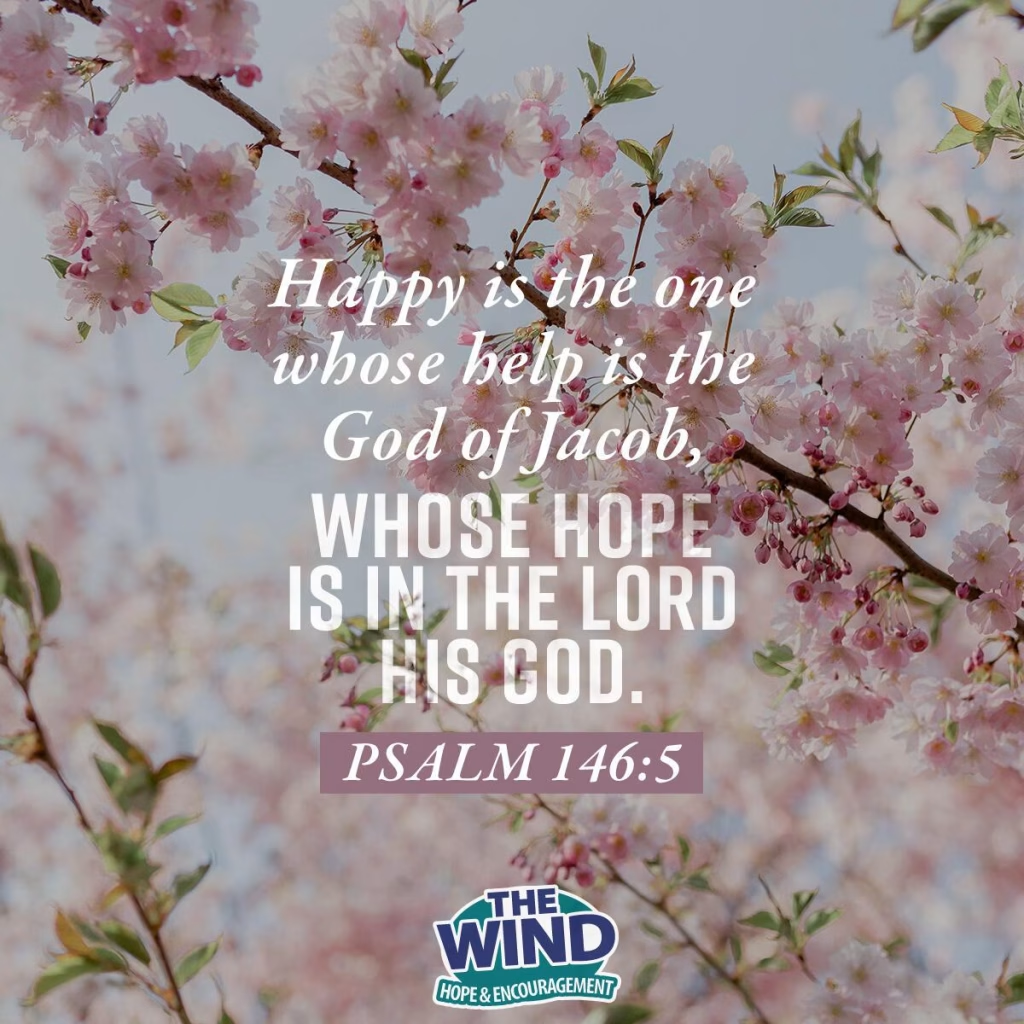
Psalm 146:5 NKJV
Happy is he who has the God of Jacob for his help,
Whose hope is in the Lord his God,
The God of Jacob: A Source of True Happiness

MY NOTES
Happy is he who has the God of Jacob for his help, Whose hope is in the LORD his God. Psalm 146:5 (NKJV)
There’s a beautiful simplicity in this verse—yet a depth that keeps unfolding the longer you sit with it. “Happy is he…” The psalmist isn’t talking about surface-level happiness, the kind that rises and falls with circumstances. He’s talking about a deep, anchored joy that comes from knowing who your help is.
Not what your help is.
Not where your help comes from.
But who.
Notice who the psalmist points us to: the God of Jacob.
Why Jacob? Because Jacob’s story is messy, complicated, full of wrestling, weakness, fear, and grace. The God of Jacob is the God who stays with His people through every twist and turn. The God who wrestles with them, blesses them, carries them, and keeps covenant with them even when they falter.
To say “the God of Jacob” is to say:
- The God who met Jacob in his fear.
- The God who redeemed him from all evil.
- The God who led his children through the wilderness.
- The God who never breaks His promises.
True happiness isn’t the absence of trouble; it’s the presence of God as your present help and future hope.
And the psalmist says that the one who has this God for his help is happy—truly blessed, deeply secure, steady in hope. Not because life is easy, but because God is faithful. Right now, in the midst of daily infirmities, heavy temptations, and practical needs, the Lord steps into your situation. He provides the grace you need for today and helps you navigate every spiritual and physical obstacle.
And then the psalmist adds:
“Whose hope is in the LORD his God.”
Hope is the forward-looking side of faith. It’s trust stretched into the future. It’s confidence that God will be just as faithful tomorrow as He was yesterday. Your expectations for the future aren’t tied to the shifting sands of this world, but to Immanuel—God with us. In Jesus Christ, our hope is anchored in a living Savior who never dies, whose merciful plans endure throughout all generations.
This hope is not vague optimism. It’s not “I hope things work out.” It’s hope rooted in Immanuel—God with us, Christ, the One who is our salvation, righteousness, and eternal life.
Happy is the one whose hope rests entirely on Him.
Happy when others despair.
Happy when circumstances shake.
Happy even in the hour of trouble, because God is both present help and eternal hope.
When you know that the eternal God is actively holding your present and securely guarding your future, you experience a joy that Spurgeon described as “beyond description, beyond comparison, beyond conception.” You don’t have to wait for your circumstances to become perfect to be blessed—you are already blessed because your God never changes, never fails, and never lets go.
Prayer
Abba, thank You for being the God of Jacob—the God who helps, carries, redeems, and stays faithful through every season. Teach me to rest my hope fully in You. When I am tempted to rely on myself or fear the future, remind me that my help comes from the Maker of heaven and earth. Fill my heart with the deep happiness that comes from trusting You. Let my hope be steady, my faith be strong, and my joy be rooted in Your unchanging love. In Jesus, my Help and my Hope, I pray. Amen.
Key Takeaways
- True happiness is rooted in God — Not in circumstances, but in the character of the God who helps us.
- The God of Jacob is our God — Faithful, covenant-keeping, patient with our weaknesses.
- Hope is confidence in God’s future faithfulness — It looks forward with trust, not fear.
- Christ is our help and hope — He is both the giver and the object of our hope.
- Blessing comes from dependence — The happiest people are those who lean fully on God.
Cross References (NKJV)
Jeremiah 17:7–8
“Blessed is the man who trusts in the Lord, And whose hope is the Lord. For he shall be like a tree planted by the waters, Which spreads out its roots by the river, And will not fear when heat comes; But its leaf will be green, And will not be anxious in the year of drought, Nor will cease from yielding fruit.”
Genesis 48:15–16
“And he blessed Joseph, and said: ‘God, before whom my fathers Abraham and Isaac walked, The God who has fed me all my life long to this day, The Angel who has redeemed me from all evil, Bless the lads; Let my name be named upon them, And the name of my fathers Abraham and Isaac; And let them grow into a multitude in the midst of the earth.’”
Psalm 33:20–22
“Our soul waits for the Lord; He is our help and our shield. For our heart shall rejoice in Him, Because we have trusted in His holy name. Let Your mercy, O Lord, be upon us, Just as we hope in You.”
Romans 15:13
“Now may the God of hope fill you with all joy and peace in believing, that you may abound in hope by the power of the Holy Spirit.”
Things to Think About
Identifying False Helps: In what areas of life are you most tempted to place your trust in human solutions rather than leaning on the God of Jacob?
Recognizing Past Mercies: Look back at a time when you felt weak or tested. How did God prove Himself to be your helper, just as He did for Jacob?
Cultivating Daily Hope: What practical step can you take today to shift your focus away from changing circumstances and onto the eternal promises of Christ?
Proverb for Today
Do not exalt yourself in the presence of the king, And do not stand in the place of the great; For it is better that he say to you, “Come up here,” Than that you should be put lower in the presence of the prince, Whom your eyes have seen. Proverbs 25:6-7 NKJV
Daily Scripture
But blessed are your eyes for they see, and your ears for they hear; for assuredly, I say to you that many prophets and righteous men desired to see what you see, and did not see it, and to hear what you hear, and did not hear it. Matthew 13:16-17 NKJV
Closing
“The Lord bless you and keep you; The Lord make His face shine upon you, And be gracious to you; The Lord lift up His countenance upon you, And give you peace.” Numbers 6:24-26 NKJV
Grace be with you. Amen.
Please enter your email and click subscribe to be notified whenever I submit a new post.

Summary of Commentaries:
These commentaries highlight the joy of trusting in Yahweh, the covenant-keeping “God of Jacob,” rather than unreliable human power. Scholars stress that true, lasting happiness comes from anchoring both present needs and eternal hopes in God. By choosing Him personally, believers receive complete security, grace, and spiritual help throughout life’s trials. Ultimately, commentator insights connect this unshakable hope directly to faith in the Messiah, Jesus Christ, who perfectly fulfills God’s promises to His people.
Commentaries:
Charles Spurgeon
“Happy is he that hath the God of Jacob for his help.” Heaped up is his happiness. He has happiness indeed: the true and the real delight is with him. The God of Jacob is the God of the covenant, the God of wrestling prayer, the God of the tried believer; he is the only living and true God. The God of Jacob is Jehovah, who appeared unto Moses, and led the tribes of Jacob out of Egypt, and through the wilderness. Those are happy who trust him, for they shall never be ashamed or confounded. The Lord never dies, neither do his thoughts perish: his purpose of mercy, like himself, endures throughout all generations. Hallelujah!
“Whose hope is in the LORD his God.” He is happy in help for the present and in hope for the future, who has placed all his confidence in Jehovah, who is his God by a covenant of salt. Happy is he when others are despairing! Happiest shall he be in that very hour when others are discovering the depths of agony. We have here a statement which we have personally tried and proved: resting in the Lord, we know a happiness which is beyond description, beyond comparison, beyond conception. O how blessed a thing it is to know that God is our present help, and our eternal hope. Full assurance is more than heaven in the bud; the flower has begun to open. We would not exchange with Caesar; his scepter is a bauble, but our bliss is true treasure.
In each of the two titles here given, namely, “the God of Jacob,” and “Jehovah his God,” there is a peculiar sweetness. Either one of them has a fountain of joy in it; but the first will not cheer us without the second. Unless Jehovah be his God no man can find confidence in the fact that he was Jacob’s God. But when by faith we know the Lord to be ours, then we are “rich to all the intents of bliss.”
______________________________________________________
Enduring Word
Happy is he who has the God of Jacob for his help: Princes among men often fail, but God never disappoints the one who hopes in Him. (Guzik)
i. The psalmist has abruptly transitioned from negative to positive. “His negative teaching, if it stood alone, would be a gospel of despair, the reduction of life to a torturing cheat; but taken as the prelude to the revelation of One whom it is safe to trust, there is nothing sad in it.” (Maclaren)
ii. “We have here a statement which we have personally tried and proved: resting in the Lord, we know a happiness which is beyond description, beyond comparison, beyond conception.” (Spurgeon)
iii. Whose hope is in the LORD his God: “We never praise God better than by exercising faith in him! Quiet trust is among the sweetest music that reaches the heart of God; and when we put our trust in man, we rob God of his glory; we are giving to others the confidence which belongs alone to him.” (Spurgeon)
______________________________________________________
Albert Barnes
Happy is he that hath the God of Jacob for his help — Who may rely for protection on the God who defended Jacob in his travels and dangers. Or, perhaps the word Jacob is used here collectively to denote Israel – the Jewish people: the God whom they adore and worship, rather than the gods of the pagan. Compare Psalms 144:15, note; Psalms 54:4, note.
Whose hope is in the Lord his God — In Yahweh, worshipped as his God. That is, who truly worships Yahweh, or makes Yahweh his God.
______________________________________________________
Calvin’s Commentary
Blessed is he, etc. As it would not have been enough to reprove the sin, he submits the remedy upon which the proper correction of it depends; and this is, that the hopes of men are only stable and well-founded when they rest entirely upon God. For even the wicked sometimes come the length of acknowledging the folly of trust in man. Accordingly they are often angry with themselves for being so inconsiderate as to expect deliverance from men; but by neglecting the remedy, they are not extricated from their error. The Psalmist having condemned the infatuation, which we have seen to be natural to us all, wisely subjoins that they are blessed who trust in God. Jeremiah observes the same order. (Jeremiah 17:5.)
“Cursed is he that trusteth in man, and maketh flesh his arm,” etc.;
and then — “Blessed is the man whose hope the Lord is.” When David pronounces those blessed whose help is the Lord, he does not restrict the happiness of believers to present sense, as if they were only happy when God openly and in outward acts appeared as their helper, but he places their happiness in this — that they are truly persuaded of its being entirely by the grace of God they stand. He calls him the God of Jacob, to distinguish him from the multitude of false gods in which unbelievers gloried at that time; and there was good reason for this; for while all propose to themselves to seek God, few take the right way. In designating the true God by his proper mark, he intimates that it is only by an assured faith of adoption that any of us can rest upon him; for he must show himself favorable to us before we can look for help from him.
______________________________________________________
John Gill
Happy [is he] that [hath] the God of Jacob for his help,…. The God of the patriarch Jacob, the Messiah, who is that God that fed him all his life, the Angel that redeemed him from all evil, with whom in the form of a man he wrestled, when he had power over God, and saw him face to face; the God of the posterity of Jacob, the Angel of Jehovah’s presence, who went before them by day and night in the wilderness, and saved and carried them all the days of old; the God of spiritual Jacob, or Israel, the church of the chosen, redeemed, and called ones; the God of every Israelite indeed, of every true believer, as he was Thomas’s Lord and God: now happy is that man that has him for his help, who helps his servant Israel, all his people out of the sad estate of sin and misery into which they are brought; helps them to all the blessings of grace, and to all the supplies of it in their time of need; helps them under all their infirmities, temptations, and afflictions; helps them in all their way to heaven, and against every enemy of their souls; and at last helps them to everlasting glory and happiness;
whose hope [is] in the Lord his God; in Immanuel, God with us, God manifest in the flesh; Christ the hope of Israel, and the Savior thereof; who is our hope, and in all his people the hope of glory; not only the author and giver of the grace of hope, but the object, ground, and foundation of it: now happy is that man whose hope alone is in him; who hopes for salvation, pardon, righteousness, and eternal life, through him, and him only; such are safe and secure, who, as prisoners of hope, turn to him their strong hold; those shall want no good thing that hope and trust in him; they have peace now through his blood and righteousness, and shall be saved with an everlasting salvation; see Jeremiah 17:7.
______________________________________________________
Matthew Henry
The psalmist, having cautioned us not to trust in princes (because, if we do, we shall be miserably disappointed), here encourages us to put our confidence in God, because, if we do so, we shall be happily secured: Happy is he that has the God of Jacob for his help, that has an interest in his attributes and promises, and has them engaged for him, and whose hope is in the Lord his God.
Let us take a view of the character here given of those whom God will uphold. Those shall have God for their help,
1. Who take him for their God, and serve and worship him accordingly.
2. Who have their hope in him, and live a life of dependence upon him, who have good thoughts of him, and encourage themselves in him, when all other supports fail. Every believer may look upon him as the God of Jacob, of the church in general, and therefore may expect relief from him, in reference to public distresses, and as his God in particular, and therefore may depend upon him in all personal wants and straits. We must hope,
(1.) In the providence of God for all the good things we need, which relate to the life that now is.
(2.) In the grace of Christ for all the good things which relate to the life that is to come. To this especially the learned Dr. Hammond refers this and the following verses, looking upon the latter part of this psalm to have a most visible remarkable aspect towards the eternal Son of God in his incarnation. He quotes one of the rabbis, who says of v. 10 that it belongs to the days of the Messiah. And that it does so he thinks will appear by comparing v. 7, 8, with the characters Christ gives of the Messiah (Mt. 11:5, 6), The blind receive their sight, the lame walk; and the closing words there, Blessed is he whosoever shall not be offended in me, he thinks may very well be supposed to refer to v. 5. Happy is the man that hopes in the Lord his God, and who is not offended in him.
- Exploring the Beauty of Psalms: Insights and Commentaries
- Monthly Breakdown of Our Blog Content
- Psalms Commentary: Faith and Inspiration
Leave a Reply