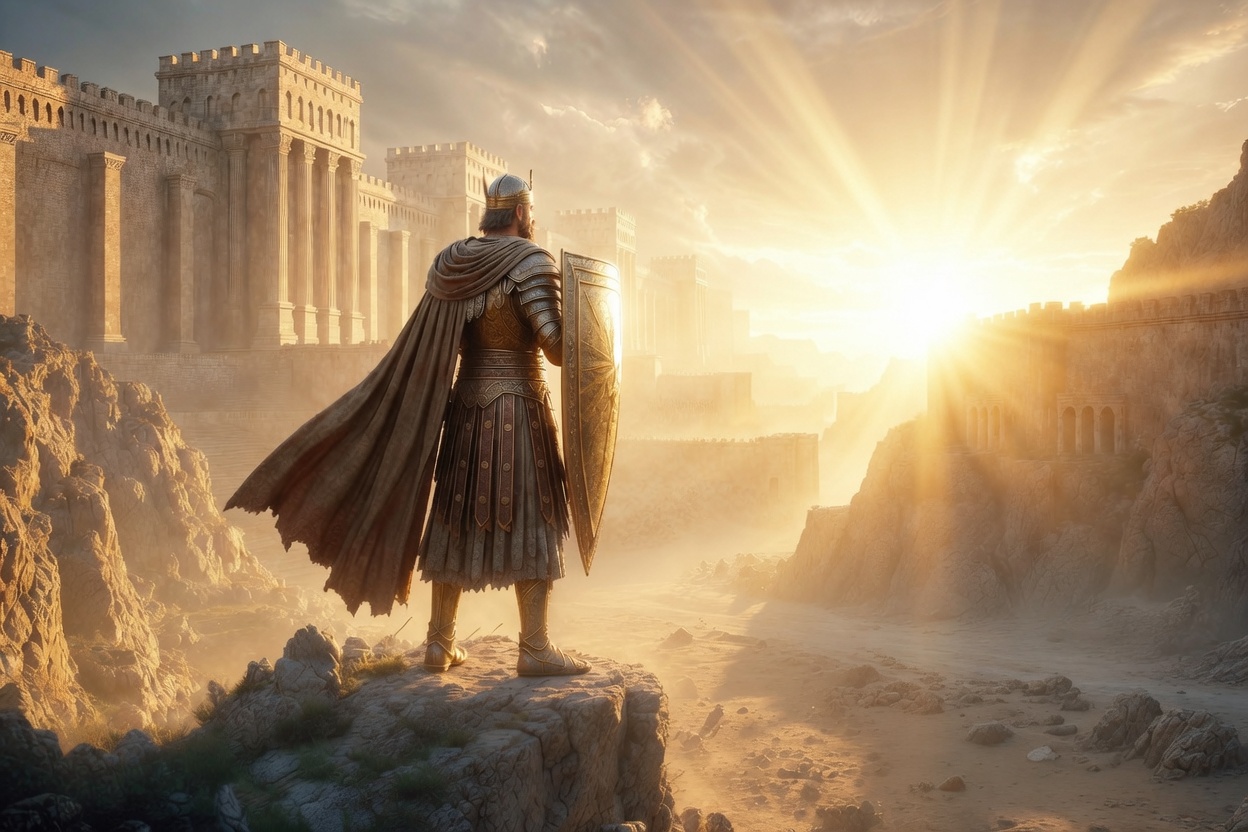
Psalm 144:2 NKJV
My lovingkindness and my fortress,
My high tower and my deliverer,
My shield and the One in whom I take refuge,
Who subdues my people under me.
More Than a Fortress

MY NOTES
When life feels like a constant battle, it is easy to view God simply through the lens of a utility—a cosmic vending machine we turn to only when we need a quick rescue. But when King David sat down to pen Psalm 144, he didn’t just look at what God could do; he looked intensely at who God is. In this single, breathtaking verse, David stacks title upon title, building a fortress of words to describe his relationship with the Almighty.
Look closely at how this verse begins. Before David calls God a fortress, a tower, or a shield, he calls Him “My lovingkindness.” The original Hebrew word here is Hesed—the beautiful, untranslatable word for God’s loyal, covenant-keeping love, mercy, and unfailing goodness.
It is incredibly profound that David starts here. He doesn’t begin with tactical defense; he begins with intimacy. He recognizes that God is not just good, but goodness itself. We have no inherent goodness of our own to plead, yet the Lord wraps us in His. It is only because of His foundational Hesed that He chooses to be any of these other defensive structures for us. Love is the bedrock of our safety.
From that baseline of love, David uses five distinct military metaphors to describe how God surrounds him:
- My Fortress: A place prepared for a siege. When the enemy tries to starve you out through isolation or wear you down through financial, emotional, or physical trials, you are enclosed behind impregnable ramparts. Inside this fortress, the storehouses are full, and the living water never runs dry.
- My High Tower: This is about perspective and safety. A high tower lifts you far above the chaos of the battlefield. Up here, you are completely out of the enemy’s bowshot and beyond the reach of their scaling ladders. From this elevated vantage point of faith, you can look down calmly at the threats that once terrified you.
- My Deliverer: The original language carries an emphatic note: “my deliverer to me.” He is a personal savior who is always close at hand, actively stepping onto the field to raise the siege, rout the foe, and rescue you when you are cornered.
- My Shield: A fortress protects you when you are at home, but a shield protects you when you are out in the open field of battle. Wherever you go today, you carry His active protection with you, deflecting the fiery, malignant darts of doubt and accusation.
- The One in whom I take refuge: The ultimate resting place for an exhausted soul.
Finally, David notes that God is the one “Who subdues my people under me.” David was a king, yet he knew he couldn’t command loyalty or maintain peace by his own charisma or political maneuvering. He knew that any influence, authority, or peace in his realm was a gift from God. For us, this is a beautiful picture of Jesus, our true King, who subdues our rebellious hearts with His grace, making us willing followers in the day of His power.
No matter what angle the enemy chooses to attack you from today, look up. You are completely surrounded by the King of kings. He is your home, your armor, your perspective, and your deep, unwavering love.
Prayer of Trust
Abba, You are my goodness and my mercy. I praise You because You don’t just offer me shelter; You invite me into Your very character. Thank You for being my covenant love when I feel unlovable, and my immovable fortress when the world around me feels unstable. I run into Your High Tower today, asking for Your perspective on the trials that are currently pressing against me. Be my shield in the open field of my workplace, my home, and my community. Deflect the lies, the anxieties, and the arrows of the enemy. I confess that I cannot manage my life, my relationships, or my stressors in my own strength, so I ask You to bring peace to the chaos and subdue the storms around me. I choose to rest, hide, and take total refuge in You today. In the saving name of Jesus, Amen.
Cross References (NKJV)
Psalm 59:10
“The God of my mercy shall come to meet me; God shall let me see my desire on my enemies.”
Proverbs 18:10
“The name of the Lord is a strong tower; The righteous run into it and are safe.”
1 Peter 1:5
“…who are kept by the power of God through faith for salvation ready to be revealed in the last time.”
Ephesians 6:16
“…above all, taking the shield of faith with which you will be able to quench all the fiery darts of the wicked one.”
Key Takeaways
- Love Comes First: Before God is our defense, He is our Hesed—our covenant love and mercy. Every protection we experience flows directly out of His deep affection for us.
- Total Coverage: God is both our stationary defense (Fortress and High Tower) when we need to hide, and our mobile defense (Shield and Deliverer) when we are moving through the world.
- An Elevated Perspective: Running into the “High Tower” of God’s presence changes how we see our problems, placing us safely out of reach of the enemy’s arrows.
- Sovereignty Over Circumstances: Just as God subdued the people under David, He is sovereign over the chaos, dynamics, and relationships in our lives. We can trust Him to align what we cannot control.
Things to Think About:
- Reflect on Hesed: What does it mean to you personally that God identifies Himself as your “goodness” and “lovingkindness” before listing His roles as a defender? How does this change the way you approach Him in prayer?
- Identify your current hiding place: When anxiety or trouble strikes, what is your instinctive “fortress” or “refuge” (e.g., control, distraction, isolation)?
- Who: Which specific title do you need to rely on most today? Do you need Him as a high tower to get a better perspective, a fortress to rest in, or a shield to protect you as you step into a difficult environment?
- Survey the battlefield: Where do you currently feel exposed to the “fiery darts” of the enemy?
Proverb for Today
My son, give me your heart, And let your eyes observe my ways. Proverbs 23:26 NKJV
Daily Scripture
He who dwells in the secret place of the Most High Shall abide under the shadow of the Almighty. I will say of the Lord, “He is my refuge and my fortress; My God, in Him I will trust.” Psalm 91:1-2 NKJV
Closing
“The Lord bless you and keep you; The Lord make His face shine upon you, And be gracious to you; The Lord lift up His countenance upon you, And give you peace.” Numbers 6:24-26 NKJV
Grace be with you. Amen.
Please enter your email and click subscribe to be notified whenever I submit a new post.

Summary of Commentaries:
In the commentaries below, David passionately piles up military titles for God—calling Him his fortress, high tower, deliverer, and shield. But notice how he remarkably begins with “my lovingkindness” or hesed. David recognizes that God’s covenant love is the ultimate foundation for every protection he enjoys. Whether needing a safe haven at home or a shield out on the battlefield, David completely trusts God to encompass his entire life and gracefully bring order to his leadership.
Commentaries:
Charles Spurgeon
Now our royal poet multiplies metaphors to extol his God. “My goodness, and my fortress.” The word for goodness signifies mercy. Whoever we may be, and wherever we may be, we need mercy such as can only be found in the infinite God. It is all of mercy that he is any of the other good things to us, so that this is a highly comprehensive title. O, how truly has the Lord been mercy to many of us in a thousand ways! He is goodness itself, and he has been unbounded goodness to us. We have no goodness of our own, but the Lord has become goodness to us. So is he himself also our fortress and safe abode: in him we dwell as behind impregnable ramparts and immovable bastions. We cannot be driven out, or starved out; for our fortress is prepared for a siege; it is stored with an abundance of food, and a well of living water is within it. Kings usually think much of their fenced cities, but King David relies upon his God, who is more to him than fortresses could have been.
“My high tower, and my deliverer.” As from a lofty watch-tower, the believer, trusting in the Lord, looks down upon his enemies. They cannot reach him in his elevated position; he is out of bowshot; he is beyond their scaling ladders; he dwells on high. Nor is this all; for Jehovah is our Deliverer as well as our Defender. These different figures set forth the varied benefits which come to us from our Lord. He is every good thing which we can need for this world or the next. He not only places us out of harm’s way full often, but when we must be exposed, he comes to our rescue, he raises the siege, routs the foe, and sets us in joyous liberty.
“My shield, and he in whom I trust.” When the warrior rushes on his adversary, he bears his target upon his arm, and thrusts death aside; thus doth the believer oppose the Lord to the blows of the enemy, and finds himself secure from harm. For this and a thousand other reasons, our trust rests in our God for everything; he never fails us, and we feel boundless confidence in him.
“Who subdueth my people under me.” He keeps my natural subjects subject, and my conquered subjects peaceful under my sway. Men who rule others should thank God if they succeed in the task. Such strange creatures are human beings, that if a number of them are kept in peaceful association under the leadership of any one of the Lord’s servants, he is bound to bless God every day for the wonderful fact. The victories of peace are as much worthy of joyful gratitude as the victories of war. Leaders in the Christian church cannot maintain their position except as the Lord preserves to them the mighty influence which ensures obedience and evokes enthusiastic loyalty. For every particle of influence for good which we may possess, let us magnify the name of the Lord.
Thus has David blessed Jehovah for blessing him. How many times he has appropriated the Lord by that little word My! Each time he grasps the Lord, he adores and blesses him; for the one word Blessed runs through all the passage like a golden thread. He began by acknowledging that his strength for fighting foreign enemies was of the Lord, and he concluded by ascribing his domestic peace to the same source. All round as a king, he saw himself to be surrounded by the King of kings, to whom he bowed in lowly homage, doing suit and service on bent knee, with grateful heart admitting that he owed everything to the Rock of his salvation.
______________________________________________________
Enduring Word
My lovingkindness and my fortress, my high tower and my deliverer: David poured out names and titles for God, each representing some aspect of God’s character or help that had been of use in battle. David knew God’s help and presence in many ways, not just one or two. (Guzik)
i. Of all the names and titles, we note that David began with my lovingkindness (hesed, the great word for God’s loyal and covenant love). He loved and valued God for being his fortress, his high tower, his deliverer, his shield, his refuge, and his conquering victory. Yet first among all those was the gift from God of love, mercy, and faithfulness. (Guzik)
ii. “In Psalm 144, David is extremely personal as he confesses who he had found God to be. He says ‘my Rock,’ ‘my loving God,’ ‘my fortress,’ ‘my stronghold,’ ‘my deliverer,’ and ‘my shield’.” (Boice)
Who subdues my people under me: David likely wrote this after he was received as king over all the tribes of Israel (2 Samuel 5:1-5). If this psalm comes from an earlier period, he may have meant the subduing of the mighty men under his authority (as in 1 Samuel 22:1-2). (Guzik)
i. “Men who rule others should thank God if they succeed in the task. Such strange creatures are human beings, that if a number of them are kept in peaceful association under the leadership of any one of the Lord’s servants, he is bound to bless God every day for the wonderful fact.” (Spurgeon)
______________________________________________________
Albert Barnes
My goodness – Margin, “my mercy.” That is, He shows me mercy or favor. All the favors that I receive come from him.
And my fortress; my high tower, and my deliverer – See the notes at Psalms 18:2, where the same words occur.
My shield – The same word which in Psalms 18:2 is rendered “buckler.” See the notes at that passage.
And he in whom I trust – The same idea as in Psalms 18:2. The tense of the verb only is varied.
Who subdueth my people under me – See the notes at Psalms 18:47. The language is slightly different, but the idea is the same. It is to be remarked that
David “here” refers to his people – “who subdueth my people,” meaning that those over whom God had placed him had been made submissive by the divine power.
______________________________________________________
John Gill
My goodness,…. Not only good, but goodness itself; the donor of all the blessings of goodness to him; the author of all goodness in him; the provider of all goodness for him, laid up to be used hereafter. The Septuagint and Vulgate Latin versions render it my mercy, properly enough; that is, the God of “my mercy,” as in Psalm 59:10, who is all mercy, full of mercy, rich and plenteous in it; which is abundant, and from everlasting to everlasting. Or, “my grace”; the God of all grace, the giver of every grace, and who is able to make all grace to abound; and from whom every blessing of grace, and every particular grace, as faith, hope, and love, and all the supplies of grace, as well as every good and perfect gift, come: Christ is presented with all the blessings of goodness; in him all fulness of grace dwells, and with him God keeps his mercy for evermore;
and my fortress; garrison or strong hold: what fortresses or fortifications are to cities, whether natural or artificial, that is God to his people; all his perfections are on their side; and particularly they are kept by his power, as in a garrison, through faith unto salvation, 1 Peter 1:5;
my high tower: the name of the Lord, which is himself, is a strong tower, where his righteous ones that flee to him are safe; and is an “high” one, where they are out of the reach of all their enemies, Proverbs 18:10;
and my deliverer; that delivered him from his temporal enemies; and from his spiritual ones, from sin, Satan, and the world; from all afflictions and temptations, from wrath and ruin, death and hell;
my shield; that protected him from all evil and danger; whose favor encompassed him as a shield; whose salvation was a shield to him; and more particularly the person, blood, righteousness, and sacrifice of his Son, called the shield of faith, Ephesians 6:16;
and [he] in whom I trust; not in men, no, not in princes; but in the Lord only; in his Word, as the Targum; for things temporal and spiritual; for the blessings of grace here, and glory hereafter; of these several titles, see more on Psalm 18:2;
who subdueth my people under me; the people of Israel, all the tribes; whose hearts the Lord inclined to make him king over them all, 2 Samuel 5:1. Or, “the people”; so the Targum, Syriac, and Arabic versions; the Heathen people, the Philistines, Ammonites, Edomites, Moabites, and Syrians; see 2 Samuel 8:1. The former reading seems best, and is followed by the Septuagint, Vulgate Latin, and other versions: and this may be typical of the subduing of Christ’s people under him; who are made willing, in the day of his power, to receive and own him as their King; profess subjection to his Gospel, and submit to his ordinances.
______________________________________________________
Matthew Henry
(1.) “He is my strength, on whom I stay, and from whom I have power both for my work and for my warfare, my rock to build on, to take shelter in.” Even when we are weak we may be strong in the Lord and in the power of his might.
(2.) “My goodness, not only good to me, but my chief good, in whose favor I place my felicity, and who is the author of all the goodness that is in me, and from whom comes every good and perfect gift.”
(3.) “My fortress, and my high tower, in whom I think myself as safe as ever any prince thought himself in a castle or strong-hold.” David had formerly sheltered himself in strongholds at En-gedi (1 Sa. 23:29), which perhaps were natural fastnesses. He had lately made himself master of the strong-hold of Zion, which was fortified by art, and he dwelt in the fort (2 Sa. 5:7, 9), but he depends not on these. “Lord,” says he, “thou art my fortress and my high tower.” The divine attributes and promises are fortifications to a believer, far exceeding those either of nature or art.
(4.) My deliverer, and, as it is in the original, very emphatically, my deliverer to me, “not only a deliverer I have interest in, but who is always nigh unto me and makes all my deliverances turn to my real benefit.”
(5.) “My shield, to guard me against all the malignant darts that my enemies let fly at me, not only my fortress at home, but my shield abroad in the field of battle.” Wherever a believer goes, he carries his protection along with him. Fear not, Abram, I am thy shield.
______________________________________________________
Miscellaneous Comments
“My fortress,” David calls God by names connected with the chief deliverances of his life. The psalms abound in local references and descriptive expressions, e.g., Psa 18:2 (and in this place). The word translated “fortress” is metzudah or masada. From 1Sa 23:29, I have no doubt that he is speaking of Masada, an isolated peak 1,500 feet high, on which was a stronghold.
—James Wareing Bardsley, in “Glimpses through the Veil,” 1883.

- Exploring the Beauty of Psalms: Insights and Commentaries
- Monthly Breakdown of Our Blog Content
- Psalms Commentary: Faith and Inspiration


Leave a Reply