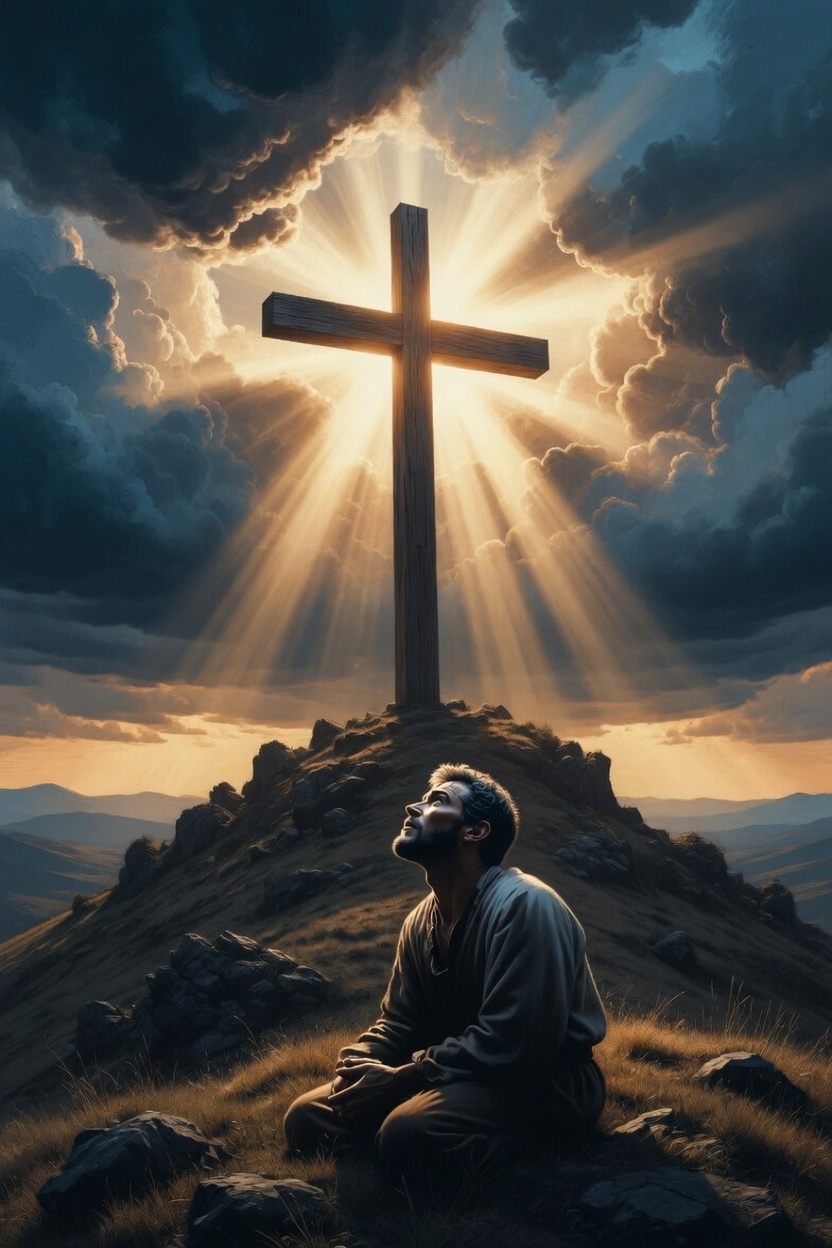
Psalm 141:8 NKJV
But my eyes are upon You, O God the Lord;
In You I take refuge;
Do not leave my soul destitute.
Finding Peace in the Wreckage

“But my eyes are upon You, O God the Lord; In You I take refuge; Do not leave my soul destitute.” Psalm 141:8 (NKJV)
MY NOTES
Ever had one of those days where everything around you feels like a total wreck? You look to the left, and there’s stress. You look to the right, and there’s a pile of problems waiting for you. It’s in these exact moments that our natural instinct is to scramble. We look for exits, we look for people to fix it, or we look inward and try to muscle our way through.
It is one thing to praise God when the horizon is clear; it is an entirely different thing to look up when the ground beneath you is littered with the wreckage of your circumstances. When David penned this psalm, he wasn’t sitting on a comfortable throne. He was likely running for his life, hid in dark caves, surrounded by the literal and figurative “bones” of a broken situation. His friends were dropping hints that maybe it was time to take matters into his own hands—maybe a little dishonorable shortcut or a stealthy, treacherous act could fix things.
But David refuses the bait. He bypasses the easy exit and makes a massive, intentional pivot: “But my eyes are upon You.”
That tiny word—but—is the hinge upon which David’s survival turns. He doesn’t close his eyes in flat-out despair, pretending the danger isn’t real. He doesn’t fixate on the armies marching against him, nor does he stare at his own meager defenses. He lifts his gaze higher. He looks past the external providences of the moment and anchors his eyes on the person and promise of Jehovah Adonai—the Sovereign Lord.
When you look at your own life right now, what is consuming your view? Is it the unpaid bills, the fractured relationship, or the heavy cloud of an uncertain tomorrow? It is incredibly easy to let our eyes get trapped by what is broken. But like David, we are invited to a dynamic, loving confidence. To have our eyes on God means to look to Him for everything—for the physical bread we need today, and the quiet grace required to keep from losing our minds tomorrow.
David goes on to say, “In You I take refuge.” The Hebrew word used here is chasah, which means to flee for shelter, to hide under the shadow of a wing. David didn’t just trust in God’s attributes or memorize His promises as a cold, intellectual exercise; he trusted in God Himself. He didn’t find shelter in his military strategy or his own cleverness. He ran straight into the person of God and pulled the door shut behind him. Think of it like running into a sturdy fortress during a violent thunderstorm. You don’t just stand outside and admire the architecture; you go inside where it’s safe.
When the temptation comes to take a shortcut, to use underhanded methods to get ahead, or to compromise your integrity just to escape a hard situation, taking refuge in God keeps you anchored. It means saying, “I’d rather be stuck in this storm with God than build my own fake shelter out of compromise.”
To be broke in your bank account is rough. To be abandoned by friends hurts deeply. But to be destitute in your soul? That’s an entirely different level of empty. David’s deepest fear wasn’t losing his physical life; it was losing the felt presence and grace of God.
The beautiful truth we get to cling to is that God has already answered this plea with a resounding promise. The very fact that David is able to look up and say, “My eyes are on You,” is proof that his anchor is still holding. The storm is howling, but the anchor hasn’t slipped. God hasn’t left him, and He won’t leave you. When you feel exposed, raw, and utterly poured out, remember that the Lord is not a passive spectator. He is your shield, your hiding place, and the keeper of your soul.
Prayer
Abba, it feels like there are a thousand things competing for my attention right now. My problems are loud, and my anxieties are real. But today, I am making a choice to say ‘BUT.’ But my eyes are upon You. I choose to look at Your track record, Your goodness, and Your power instead of staring at my fears. You are my safe place. I’m running to You for shelter today. Wrap Your protection around my heart and mind, and don’t let my soul feel empty or abandoned. Fill me with Your peace and remind me that You will never leave me or forsake me. I thank You for this in Jesus’ name, Amen.
Key Takeaways
- The Power of the Pivot: Faith doesn’t deny the reality of a crisis; it simply refuses to make the crisis the highest authority. We must actively turn our eyes away from our circumstances and fix them on God.
- Refuge is Person-Specific: True shelter isn’t found in a change of scenery, a better bank account, or a human ally. It is found in chasah—actively fleeing into the personal presence of the Lord.
- The Anchor Holds: Even when your prayer feels desperate (“do not leave me destitute”), the very fact that you are crying out to God proves that your faith is still anchored to the truth of who He is.
- Soul Protection Over Comfort: True safety isn’t the absence of trouble; it’s the presence of God inside the trouble.
Cross References (NKJV)
Psalm 46:1
“God is our refuge and strength, A very present help in trouble.”
Psalm 121:1–2
“I will lift up my eyes to the hills—From whence comes my help? My help comes from the Lord, Who made heaven and earth.”
Hebrews 13:5
“Let your conduct be without covetousness; be content with such things as you have. For He Himself has said, ‘I will never leave you nor forsake you.’”
Things to Think About
- What has been capturing your gaze lately?
- What does “taking refuge” look like for you today?
- Where do you feel “destitute” or empty?
Proverb for Today
Turn at my rebuke; Surely I will pour out my spirit on you; I will make my words known to you. Proverbs 1:23 NKJV
But whoever listens to me will dwell safely, And will be secure, without fear of evil.” Proverbs 1:33 NKJV
Daily Scripture
By faith Enoch was taken away so that he did not see death, “and was not found, because God had taken him”; for before he was taken he had this testimony, that he pleased God. But without faith it is impossible to please Him, for he who comes to God must believe that He is, and that He is a rewarder of those who diligently seek Him. Hebrews 11:5-6 NKJV
Closing
“The Lord bless you and keep you; The Lord make His face shine upon you, And be gracious to you; The Lord lift up His countenance upon you, And give you peace.” Numbers 6:24-26 NKJV
Grace be with you. Amen.
Please enter your email and click subscribe to be notified whenever I submit a new post.

Summary of Commentaries:
The following commentaries emphasize that in times of deep distress, David deliberately fixed his gaze on God rather than his bleak circumstances, weak forces, or temptations to compromise. Rejecting self-reliance and despair, he placed his absolute, unreserved trust directly in the Lord as his fortress. His desperate plea, “leave not my soul destitute,” reflects a profound vulnerability—a dread of spiritual abandonment—met by the enduring assurance of God’s protective, ever-present grace.
Commentaries:
Charles Spurgeon
But mine eyes are unto thee, O GOD the Lord.” He looked upward and kept his eyes fixed there. He regarded duty more than circumstances; he considered the promise rather than the external providence; and he expected from God rather than from men. He did not shut his eyes in indifference or despair, neither did he turn them to the creature in vain confidence, but he gave his eyes to his God and saw nothing to fear. Jehovah, his Lord, is also his hope. Thomas called Jesus Lord and God, and David here speaks of his God and Lord. Saints delight to dwell upon the divine names when they are adoring or appealing.
“In thee is my trust.” Not alone in thine attributes or in thy promises, but in thyself. Others might confide where they chose, but David kept to his God: in him he trusted always, only, confidently, and unreservedly.
“Leave not my soul destitute,” as it would be if the Lord did not remember and fulfill his promise. To be destitute in circumstances is bad, but to be destitute in soul is far worse; to be left of friends is a calamity, but to be left of God would be destruction. Destitute of God is destitution with a vengeance. The comfort is that God hath said, “I will never leave thee nor forsake thee.”
______________________________________________________
Enduring Word
But my eyes are upon You: Even in such a terrible condition (described in the previous lines), David deliberately set his eyes upon the Lord. Because God Himself was his refuge, David prayed do not leave my soul destitute. Without God’s protection, he was at the mercy of his wicked enemies. (Guzik)
i. But my eyes are upon You: “In all times, in all places, on all occasions, I will cleave unto the Lord, and put my whole confidence in him.” (Clarke)
ii. “That he is able to say, ‘Mine eyes are unto Thee, O God the Lord,’ is a revelation of the fact that his anchor still holds, not only against the fierce onslaught of enemies, but also against the insidious temptation to turn aside from the path of rectitude in order to escape the vindictive opposition of his enemies.” (Morgan)
iii. Remember what David said to Saul in 1 Samuel 26:19: If the LORD has stirred you up against me, let Him accept an offering. But if it is the children of men, may they be cursed before the LORD, for they have driven me out this day from sharing in the inheritance of the LORD, saying, “Go, serve other gods.” This shows that David knew that many others lied about him to Saul, hoping to slay him with their slander. It also shows that when David was a fugitive, his enemies hoped to entice him to idolatry, saying, Go, serve other gods. David would not; in the LORD alone he took refuge. (Guzik)
______________________________________________________
Albert Barnes
But mine eyes are unto thee, O God the Lord – My hope is in thee. I do not rely on my own power. I do not trust in my armed forces. I know that they are weak, dispirited, scattered – like strewed bones – like the chips and splinters lying around the place where wood is chopped. I look, therefore, solely to God. I believe that he “will” interpose; and now that my enemy has placed himself in this position, I do not need to resort to stealthful arts – to dishonorable acts – to assassination – as my friends advise, but the object will be accomplished, and I shall be placed on the throne by the act of God, and in a manner that will not subject my name and memory to reproach by a base and treacherous deed.
In thee is my trust – I rely on thee alone.
Leave not my soul destitute – My life; my all. Do not now leave me without thy gracious interposition; do not suffer this juncture to pass by without such an interposition as will end the war, and restore peace to me and to a distracted land.
______________________________________________________
John Gill
But mine eyes are unto thee, O God the Lord,…. Not only the eyes of his body, lifted up to God in prayer, this being a prayer gesture, John 11:41; but the eyes of his mind, or understanding, especially the eyes of faith and love; for it is expressive of his affection to God, his holy confidence in him, and humble hope and expectation of good things from him, in this his time of distress: his eyes were to him and him only, both for temporal food for himself and his men; and for spiritual food, for all supplies of grace, for wisdom and direction, for strength and assistance, for protection and deliverance;
in thee is my trust; not in himself, nor in his friends, nor in any creature, prince or potentate, but in the Lord, as the God of nature, providence, and grace; to which he was encouraged by his lovingkindness to him; by the everlasting strength in him; by what he had done for others and for him in times past; by the provisions he has made in his covenant and promises for those that trust in him, who are of all men most happy;
leave not my soul destitute; of daily food, of help and assistance, of the presence, spirit, and grace of God; or “naked”, and defenseless, but let it be surrounded or protected by almighty power and grace; or “pour not out my soul”, that is, unto death; suffer me not to be taken by enemies and slain; see Isaiah 53:12. The Targum is, “in the Word (of the Lord) I trust, do not empty my soul,” or “evacuate” it, as Aben Ezra; that is, out of his body; for he observes, that the soul fills the body.
______________________________________________________
Matthew Henry
David casts himself upon God, and depends upon him for deliverance: “But my eyes are unto thee (v. 8); for, when the case is ever so deplorable, thou canst redress all the grievances. From thee I expect relief, bad as things are, and in thee is my trust.” Those that have their eye towards God may have their hopes in him.
______________________________________________________
Miscellaneous Comments
“Mine eyes are unto thee, O GOD the Lord.” If you would keep your mind fixed in prayer, keep your eye fixed. Much vanity comes in at the eye. When the eyes wander in prayer, the heart wanders. To think to keep the heart fixed in prayer, and yet let the eyes gaze abroad, is as if one should think to keep his house sate, yet let the windows be open.
—Thomas Watson.
“Leave not my soul destitute.” His soul knew what it was to be “destitute;” he had known the misery of spiritual beggary and soul poverty. It was not with him as natural poverty is with the rich, a matter of speculation, a mere matter of theory, but a matter of personal and painful experience. It is in the margin, “Make not my soul bare,”…strip me not of every hope; leave me not completely naked; abandon me not to nature’s beggary and misery; let me not go down into the pit with all my sins upon my head; leave not my soul destitute of pardon and peace.
—Joseph C. Philpot.

- Exploring the Beauty of Psalms: Insights and Commentaries
- Monthly Breakdown of Our Blog Content
- Psalms Commentary: Faith and Inspiration

Leave a Reply