
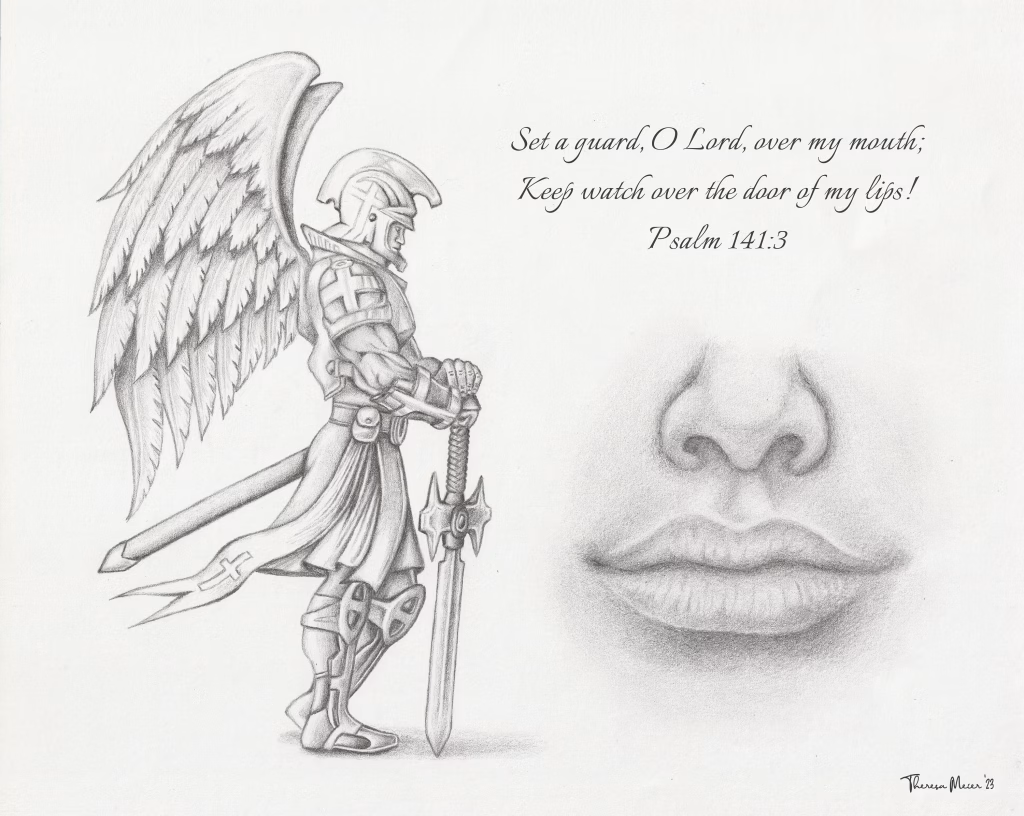
Psalm 141:3 NKJV
Set a guard, O Lord, over my mouth;
Keep watch over the door of my lips.
Taming the Tongue

My Notes
“Set a guard, O Lord, over my mouth; keep watch over the door of my lips.” Psalm 141:3 (NKJV)
There is a profound, almost uncomfortable vulnerability in realizing that the biggest threat to your testimony might not be what someone says about you, but what escapes from your own mouth.
Some days the hardest battle isn’t out there—it’s right here, behind our teeth. David knows how easily words can run ahead of wisdom, especially when enemies provoke or pressure mounts. So he prays a simple, gutsy prayer: “Set a guard… keep watch.” He’s asking God to be the doorkeeper of his mouth.
In Psalm 141:2, He’d just asked for his prayer to be like incense; now he asks that the same mouth not become a source of smoke that chokes—lies, pride, wrath, gossip. “Set a guard, O Lord, over my mouth; keep watch over the door of my lips.” Notice the humility. David doesn’t trust his own self-control. He knows even good people are prone to tongue-sins—rash replies, cutting sarcasm, half-truths, venting that wounds, subtle lies under pressure.
Your lips are like a door. Doors should open and close at the right times. Without a guard, intruders get in, and valuables get out. We need more than resolve; we need grace—divine help to open for truth, blessing, and courage, and to shut against anger, slander, and foolishness. Especially when the “wicked are before us”—when critics are listening, tempers are hot, and our words could be twisted—God’s watch at our lips becomes protection for our integrity and His honor.
Even Moses, the meekest man on earth, famously spoke unadvisedly with his lips when he was provoked by others. If Moses could slip up, we have to admit that our own willpower, filters, and New Year’s resolutions are simply not enough to tame the tongue.
Guarded mouths can still speak truth—clear, timely, gracious truth. But they don’t hand the enemy ammunition or bring reproach on God’s name. Ask God to be your doorkeeper today. Let Him post sentries—Scripture in your mind, the Spirit in your heart—so what passes through your lips carries His life, not your heat.
There is a beautiful irony here: we often find joy in being doorkeepers in the house of the Lord, yet God condescends to be the doorkeeper for us. Today, instead of trying to manage your reactions in your own strength, hand the keys of the door over to Him.
Cross References (NKJV)
- Psalm 39:1 – “I said, ‘I will guard my ways, lest I sin with my tongue; I will restrain my mouth with a bridle, while the wicked are before me.’”
- James 3:2 – “For we all stumble in many things. If anyone does not stumble in word, he is a perfect man, able also to bridle the whole body.”
- Proverbs 13:3 – “He who guards his mouth preserves his life, but he who opens wide his lips shall have destruction.”
- Ephesians 4:29 – “Let no corrupt word proceed out of your mouth, but what is good for necessary edification, that it may impart grace to the hearers.”
- Colossians 4:6 – “Let your speech always be with grace, seasoned with salt, that you may know how you ought to answer each one.”
- Proverbs 21:23 – “Whoever guards his mouth and tongue keeps his soul from troubles.”
Prayer
Abba, You are the ultimate protector of my soul, and today I ask You to protect me from myself. I confess that I am prone to speaking hastily, especially when I feel hurt, defensive, or misunderstood. Set a holy guard over my mouth today. Stand watch at the door of my lips. Do not allow any corrupt, deceitful, or prideful talk to slip through. When I am provoked, grant me the grace of restraint. When I am tempted to gossip or vent, close the door. But when there is an opportunity to encourage, speak truth, and bring healing, open my lips wide. Let the words of my mouth and the meditation of my heart be acceptable in Your sight, my Strength and my Redeemer. I ask for this in Jesus’ name, Amen.
Key Takeaways
- Human effort isn’t enough: Controlling the tongue requires supernatural grace, not just personal willpower or social filters.
- Provocation is the test: We are most vulnerable to “tongue-sins” when we are defending ourselves against perceived enemies or unfair treatment.
- Worship and words are connected: The mouth that offers the “incense” of prayer must not be defiled by destructive, idle, or foolish speech.
- God is a compassionate Doorkeeper: When we hand control over to Him, He actively garrison our hearts and minds, filtering our speech to reflect His character.
Things to Think About
- The Vulnerable Triggers: Think about the last week. In what specific situations or around which people did you find it hardest to “keep the door” of your lips closed?
- Incense vs. Poison: Is there any area of your life where your casual speech (complaining, sarcasm, gossip) is currently undermining the “incense” of your morning prayers or worship?
- The Power of Pause: What would it practically look like for you to pause and invite God to guard your mouth the next time you feel a surge of anger or defensive resentment?
- Words of Grace: Write down the name of someone in your life who desperately needs to hear a word of “necessary edification” or encouragement today. What will you choose to say to them?
- A Heart Check: Because the mouth speaks out of the overflow of the heart, what does your recent speech reveal about what is currently simmering deep inside your soul?
Proverb for Today
A fool vents all his feelings, But a wise man holds them back. Proverbs 29:11 NKJV
The fear of man brings a snare, But whoever trusts in the Lord shall be safe. Proverbs 29:25 NKJV
Daily Scripture
For this is the covenant that I will make with the house of Israel after those days, says the Lord: I will put My laws in their mind and write them on their hearts; and I will be their God, and they shall be My people. None of them shall teach his neighbor, and none his brother, saying, ‘Know the Lord,’ for all shall know Me, from the least of them to the greatest of them. For I will be merciful to their unrighteousness, and their sins and their lawless deeds I will remember no more.” Hebrews 8:10-12 NKJV
Closing
“The Lord bless you and keep you; The Lord make His face shine upon you, And be gracious to you; The Lord lift up His countenance upon you, And give you peace.” Numbers 6:24-26 NKJV
Grace be with you. Amen.
Please enter your email and click subscribe to be notified whenever I submit a new post.
Summary of Commentaries:
The commentaries that follow emphasize that human willpower is insufficient to control the tongue, especially under provocation or persecution. Because our mouths are used for prayer, allowing them to be defiled by pride, wrath, or lies dishonors God. Therefore, believers must humbly ask God to act as a holy doorkeeper. When divine grace guards our lips, it prevents rash, sinful speech, protects our personal integrity, and successfully garrisons the entire self against temptation.
Commentaries:
Charles Spurgeon
“Set a watch, O LORD, before my mouth.” That mouth had been used in prayer; it would be a pity it should ever be defiled with untruth, or pride, or wrath; yet so it will become unless carefully watched, for these intruders are ever lurking about the door. David feels that with all his own watchfulness, he may be surprised into sin, and so he begs the Lord himself to keep him. When Jehovah sets the watch, the city is well guarded: when the Lord becomes the guard of our mouth, the whole man is well garrisoned.
“Keep the door of my lips.” God has made our lips the door of the mouth, but we cannot keep that door of ourselves; therefore, do we entreat the Lord to take the rule of it. O that the Lord would both open and shut our lips, for we can do neither the one nor the other aright if left to ourselves. In times of persecution by ungodly men, we are peculiarly liable to speak hastily or evasively, and therefore we should be specially anxious to be preserved in that direction from every form of sin. How condescending is the Lord! We are ennobled by being doorkeepers for him, and yet he deigns to be a doorkeeper for us.
______________________________________________________
Enduring Word
Set a guard, O LORD, over my mouth: David didn’t want the same mouth that prayed as if it were incense to be used for lies or any evil thing. He asked God to keep watch over the door of my lips, so that he would not say evil or foolish things. (Guzik)
i. Keep watch over the door of my lips: “That it move not creaking, and complaining, as on rusty hinges, for want of the oil of joy and gladness.” (Trapp)
ii. “If the house of God needed its guards and doorkeepers, how much more the man of God!” (Kidner)
iii. “Nature having made my lips to be a door to my words, let grace keep that door, that no word may be suffered to go out which may any way tend to the dishonor of God, or the hurt of others.” (Henry, cited in Spurgeon)
______________________________________________________
Albert Barnes
Set a watch, O Lord, before my mouth – That I may not say anything rashly, unadvisedly, improperly. Compare Psalms 39:1. The prayer here is that God would guard him from the temptation to say something wrong. To this, he seems to have been prompted by the circumstances of the case and by the advice of those who were with him. See the introduction to the psalm. Compare the notes at Psalms 11:1.
Keep the door of my lips – That my lips or mouth may not open except when it is proper and right; when something good and true is to be said. Nothing can be more proper than “this” prayer; nothing more desirable than that God should keep us from saying what we ought not to say.
______________________________________________________
John Gill
Set a watch, O Lord, before my mouth,…. While praying, as Jarchi and Kimchi; that he might not utter any rash, unguarded, and unbecoming word; but take and use the words which God gives, even the taught words of the Holy Ghost; or lest, being under affliction and oppression, he should speak unadvisedly with his lips, and utter any impatient murmuring and repining word against God; or express any fretfulness at the prosperity of the wicked, or speak evil of them; especially of Saul, the Lord’s anointed, for the ill usage of him;
keep the door of my lips; which are as a door that opens and shuts: this he desires might be kept as with a bridle, especially while the wicked were before him; lest he should say anything they would use against him, and to the reproach of religion; and that no corrupt communication, or any foolish and filthy talk, or idle and unprofitable words, might proceed from them. The phrase signifies the same as the other; he was sensible of his own inability to keep a proper watch and guard over his words, as was necessary, and therefore prays the Lord to do it; see Psalm 39:1.
______________________________________________________
Matthew Henry
He prays that he might not be surprised into any sinful words (v. 3): “Set a watch, O Lord! before my mouth, and, nature having made my lips to be a door to my words, let grace keep that door, that no word may be suffered to go out which may in any way tend to the dishonor of God or the hurt of others.” Good men know the evil of tongue-sins, and how prone they are to them (when enemies are provoking we are in danger of carrying our resentment too far, and of speaking unadvisedly, as Moses did, though the meekest of men), and therefore they are earnest with God to prevent their speaking amiss, as knowing that no watchfulness or resolution of their own is sufficient for the governing of their tongues, much less of their hearts, without the special grace of God. We must keep our mouths as with a bridle, but that will not serve: we must pray to God to keep them. Nehemiah prayed to the Lord when he set a watch, and so must we, for without him the watchman walketh but in vain.
______________________________________________________
Miscellaneous Comments
“Set a watch, O LORD, before my mouth,” etc. Watching and prayer are often joined together. We are best kept when recommended into God’s hand. I do observe here:
First, that unadvised and passionate speeches do easily drop from us in our troubles, especially in our persecution.
Secondly, that a godly, conscientious man is very tender of these, as of all evil. He that would live in communion with God for the present, and hope to appear with comfort before him hereafter, is sensible of the least thing that tends to God’s displeasure, and God’s dishonor: this is the true spirit of one that will be owned by Christ at the last day.
Thirdly, there is no way to prevent being provoked to impatience and rashness of speech, or any evil, but by keeping a watch and renewing our obligations to God.
Fourthly, whoever would keep a watch must call in the aid and assistance of God’s grace; “Lord, set a watch before my mouth.”
—Thomas Manton.
Set a watch, O LORD, before my mouth,” etc. Thus, holy men have kept the sessions at home, and made their hearts the foremen of the jury, and examined themselves as we examine others. The fear of the Lord stood at the door of their souls, to examine every thought before it went in, and at the door of their lips, to examine every word before it went out, whereby they escaped a thousand sins which we commit, as though we had no other work.
—Henry Smith.

- Exploring the Beauty of Psalms: Insights and Commentaries
- Monthly Breakdown of Our Blog Content
- Psalms Commentary: Faith and Inspiration

Leave a Reply