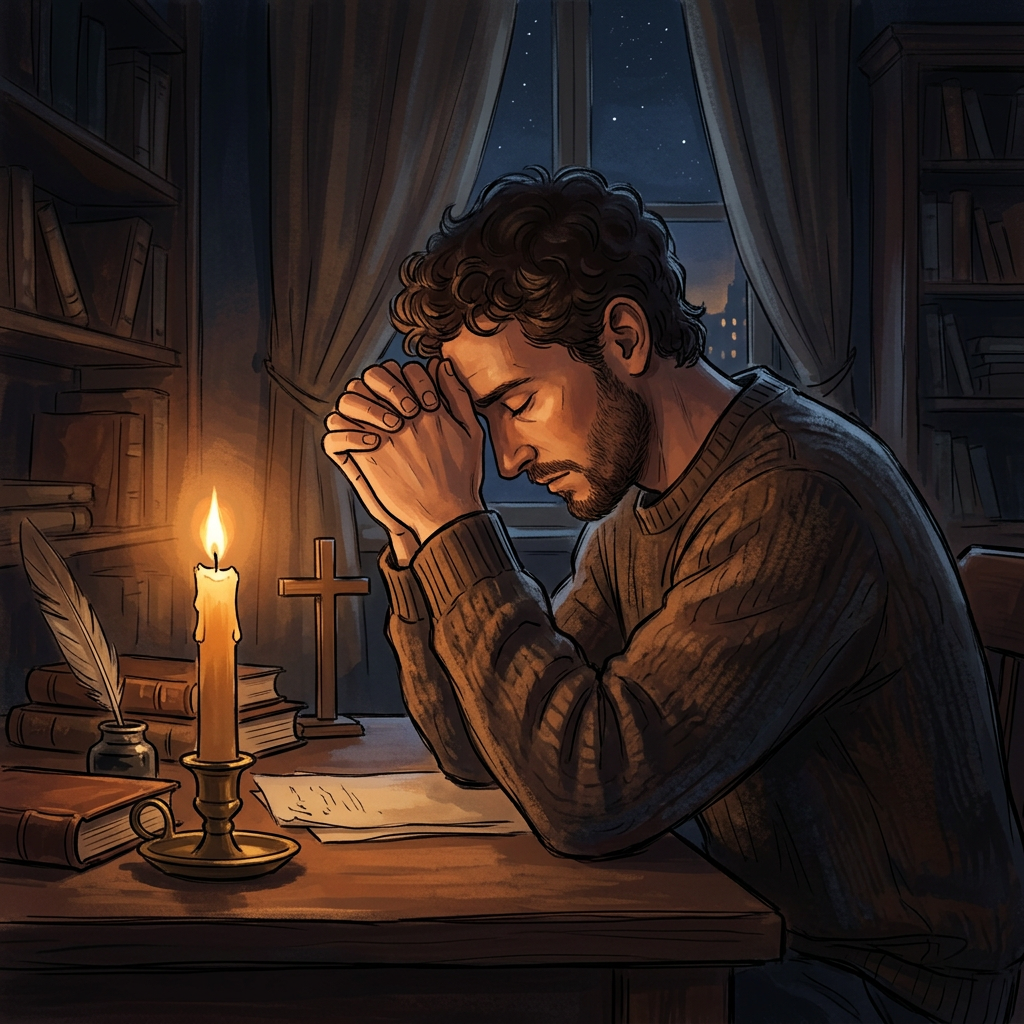
Psalm 141:2 NKJV
Let my prayer be set before You as incense,
The lifting up of my hands as the evening sacrifice.
Transforming Your Prayer into a Sweet Aroma

My Notes
“Let my prayer be set before You as incense, the lifting up of my hands as the evening sacrifice.” Psalm 141:2 (NKJV)
When David wrote Psalm 141, he was in exile. He was physically cut off from the temple, barred from the grand worship services, and unable to watch the priests perform the daily rituals. For a devout believer, this was an agonizing isolation.
Yet, sitting in the dust of his banishment, David realizes a radical truth: he doesn’t need an altar of gold to touch the heart of God. He has his breath, his heart, and his hands. He prays in verse 2: “Let my prayer be set before You as incense, the lifting up of my hands as the evening sacrifice.”
This beautiful imagery sheds light on what happens behind the scenes in the spiritual realm when you sit down to talk to God.
1. The Activation of Holy Fire
David compares his prayers to incense. In the ancient tabernacle, incense was a meticulous blend of sweet spices. But those spices sat dormant and odorless until they were touched by holy fire from the altar. Once ignited, a fragrant cloud of smoke would rise upward, filling the holy place with a pleasing aroma.
The New Testament confirms this in Revelation 5:8, noting that the prayers of the saints are stored in golden bowls of incense before the throne. Your prayers matter to God. They please Him like a fragrant perfume. However, as Matthew Henry noted, incense has no savor without fire, and prayer lacks power without the fire of holy fervor and love. True prayer isn’t about checking a box; it’s about letting the Holy Spirit ignite your heart with genuine, passionate desire.
2. Formed, Fitted, and Established
The phrase “set before You” can be translated from the original Hebrew as “directed,” “fitted,” or “made firm.” David isn’t just tossing random, half-hearted thoughts into the wind. He is presenting his requests with intention and holy reverence, aligning his heart with a deep awareness of God’s presence. He asks that his prayers wouldn’t be feeble, easily blown away, or distracted, but rather established securely before the throne.
3. The Hands of Expectation
David pairs the rising incense with “the lifting up of my hands as the evening sacrifice.” In Israel, the evening sacrifice was a time of total surrender and atonement. When David lifts his hands, he is physically acting out his spiritual surrender.
Lifting your hands in prayer is an expression of holy expectation. It’s the posture of a child reaching up to a father, or an empty vessel waiting to be filled. Charles Spurgeon beautifully remarked that there is a “hand prayer” as well as a “heart prayer.” When you lift up hands that hang down due to exhaustion or defeat, you are performing a profound act of sacrificial worship. You are telling the Lord, “I am empty, I am tired, but I am expecting You to move.”
You might feel isolated or far from a vibrant church environment today. You might feel stuck in your own personal wilderness. But remember this: the spiritual is always higher than the ceremonial. Your simple, broken prayers—offered through the ultimate mediation of Jesus Christ, our Great High Priest—are a sweet-smelling sacrifice that receives the full attention of the Lord.
Prayer
Abba, I ask that my prayer would rise before You today like sweet incense. Let the Holy Spirit kindle a fresh, holy fire inside my heart so that my requests are not cold, formal, or distracted, but fervent and full of faith. I lift up my hands to You today as an evening sacrifice. I lift up my worries, my exhaustion, and my expectations, casting them entirely onto You. Thank You, Lord Jesus, that You are my Great High Priest, making my imperfect prayers perfect and fragrant before the Father’s throne. Receive my worship today as a gift of love. In Jesus’ holy and precious name, Amen.
Cross References (NKJV)
- Exodus 30:7–8 — “Aaron shall burn on it sweet incense every morning; when he tends the lamps, he shall burn incense on it. And when Aaron lights the lamps at twilight, he shall burn incense on it, a perpetual incense before the Lord throughout your generations.”
- Malachi 1:11 — “For from the rising of the sun, even to its going down, My name shall be great among the Gentiles; In every place incense shall be offered to My name, And a pure offering; For My name shall be great among the nations,’ Says the Lord of hosts.”
- Luke 1:9–10 — “according to the custom of the priesthood, his lot fell to burn incense when he went into the temple of the Lord. And the whole multitude of the people was praying outside at the hour of incense.”
- James 5:16 — “Confess your trespasses to one another, and pray for one another, that you may be healed. The effective, fervent prayer of a righteous man avails much.”
- Hebrews 13:15 — “Therefore by Him let us continually offer the sacrifice of praise to God, that is, the fruit of our lips, giving thanks to His name.”
- Revelation 5:8 — “Now when He had taken the scroll, the four living creatures and the twenty-four elders fell down before the Lamb, each having a harp, and golden bowls full of incense, which are the prayers of the saints.”
Key Takeaways
- Prayer is Fragrant to God: Your prayers are not a bother to the Lord; they are a sweet, pleasing aroma that He delights to receive.
- The Need for Fervor: Just as incense requires fire to release its fragrance, our prayers need the warmth of earnest sincerity and Holy Spirit fire.
- Spiritual Sacrifices Outweigh Rituals: Even when you cannot participate in corporate settings, your personal, heartfelt prayer serves as a powerful spiritual altar.
- The Power of Posture: Lifting your hands or bowing your knees is a physical manifestation of an expectant heart casting all hope onto God.
Things to Think About
- When you pray, do you tend to view it as “easy work,” or do you approach it with the intentional focus of setting it forth as incense? How can you add more focus to your prayer time?
- James 5:16 notes that fervent prayer avails much. On a scale of 1 to 10, how much “holy fire” or passion is currently fueling your communication with God? What is draining that fire?
- David was cut off from the physical temple but realized his heart was an altar. Have you ever felt isolated from community or church? How does this verse encourage you to worship right where you are?
- What are your lifted hands expressing to God today? Are they expressing surrender, a plea for help, or a declaration of victory and expectation?
Proverb for Today
As in water face reflects face, So a man’s heart reveals the man. Proverbs 27:19 NKJV
Daily Scripture
For such a High Priest was fitting for us, who is holy, harmless, undefiled, separate from sinners, and has become higher than the heavens; who does not need daily, as those high priests, to offer up sacrifices, first for His own sins and then for the people’s, for this He did once for all when He offered up Himself. For the law appoints as high priests men who have weakness, but the word of the oath, which came after the law, appoints the Son who has been perfected forever. Hebrews 7:26-28 NKJV
Closing
“The Lord bless you and keep you;The Lord make His face shine upon you, And be gracious to you;The Lord lift up His countenance upon you, And give you peace.” ’ Numbers 6:24-26 NKJV
Grace be with you. Amen.
Please enter your email and click subscribe to be notified whenever I submit a new post.

Summary of Commentaries:
These commentaries emphasize that when physical exile kept David from tabernacle rituals, heartfelt prayer became his spiritual altar. To be accepted by God, prayer must be intentional, prepared, firmly established, and ignited with the fire of holy fervor. Rising upward like incense through Christ’s mediation, the physical posture of lifting expectant hands serves as a pleasing, spiritual “evening sacrifice.” Ultimately, this sincere devotion of the soul holds higher value to the Lord than any outward, ceremonial ordinance.
Commentaries:
Charles Spurgeon
“Let my prayer be set forth before thee as incense.” As incense is carefully prepared, kindled with holy fire, and devoutly presented unto God, so let my prayer be. We are not to look upon prayer as easy work requiring no thought. It needs to be “set forth;” what is more, it must be set forth “before the Lord,” by a sense of his presence and a holy reverence for his name: neither may we regard all supplication as certain of divine acceptance, it needs to be set forth before the Lord “as incense,” concerning the offering of which there were rules to be observed, otherwise it would be rejected of God.
“And the lifting up of my hands as the evening sacrifice.” Whatever form his prayer might take, his one desire was that it might be accepted of God. Prayer is sometimes presented without words by the very motions of our bodies: bent knees and lifted hands are the tokens of earnest, expectant prayer. Certainly, work, or the lifting up of the hands in labour, is prayer if it be done in dependence upon God and for his glory: there is a hand prayer as well as a heart prayer, and our desire is that this may be sweet unto the Lord as the sacrifice of even tide. Holy hope, the lifting up of hands that hang down, is also a kind of worship: may it ever be acceptable with God. The Psalmist makes a bold request: he would have his humble cries and prayers to be as much regarded of the Lord as the appointed morning and evening sacrifices of the holy place. Yet the prayer is by no means too bold, for, after all, the spiritual is in the Lord’s esteem higher than the ceremonial, and the calves of the lips are a truer sacrifice than the calves of the stall.
______________________________________________________
Enduring Word
Let my prayer be set before You as incense: David used the smoke and smell of incense as a representation of his prayer to God. His posture of prayer (the lifting up of my hands) was a gift to God, even as the evening sacrifice was a gift to God. Revelation 5:8 says that the prayers of God’s people are like incense, and Hebrews 13:15 describes praise as a sacrifice unto God.
· Prayer rises to heaven even as the smoke of incense rises upward.
· Prayer pleases God even as incense has a pleasing smell.
· Prayer needs some “fire” to be effective (James 5:16 speaks of “…the effective, fervent prayer”), and incense is activated with fire. (Guzik)
i. If David wrote this psalm while a fugitive from King Saul, then the ideas of incense and the evening sacrifice held special meaning, because he was not free to publicly go to the tabernacle and share in these acts of worship. When necessity kept him from the tabernacle, prayer would replace the offering of incense and sacrifice.
ii. “Incense was offered every morning and evening before the Lord, on the golden altar, before the veil of the sanctuary. Exodus 29:39, and Numbers 28:4.” (Clarke)
iii. Incense connected with the tabernacle and temple rituals needed to be pure and it needed to be prepared. David intended to offer pure and prepared prayers unto God. (Guzik)
iv. “The raising up of one’s hands was symbolic of dependence on and praise of the Lord.” (VanGemeren)
______________________________________________________
Albert Barnes
Let my prayer be set forth before thee – Margin, “directed.” The Hebrew word means to fit; to establish; to make firm. The psalmist desires that his prayer should not be like that which is feeble, languishing, easily dissipated, but that it should be like that which is firm and secure.
As incense – See the notes and illustrations at Luke 1:9-10. Let my prayer come before thee in such a manner as incense does when it is offered in worship; in a manner of which the ascending of incense is a suitable emblem. See the notes at Revelation 5:8; notes at Revelation 8:3.
And the lifting up of my hands – In prayer; a natural posture in that act of worship.
As the evening sacrifice – The sacrifice offered on the altar at evening. Let my prayer be as acceptable as that is when it is offered in a proper manner.
______________________________________________________
John Gill
Let my prayer be set forth before thee [as] incense,…. Which was offered every morning on the altar of incense, at which time the people were praying, Exodus 30:1; and was an emblem of it, even of pure, holy, and fervent prayer; which being offered on the altar Christ, which sanctifies every gift, and by him the High Priest; through whom every sacrifice is acceptable unto God; and through whose blood and righteousness, and the sweet incense of his mediation and intercession, it becomes fragrant and a sweet odor to the Lord; and being directed to him, it goes upwards, is regarded by him, and continues before him as sweet incense; which is what the psalmist prays for; see Malachi 1:11;
[and] the lifting up of my hands as the evening sacrifice; the burnt sacrifice of the evening, according to Ben Melech, the lamb slain every evening; or else the minchah, as the word is; the meat, or rather the bread offering made of fine flour, with oil and frankincense on it, which went along with the former, Exodus 29:38; and so the Targum, “as the sweet gift offered in the evening.” This only is mentioned, as being put for both the morning and the evening sacrifice; or because the incense was offered in the morning, from which it is distinguished; or it may be, as Kimchi thinks, this psalm was composed in the evening; and so the inscription in the Syriac version is, “a psalm of David, when he meditated the evening service.”
Or because this was the last sacrifice of the day; there was no other after it, as Aben Ezra observes; and the most acceptable; to which may be added, that this was the hour for prayer, Acts 3:1. Wherefore “lifting up of [the] hands” was a prayer gesture, and a very ancient one both among Jews and Gentiles; Aristotle says, all men, when we pray, lift up our hands to heaven; and it is put for that itself, 1 Timothy 2:8; and is desired to be, like that, acceptable unto God; as it is when the heart is lifted up with the hands, and prayer is made in the name and faith of Christ.
______________________________________________________
Matthew Henry
That he would be well pleased with him in it, well pleased with his praying and the lifting up of his hands in prayer, which denotes both the elevation and enlargement of his desire and the out-goings of his hope and expectation, the lifting up of the hand signifying the lifting up of the heart, and being used instead of lifting up the sacrifices which were heaved and waved before the Lord. Prayer is a spiritual sacrifice; it is the offering up of the soul, and its best affections, to God. Now he prays that this may be set forth and directed before God as the incense which was daily burnt upon the golden altar, and as the evening sacrifice, which he mentions rather than the morning sacrifice, perhaps because this was an evening prayer, or with an eye to Christ, who, in the evening of the world and in the evening of the day, was to offer up himself a sacrifice of atonement, and establish the spiritual sacrifices of acknowledgement, having abolished all the carnal ordinances of the law. Those that pray in faith may expect it will please God better than an ox or bullock. David was now banished from God’s court, and could not attend the sacrifice and incense, and therefore begs that his prayer might be instead of them. Note, Prayer is of a sweet-smelling savor to God, as incense, which yet has no savor without fire; nor has prayer without the fire of holy love and fervor.
______________________________________________________
Miscellaneous Comments
“Let my prayer be set forth before thee as incense.” Literally, Let my prayer, incense, be set in order before Thee,—implying that prayer was in the reality what incense was in the symbol…Passing to New Testament Scripture, though still only to that portion which refers to Old Testament times, we are told of the people without being engaged in prayer, while Zacharias was offering incense within the Sanctuary (Luk 1:10); they were in spirit going along with the priestly service. And in the book of Revelation, the prayers of saints are once again identified with the offering of incense on the golden altar before the throne. Rev 5:8; 8:3-4.
—Patrick Fairbairn, in “The Typology of Scripture“
“Set forth.” Prayer is knowing work, believing work, thinking work, searching work, humbling work, and nothing work if heart and hand do not join in it.
—Thomas Adam, 1701-1784.

- Exploring the Beauty of Psalms: Insights and Commentaries
- Monthly Breakdown of Our Blog Content
- Psalms Commentary: Faith and Inspiration

Leave a Reply