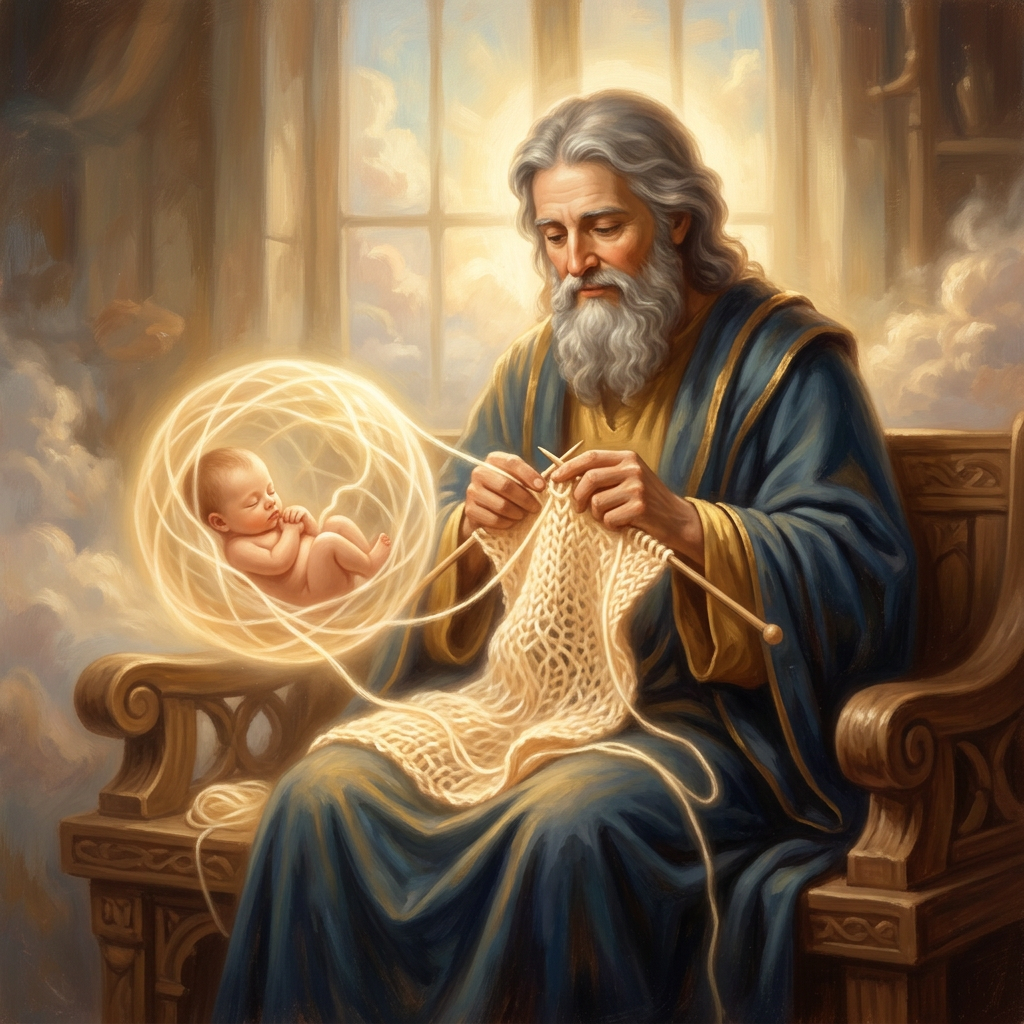
Psalm 139:15 NKJV
My frame was not hidden from You,
When I was made in secret,
And skillfully wrought in the lowest parts of the earth.
Understanding God’s Artistry

My Notes
“My frame was not hidden from You, When I was made in secret, And skillfully wrought in the lowest parts of the earth.” — Psalm 139:15, NKJV
David continues his breathtaking meditation on how deeply God knows and values each of us—even before birth. He pictures his formation as a sacred process carried out in the private “studio” of God’s creative hand: “My frame was not hidden from You.”
Before anyone could see him, before there was even a heartbeat or breath, God saw. Not only saw—but understood. Every bone, every fiber, every hidden structure of the body was known to Him. While the process of life remains mysterious to human knowledge, nothing about you was ever hidden from God.
The phrase “skillfully wrought” is especially beautiful in the original Hebrew. It literally means “embroidered” or “variegated with color.” Think of the most intricate tapestry or a piece of fine needlework. Now, think of the human body: the complex web of veins, the delicate threading of nerves, the layering of muscles and tendons. David is saying that God didn’t just “make” us; He wove us. He sat in the “dark shop of nature” (as one commentator calls it) and meticulously embroidered our lives with divine precision.
Even when you feel hidden or unseen by people, remember that you have never been hidden from the One who made you. You were crafted in secret—but not in isolation. God was there from the beginning, attentive and intentional. Every cell bears His design, and every stage of your life is still “woven” by His ongoing care.
It’s comforting to know that the same God who skillfully formed you is still forming your heart today. Consider how Paul echoes this truth:
“Being confident of this very thing, that He who has begun a good work in you will complete it until the day of Jesus Christ.” — Philippians 1:6, NKJV
Just as God completed His secret work in the womb before bringing you into the light, He will not leave unfinished the spiritual work He’s doing within you now. The artistry of God never fails, whether in creation or in redemption.
Prayer
Abba Father, I am humbled by the thought that You spent time weaving me together in secret. Thank You for being the Divine Artist who saw my frame before anyone else did. When I feel insignificant or overlooked, help me remember that I was “skillfully wrought” by Your own hand. I trust You with the parts of my life that still feel “hidden” or unfinished. Continue Your good work in me, and let my life reflect the beauty of Your design. In Jesus’ name I pray, Amen.
Key Takeaways
- You were never hidden. Even before birth, your potential and your “strength” were fully known by God.
- You are a masterpiece. The complexity of your body and soul is like divine embroidery—intentional, intricate, and colorful.
- Solitude is where God works. Just as the physical body is formed in the “secret” of the womb, much of our spiritual growth happens in quiet, hidden moments with Him.
- Intention over Accident. No part of your existence is a mistake; God personally oversaw the “weaving” of your life.
Cross References (NKJV)
- Ecclesiastes 11:5: “As you do not know what is the way of the wind, or how the bones grow in the womb of her who is with child, so you do not know the works of God who makes everything.”
- Job 10:11: “You have clothed me with skin and flesh, and knit me together with bones and sinews.”
- Ephesians 2:10: “For we are His workmanship, created in Christ Jesus for good works, which God prepared beforehand that we should walk in them.”
- Isaiah 64:8: “But now, O Lord, You are our Father; we are the clay, and You our potter; and all we are the work of Your hand.”
- Jeremiah 1:5: “Before I formed you in the womb I knew you; before you were born I sanctified you.”
- Philippians 1:6: “He who has begun a good work in you will complete it until the day of Jesus Christ.”
Things to Think About
- How does the image of God “embroidering” your nerves and muscles change the way you view your physical body today?
- Reflect on a “secret” season of your life (a time of waiting or solitude). How might God have been “skillfully working” in you during that time?
- David says his “substance” or “strength” was not hidden from God. What strengths or talents has God woven into you that you want to use for His glory?
- If you truly believed you were a “marvelous work” of God, how would that change the way you talk to yourself today?
Proverb for Today
The fruit of the righteous is a tree of life, And he who wins souls is wise. Proverbs 11:30 NKJV
Daily Scripture
Command those who are rich in this present age not to be haughty, nor to trust in uncertain riches but in the living God, who gives us richly all things to enjoy. Let them do good, that they be rich in good works, ready to give, willing to share, storing up for themselves a good foundation for the time to come, that they may lay hold on eternal life. 1 Timothy 6:17-19 NKJV
“The Lord bless you and keep you; The Lord make His face shine upon you, And be gracious to you; The Lord lift up His countenance upon you, And give you peace.” ’ Numbers 6:24-26 NKJV
Grace be with you. Amen.
Please enter your email and click subscribe to be notified whenever I submit a new post.

Summary of Commentaries:
Psalm 139:15 reveals God’s intimate craftsmanship in creating human life. Commentators highlight that our formation, though hidden from human eyes, was fully seen and shaped by God. Described as “embroidered” or “skillfully wrought,” our bodies are divine masterpieces—complex, purposeful, and precious. David’s words inspire awe at God’s unseen artistry and tender care from conception. Just as He once fashioned us in secret, He continues to shape our inner being through His ongoing and perfecting work.
Commentaries:
Charles Spurgeon
“My substance was not hid from thee.” The substantial part of my being was before thine all-seeing eye; the bones which make my frame were put together by thine hand. The essential materials of my being before they were arranged were all within the range of thine eye. I was hidden from all human knowledge, but not from thee: thou hast ever been intimately acquainted with me.
“When I was made in secret.” Most chastely and beautifully is here described the formation of our being before the time of our birth. A great artist will often labour alone in his studio, and not suffer his work to be seen until it is finished; even so did the Lord fashion us where no eye beheld as, and the veil was not lifted till every member was complete. Much of the formation of our inner man still proceeds in secret: hence, the more of solitude the better for us. The true church also is being fashioned in secret, so that none may cry, “Lo, here!” or “Lo, there!” as if that which is visible could ever be identical with the invisibly growing body of Christ.
“And curiously wrought in the lowest parts of the earth.” “Embroidered with great skill” is an accurate poetic description of the creation of veins, sinews, muscles, nerves, etc. What tapestry can equal the human fabric? This work is wrought as much in private as if it had been accomplished in the grave, or in the darkness of the abyss. The expressions are poetical, beautifully veiling, though not absolutely concealing, the real meaning. God’s intimate knowledge of us from our beginning, and even before it, is here most charmingly set forth. Cannot he who made us thus wondrously when we were not, still carry on his work of power till he has perfected us, though we feel unable to aid in the process, and are lying in great sorrow and self-loathing, as though cast into the lowest parts of the earth?
______________________________________________________
Enduring Word
And skillfully wrought in the lowest parts of the earth: Here, David used the phrase lowest parts of the earth to refer to any mysterious, unseen place. The process of a baby’s formation in a mother’s womb has always been as unseen and mysterious as that which happens in the lowest parts of the earth. (Guzik)
i. Skillfully wrought: “Hebrew embroidered; exquisitely composed of bones, and muscles, and sinews, and veins, and arteries, and other parts, all framed with such wonderful skill, that even heathens, upon the contemplation of all the parts of man’s body, and how excellently they were framed, both for beauty and use, have broken forth into pangs of admiration and adoration of the Creator of man.” (Poole)
ii. The work of God in fashioning the body of the individual has made some people wonder about the presence of birth defects and what that may mean regarding God’s work. We should regard such birth defects as injuries to God’s original design, and even as a person may be injured out of the womb, so they can be injured while still in the womb and in the process of formation. Such injuries are the result of the fall and the corruption it introduced into the world, yet still the eye of faith can see the hand of God at work in what defects or injuries He would allow in His providence. (Guzik)
iii. The lowest parts of the earth: “The mysterious receptacle in which the unborn body takes shape and grows is delicately described as ‘secret’ and likened to the hidden region of the underworld, where are the dead. The point of comparison is the mystery enwrapping both.” (Maclaren)
iv. “Much of the formation of our inner man still proceeds in secret; hence the more of solitude the better for us.” (Spurgeon)
______________________________________________________
Albert Barnes
My substance was not hid from thee – Thou didst see it; thou didst understand it altogether, when it was hidden from the eyes of man. The word “substance” is rendered in the margin, “strength” or “body.” The Septuagint, the Latin Vulgate, the Syriac, the Arabic, and Luther render it, “my bone,” or “my bones.” The word properly means strength, and then anything strong. Another form of the word, with a different pointing in the Hebrew, means a bone, so called from its strength. The allusion here is to the bodily frame, considered as strong, or as that which has strength. Whatever there was that entered into and constituted the vigor of his frame, the psalmist says, was seen and known by God, even in its commencement, and when most feeble. Its capability to become strong – feeble as it then was – could not even at that time be concealed or hidden from the view of God.
When I was made in secret – In the womb; or, hidden from the eye of man. Even then thine eye saw me, and saw the wondrous process by which my members were formed.
And curiously wrought. – Literally, “embroidered.” The Hebrew word – רקם râqam – means to deck with color, to variegate. Hence, it means to variegate a garment; to weave with threads of various colors. With us, the idea of embroidering is that of working various colors on a cloth by a needle. The Hebrew word, however, properly refers to the act of “weaving in” various threads, as in weaving carpets. The reference here is to the various and complicated tissues of the human frame – the tendons, nerves, veins, arteries, muscles, “as if” they had been woven, or as they appear to be curiously interwoven. No work of tapestry can be compared with this; no art of man could “weave” together such a variety of most tender and delicate fibers and tissues as those which go to make up the human frame, even if they were made ready to his hand: and who but God could “make” them? The comparison is a most beautiful one, and it will be admired the more the more man understands the structure of his own frame.
In the lowest parts of the earth – Wrought in a place as dark, as obscure, and as much beyond the power of human observation as though it had been done low down beneath the ground where no eye of man can penetrate. Compare the notes at Job 28:7-8.
______________________________________________________
John Gill
My substance was not hid from thee when I was made in secret,…. Or “my bone”; everyone of his bones, which are the substantial parts of the body, the strength of it; and so some render it “my strength”; those, though covered with skin and flesh yet, being done by the Lord himself, were not hid from him; nor the manner of their production and growth, which being done in secret is a secret to men; for they know not how the bones grow in the womb of her that is with child, Ecclesiastes 11:5; but God does;
[and] curiously wrought in the lowest parts of the earth; or formed in my mother’s womb, as the Targum, and so Jarchi, like a curious piece of needlework or embroidery, as the word signifies; and such is the contexture of the human body, and so nicely and curiously are all its parts put together, bones, muscles, arteries, veins, nerves, and fibers, as exceed the most curious piece of needlework, or the finest embroidery that ever was made by the hands of men; and all this done in the dark shop of nature, in the “ovaries,” where there is no more light to work by than in the lowest parts of the earth. The same phrase is used of Christ’s descent into this world, into the womb of the virgin, where his human nature was curiously wrought by the finger of the blessed Spirit, Ephesians 4:9.
______________________________________________________
Matthew Henry
The glory of it is here given to God, entirely to him; for it is he that has made us and not we ourselves. “I will praise thee, the author of my being; my parents were only the instruments of it.” It was done,
(1.) Under the divine inspection: My substance, when hid in the womb, nay, when it was yet but in fieri-in the forming, an unshapen embryo, was not hidden from thee; thy eyes did see my substance.
(2.) By the divine operation. As the eye of God saw us then, so his hand wrought us; we were his work.
(3.) According to the divine model: In thy book all my members were written. Eternal wisdom formed the plan, and by that almighty power raised the noble structure.
______________________________________________________
Miscellaneous Comments
The tables of the testament, first laid up in the ark, secondly, the ark bound about with pure gold; thirdly, overshadowed with cherubim’s wings; fourthly, enclosed within the vail of the Tabernacle; fifthly, with the compass of the Tabernacle; sixthly, with a court about all; seventhly, with a treble covering of goats’, rams’, and badgers’ skins above all; they must needs be precious tables. So when the Almighty made man’s head (the seat of the reasonable soul), and overlaid it with hair, skin, and flesh, like the threefold covering of the Tabernacle, and encompassed it with a skull and bones like boards of cedar, and afterwards with divers skins like silken curtains; and lastly, enclosed it with the yellow skin that covers the brain (like the purple veil), he would doubtless have us to know it was made for some great treasure to be put therein. How and when the reasonable soul is put into this curious cabinet, philosophers dispute many things, but can affirm nothing of certainty.
—Abraham Wright.

- Exploring the Beauty of Psalms: Insights and Commentaries
- Monthly Breakdown of Our Blog Content
- Psalms Commentary: Faith and Inspiration
Leave a Reply