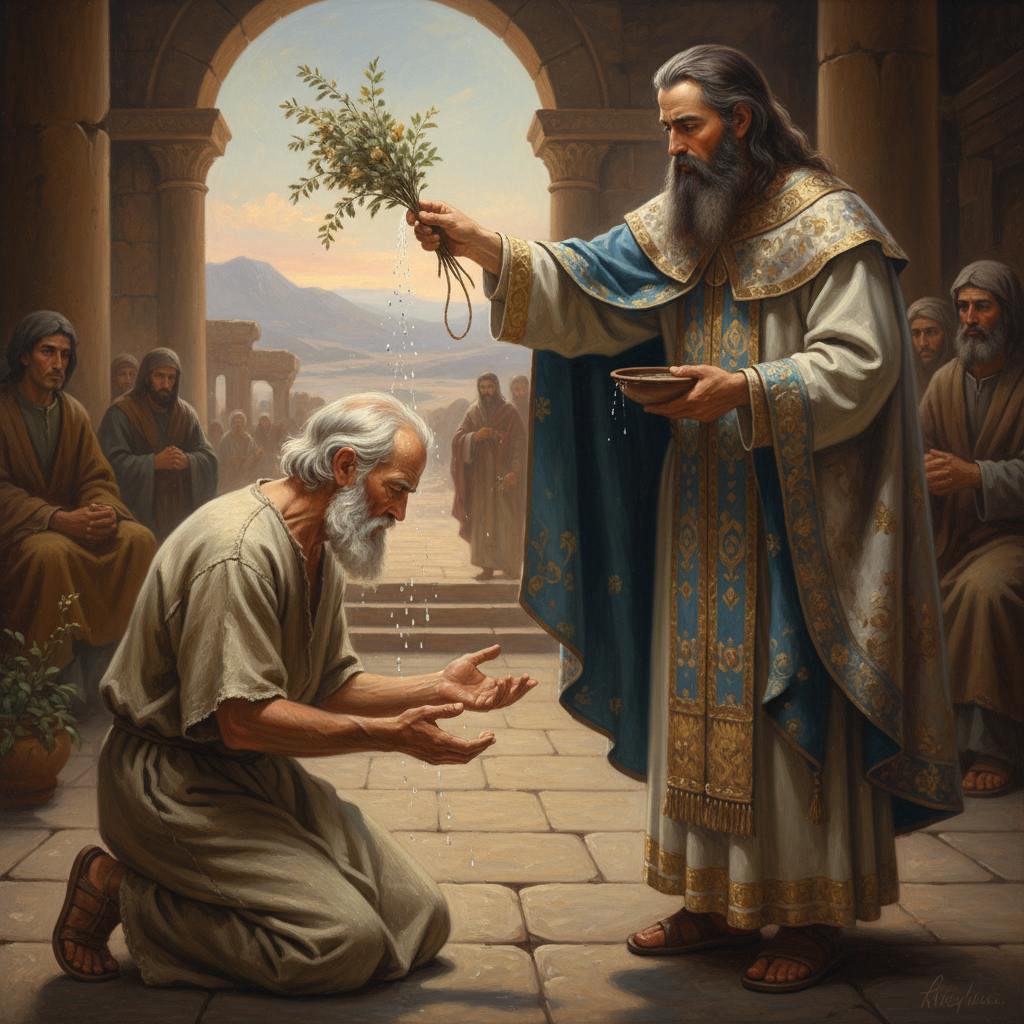
Psalm 51:7 NKJV
Purge me with hyssop, and I shall be clean;
Wash me, and I shall be whiter than snow.
The Promise of Spiritual Cleansing

MY NOTES
“Purge me with hyssop, and I shall be clean; Wash me, and I shall be whiter than snow.” — Psalm 51:7 (NKJV)
Considering the deep-seated and inherent corruption that David perceived and experienced within himself, it is a miraculous act of faith that he could rejoice in the hope of achieving perfect purity in his inner being.
Let’s be real: we’ve all had those moments where we feel “stained.” Not “spilled a little coffee on a white T-shirt” stained, but “I really messed up and I can’t scrub this off my conscience” stained. In Psalm 51, David is sitting in the aftermath of a massive moral failure. He isn’t just looking for a quick fix or a “get out of jail free” card; he’s looking for a total internal overhaul.
When David says, “Purge me with hyssop,” he’s using very specific language. In the Hebrew, the word for “purge” is actually built on the word for sin. He’s essentially saying, “Lord, de-sin me.” He isn’t asking to just look better on the outside; he’s asking for the very root of the problem to be extracted.
The mention of hyssop takes us back to the Passover. It was the branch used to sprinkle the blood of the lamb on the doorposts so that judgment would pass over. David is saying, “Lord, I need the blood. I need the sacrifice. I need the only thing strong enough to reach the places my own effort can’t touch.”
And then comes the promise: “Whiter than snow.” If you’ve ever seen fresh snow in the city, you know it doesn’t stay white for long. It gets slushy, grey, and soot-covered. But God’s cleansing isn’t like nature. It doesn’t fade, and it doesn’t just cover the dirt—it removes it. Through the sacrifice of Jesus, the “Blood of Sprinkling,” God doesn’t just see a “cleaned-up” version of you; He sees you as if the stain never existed. That takes a lot of faith to believe when you’re feeling the weight of your mistakes, but as David shows us, it’s a faith God loves to honor.
Key Takeaways
- The “De-Sinning” Process: True repentance isn’t just saying “sorry”; it’s asking God to remove the “sin-nature” from the situation.
- God is the Priest: In the Old Testament, the priest used the hyssop. Here, David asks God to be the one to do the sprinkling. We can’t wash ourselves; we have to let Him do the work.
- A Purity That Outlasts Nature: Human efforts at “being better” eventually melt or get dirty again. God’s grace provides a permanent, spiritual whiteness that is “all-sufficient.”
Cross References (NKJV)
Exodus 12:22
“And you shall take a bunch of hyssop, dip it in the blood that is in the basin, and strike the lintel and the two doorposts with the blood that is in the basin. And none of you shall go out of the door of his house until morning.”
Isaiah 1:18
“Come now, and let us reason together,” says the Lord, “Though your sins are like scarlet, they shall be as white as snow; though they are red like crimson, they shall be as wool.”
Hebrews 9:13–14
“For if the blood of bulls and goats and the ashes of a heifer, sprinkling the unclean, sanctifies for the purifying of the flesh, how much more shall the blood of Christ, who through the eternal Spirit offered Himself without spot to God, cleanse your conscience from dead works to serve the living God?”
1 John 1:7
“But if we walk in the light as He is in the light, we have fellowship with one another, and the blood of Jesus Christ His Son cleanses us from all sin.”
Prayer
Abba, I come to You today acknowledging the stains I can’t wash away on my own. I don’t want a surface-level fix; I want You to “de-sin” me. Sprinkle me with the blood of Jesus, my perfect sacrifice. I thank You that because of what He did on the cross, I am not just ‘mostly clean’ or ‘better than I was,’ but whiter than snow in Your sight. Wash my conscience, clear my heart, and help me walk in the freedom of being fully accepted. I thank you for this Father in Jesus name, Amen.
Things to Think About:
- Is there a specific “stain” or mistake from your past that you’ve been trying to scrub away with your own efforts?
- The text says it takes “glorious faith” to believe God can make us whiter than snow despite our “inbred corruption.” On a scale of 1–10, how much do you trust that God’s grace is stronger than your worst day?
- How does the reality of being “whiter than snow” change the way you view yourself when you look in the mirror tomorrow morning?
Proverb for Today
Where there is no wood, the fire goes out; And where there is no talebearer, strife ceases. Proverbs 26:20 NKJV
Daily Scripture
For though we walk in the flesh, we do not war according to the flesh. For the weapons of our warfare are not carnal but mighty in God for pulling down strongholds, casting down arguments and every high thing that exalts itself against the knowledge of God, bringing every thought into captivity to the obedience of Christ, 2 Corinthians 10:3-5 NKJV
Bill
Please enter your email and click subscribe to be notified whenever I submit a new post.

Summary of Commentaries:
David’s plea in Psalm 51:7 seeks total internal restoration through divine “de-sinning.” Using hyssop as a symbol of atoning blood, commentators emphasize that only God, acting as Priest, can truly cleanse the soul. This process moves beyond ritual to spiritual purification. Through faith in Christ’s sacrifice—the “blood of sprinkling”—even deep stains are removed, granting an enduring purity whiter than snow that restores the believer to full communion with God.
Commentaries:
Charles Spurgeon
“Purge me with hyssop.” Sprinkle the atoning blood upon me with the appointed means. Give me the reality which legal ceremonies symbolize. Nothing but blood can take away my blood stains, nothing but the strongest purification can avail to cleanse me. Let the sin offering purge my sin. Let him who was appointed to atone, execute his sacred office on me; for none can need it more than I. The passage may be read as the voice of faith as well as a prayer, and so it runs—
“Thou wilt purge me with hyssop, and I shall be clean.” Foul as I am, there is such power in the divine propitiation, that my sin shall vanish quite away. Like the leper upon whom the priest has performed the cleansing rites, I shall again be admitted into the assembly of thy people and allowed to share in the privileges of the true Israel; while in thy sight also, through Jesus my Lord, I shall be accepted.
“Wash me.” Let it not merely be in type that I am clean, but by a real spiritual purification, which shall remove the pollution of my nature. Let the sanctifying as well as the pardoning process be perfected in me. Save me from the evils which my sin has created and nourished in me.
“And I shall be whiter than snow.” None but thyself can whiten me, but thou canst in grace outdo nature itself in its purest state. Snow soon gathers smoke and dust, it melts and disappears; thou canst give me an enduring purity. Though snow is white below as well as on the outer surface, thou canst work the like inward purity in me, and make me so clean that only an hyperbole can set forth my immaculate condition. Lord, do this; my faith believes thou wilt, and well she knows thou canst.
Scarcely does Holy Scripture contain a verse more full of faith than this. Considering the nature of the sin, and the deep sense the psalmist had of it, it is a glorious faith to be able to see in the blood sufficient, nay, all sufficient merit entirely to purge it away. Considering also the deep natural inbred corruption which David saw and experienced within, it is a miracle of faith that he could rejoice in the hope of perfect purity in his inward parts. Yet, be it added, the faith is no more than the word warrants, than the blood of atonement encourages, than the promise of God deserves. O that some reader may take heart, even now while smarting under sin, to do the Lord the honor to rely thus confidently on the finished sacrifice of Calvary and the infinite mercy there revealed.
______________________________________________________
Enduring Word
Purge me with hyssop, and I shall be clean: David looked for God to do a work of spiritual and moral cleansing, and to do it in connection with the atoning sacrifice of a substitute. Hyssop was used to apply the blood of the Passover lamb (Exodus 12:22). Hyssop was also used to sprinkle the priest’s purifying water (Numbers 19:18). (Guzik)
i. In the Levitical law it was the priests who used the hyssop to sprinkle the purifying water. “Here the psalmist petitions the Lord to be his priest by taking the hyssop and by declaring him cleansed from all sin.” (VanGemeren)
ii. David didn’t think for a moment that he could cleanse himself. He needed God to cleanse him, and to do it through the blood of the perfect sacrifice anticipated by animal sacrifices.
iii. Purge: “It is based on the word for sin (chattath) and literally means ‘de-sin’ me. David wanted to have his sin completely purged away.” (Boice)
Wash me, and I shall be whiter than snow: David knew that God’s cleansing was effective. His sin was a deep stain but purity could be restored. We sense that David spoke with the voice of faith; it can be difficult for the convicted sinner to believe in such complete cleansing. It takes faith to believe God despite the doubt and difficulty. (Guzik)
i. “God could make him as if he had never sinned at all. Such is the power of the cleansing work of God upon the heart that he can restore innocence to us, and make us as if we had never been stained with transgression at all.” (Spurgeon)
______________________________________________________
Albert Barnes
Purge me with hyssop, and I shall be clean – On the word hyssop, see John 19:29; and Hebrews 9:19. The plant or herb was much used by the Hebrews in their sacred purifications and sprinklings: Exodus 12:22; Leviticus 14:4, Leviticus 14:6,Leviticus 14:49, Lev 14:51; 1 Kings 4:33. Under this name the Hebrews seem to have comprised not only the common “hyssop” of the shops, but also other aromatic plants, as mint, wild marjoram, etc. – Gesenius, “Lexicon” The idea of the psalmist here evidently is not that the mere sprinkling with hyssop would make him clean; but he prays for that cleansing of which the sprinkling with hyssop was an emblem, or which was designed to be represented by that. The whole structure of the psalm implies that he was seeking an “internal” change, and that he did not depend on any mere outward ordinance or rite. The word rendered “purge” is from the word חטא châṭâ’ – which means “to sin.” In the Piel form it means to bear the blame (or “loss”) for anything; and then to “atone for, to make atonement, to expiate:” Genesis 31:39; Leviticus 6:26; Numbers 19:19. Here it conveys the notion of cleansing from sin “by” a sacred rite, or by that which was signified by a sacred rite. The idea was that the sin was to be removed or taken away, so that he might be free from it, or that “that” might be accomplished which was represented by the sprinkling with hyssop, and that the soul might be made pure. Luther has rendered it with great force – Entsundige mich mit Ysop – “Unsin me with hyssop.”
Wash me – That is, cleanse me. Sin is represented as “defiling,” and the idea of “washing” it away is often employed in the Scriptures. See Isaiah 1:16.
And I shall be whiter than snow – See Isaiah 1:18. The prayer is, that he might be made “entirely” clean; that there might be no remaining pollution in his soul. (Albert Barnes)
______________________________________________________
John Gill
Purge me with hyssop,…. Or “thou shalt purge me with hyssop”; or “expiate me”; which was used in sprinkling the blood of the paschal lamb on the door posts of the Israelites in Egypt, that the destroying angel might pass over them, Exodus 12:22; and in the cleansing of the leper, Leviticus 14:4; and in the purification of one that was unclean by the touch of a dead body, Numbers 19:6; which the Targum on the text has respect to; and this petition of the psalmist shows that he saw himself a guilty creature, and in danger of the destroying angel, and a filthy creature like the leper, and deserving to be excluded from the society of the saints, and the house of God; and that he had respect not hereby to ceremonial sprinklings and purifications, for them he would have applied to a priest; but to the sprinkling of the blood of Christ, typified thereby; and therefore he applies to God to purge his conscience with it; and, as Suidas from Theodoret observes, hyssop did not procure remission of sins, but has a mystical signification, and refers to what was meant by the sprinkling of the blood of the passover; and then he says,
and I shall be clean; thoroughly clean; for the blood sprinkled on the heart by the spirit clears it from an evil conscience, purges the conscience from dead works, and cleanses from all sin;
wash me; or “thou shall wash me” {h}; alluding to the washing at the cleansing of a leper, and the purification of an unclean person, Leviticus 14:8; but had in view the fountain of Christ’s blood, in which believers are washed from all their sins, Zechariah 13:1;
and I shall be whiter than snow; who was black with original corruption, and actual transgressions; but the blood of Christ makes not only the conversation garments white that are washed in it; but even crimson and scarlet sins as white as wool, as white as snow, and the persons of the saints without spot or blemish, Revelation 7:14, Ephesians 5:25; “whiter than the snow” is a phrase used by Homer, and others, to describe what is exceeding white.
______________________________________________________
Matthew Henry
He prays that God would cleanse him from his sins and the defilement he had contracted by them (v. 7): “Purge me with hyssop; that is, pardon my sins, and let me know that they are pardoned, that I may be restored to those privileges which by sin I have forfeited and lost.” The expression here alludes to a ceremonial distinction, that of cleansing the leper, or those that were unclean by the touch of a body by sprinkling water, or blood, or both upon them with a bunch of hyssop, by which they were, at length, discharged from the restraints they were laid under by their pollution. “Lord, let me be as well assured of my restoration to thy favor, and to the privilege of communion with thee, as they were thereby assured of their re-admission to their former privileges.” But it is founded upon gospel-grace: Purge me with hyssop, that is, with the blood of Christ applied to my soul by a lively faith, as water of purification was sprinkled with a bunch of hyssop. It is the blood of Christ (which is therefore called the blood of sprinkling, Heb. 12:24), that purges the conscience from dead works, from that guilt of sin and dread of God which shut us out of communion with him, as the touch of a dead body, under the law, shut a man out from the courts of God’s house. If this blood of Christ, which cleanses from all sin, cleanse us from our sin, then we shall be clean indeed, Heb. 10:2. If we be washed in this fountain opened, we shall be whiter than snow, not only acquitted but accepted; so those are that are justified. Isa. 1:18, Though your sins have been as scarlet, they shall be white as snow.
______________________________________________________
Miscellaneous Comments
“Hyssop.” The lasaf or asaf, the caper plant, the bright green creeper which climbs out of the fissures of the rocks in the Sinaitic valleys, has been identified on grounds of great probability with the “hyssop” or ezob of Scripture; and thus explains whence came the green branches used, even in the desert, for sprinkling the water over the tents of the Israelites.
—Arthur Penrhyn Stanley, in “Sinai and Palestine.” 1864.

- Exploring the Beauty of Psalms: Insights and Commentaries
- Monthly Breakdown of Our Blog Content
- Psalms Commentary: Faith and Inspiration
Leave a Reply