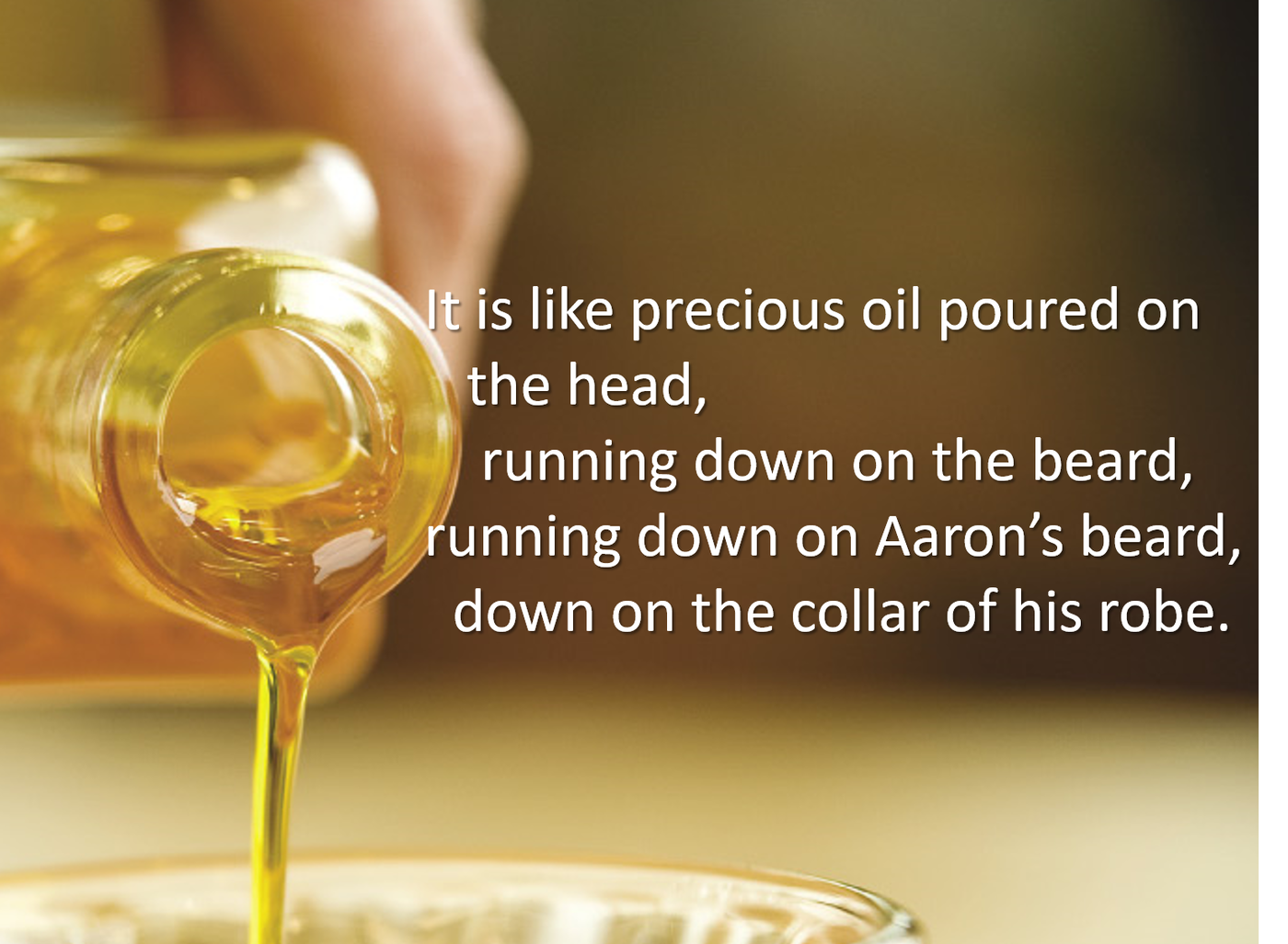
Psalm 133:2 NKJV
It is like the precious oil upon the head,
Running down on the beard,
The beard of Aaron,
Running down on the edge of his garments.
The Fragrance

My Notes
Psalm 133:2 NKJV
It is like the precious oil upon the head,
Running down on the beard,
The beard of Aaron,
Running down on the edge of his garments.
If the first verse of Psalm 133 tells us that unity is good, the second verse shows us why it’s powerful. David uses a very specific, very sensory image: the anointing of Aaron, the High Priest.
Now, if you or I got a bottle of oil poured over our heads today, our first thought would probably be about the dry-cleaning bill. But in the ancient world, this was the ultimate “smell of success”—specifically, the smell of consecration. This wasn’t just any olive oil; it was a complex, divinely-prescribed blend of myrrh, cinnamon, and cassia. It was rare, expensive, and literally holy.
The Fragrance of the Sacred Unity isn’t just a “nice-to-have.” It is a sacred thing. David compares it to this oil to remind us that when we live in peace, we aren’t just “getting along”—we are acting like priests. In the Old Testament, Aaron couldn’t start his job until he was drenched in this oil. In the same way, we aren’t fully fitted to glorify God if we are devoid of love. Love is the “anointing” that makes our service acceptable. Without it, even our best religious efforts just smell like… well, us.
The Power of the Pour Notice the direction of the oil: it starts at the head and runs down. It hits the beard, then the robes, then the very hem of the garment.
- It’s Abundant: God doesn’t do “dab-behind-the-ears” anointing. He pours. Real unity is an overflow of grace that doesn’t know when to quit.
- It’s Diffusive: It spreads. It doesn’t stay confined to the leaders (the “head”). It travels down to the “skirts”—the lowest, the poorest, the least visible, and maybe even the “least lovable” members of the body.
The Downward Descent. Here is the thing about God’s design: for oil to anoint, it must flow down. Brotherly love is exactly the same. It requires a downward motion. It’s easy to love people “above” us or “equal” to us, but the true test of this “precious oil” is when it reaches the fringes. It condescends to people of low estate. It doesn’t ask for a passport or a denominational ID card. If they belong to the “Body,” the oil of our love is meant to reach them.
When we are unified, we carry the scent of Christ into every room we enter. We become a “walking sanctuary,” signaling to a fractured world that there is a God who heals, unites, and overflows with grace.
Key Takeaways
- Unity is a Holy Ingredient: Just as the anointing oil was a specific divine recipe, unity is “taught by God.” We can’t manufacture it; we receive it and protect it.
- It Starts at the Top, But Reaches the Bottom: Unity often begins with leadership, but its true beauty is seen when it covers the most vulnerable or “fringe” members of the community.
- No Unity, No Ministry: Aaron couldn’t serve without the oil; we struggle to serve effectively without love. Unity is the prerequisite for powerful ministry.
- The Fragrance of Identity: Unity is our “divine perfume.” It identifies us as belonging to the Great High Priest, Jesus Christ.
Cross References (NKJV)
Exodus 30:22–25
“Moreover the Lord spoke to Moses, saying: “Also take for yourself quality spices—five hundred shekels of liquid myrrh, half as much sweet-smelling cinnamon (two hundred and fifty shekels), two hundred and fifty shekels of sweet-smelling cane, five hundred shekels of cassia, according to the shekel of the sanctuary, and a hin of olive oil. And you shall make from these a holy anointing oil, an ointment compounded according to the art of the perfumer. It shall be a holy anointing oil.”
1 Corinthians 13:1–2
“Though I speak with the tongues of men and of angels, but have not love, I have become sounding brass or a clanging cymbal. And though I have the gift of prophecy, and understand all mysteries and all knowledge, and though I have all faith, so that I could remove mountains, but have not love, I am nothing.”
1 John 5:1
“Whoever believes that Jesus is the Christ is born of God, and everyone who loves Him who begot also loves him who is begotten of Him.”
A Closing Prayer
Abba, thank You for the “precious oil” of Your Spirit that unites us. We admit that we sometimes try to keep our love “neat” and contained, but You are a God of the overflow. Let Your love run down from our hearts to our hands, reaching those on the fringes of our lives. Anoint us today. May the fragrance of our unity be so sweet that others are drawn to the scent of Your grace. I ask You for this in Jesus’ name, Amen.
Questions to Meditate on:
- The “Scent” Check: If my current attitude toward my brothers and sisters were a perfume, what would it smell like right now? (Be honest!)
- The Fringes: Who are the “skirts of the garment” in my life—the people who are easy to overlook or hard to love? How can I let the “oil” of my kindness reach them today?
- The Flow: In what way has someone “above” you (a mentor, parent, or leader) poured love into your life that is now “running down” to benefit others through you?
Proverb for Today
Apply your heart to instruction, And your ears to words of knowledge. Proverbs 23:12 NKJV
Daily Scripture
So Jesus answered and said to them, “Have faith in God. For assuredly, I say to you, whoever says to this mountain, ‘Be removed and be cast into the sea,’ and does not doubt in his heart, but believes that those things he says will be done, he will have whatever he says. Therefore I say to you, whatever things you ask when you pray, believe that you receive them, and you will have them. Mark 11:22-24 NKJV
Bill
Please enter your email and click subscribe to be notified whenever I submit a new post.

Summary of Commentaries:
Psalm 133:2 likens unity to Aaron’s sacred anointing oil—a rare, fragrant, and holy blessing. This diffusive oil flows downward, from the head to the lowest garment edges, symbolizing how brotherly love reaches even the humblest members. Just as Aaron required anointing for ministry, believers need this “divine perfume” of love to serve God effectively. Unity is an abundant, sacred overflow that consecrates the entire community, carrying the fragrance of Christ to all.
Commentaries:
Charles Spurgeon
“It is like the precious ointment upon the head.” In order that we may better behold brotherly unity, David gives us a resemblance, so that, as in a glass, we may perceive its blessedness. It has a sweet perfume about it, comparable to that precious ointment with which the first High Priest was anointed at his ordination. It is a holy thing, and so again is like the oil of consecration, which was to be used only in the Lord’s service. What a sacred thing must brotherly love be when it can be likened to an oil which must never be poured on any man but on the Lord’s high priest alone! It is a diffusive thing: being poured on his bead the fragrant oil flowed down upon Aaron’s head, and thence dropped upon his garments till the utmost hem was anointed therewith; and even so doth brotherly love extend its benign power and bless all who are beneath its influence. Hearty concord brings a benediction upon all concerned; its goodness and pleasure are shared in by the lowliest members of the household; even the servants are the better and the happier because of the lovely unity among the members of the family. It has a special use about it; for as by the anointing oil Aaron was set apart for the special service of Jehovah, even so those who dwell in love are the better fitted to glorify God in his church. The Lord is not likely to use for his glory those who are devoid of love; they lack the anointing needful to make them priests unto the Lord.
“That ran down upon the beard, even Aaron’s beard.” This is a chief point of comparison, that as the oil did not remain confined to the place where it first fell, but flowed down the High Priest’s hair and bedewed his beard, even so brotherly love descending from the head distills and descends, anointing as it runs, and perfuming all it lights upon.
“That went down to the skirts of his garments.” Once set in motion, it would not cease from flowing. It might seem as if it were better not to smear his garments with oil, but the sacred unguent could not be restrained, it flowed over his holy robes; even thus does brotherly love not only flow over the hearts upon which it was first poured out, and descend to those who are an inferior part of the mystical body of Christ, but it runs where it is not sought for, asking neither leave nor license to make its way. Christian affection knows no limits of parish, nation, sect, or age. Is the man a believer in Christ? Then he is in the one body, and I must yield him an abiding love. Is he one of the poorest, one of the least spiritual, one of the least lovable? Then he is as the skirts of the garment, and my heart’s love must fall even upon him. Brotherly love comes from the head, but falls to the feet. Its way is downward. It “ran down,” and it “went down:” love for the brethren condescends to men of low estate, it is not puffed up, but is lowly and meek. This is no small part of its excellence: oil would not anoint if it did not flow down, neither would brotherly love diffuse its blessing if it did not descend.
______________________________________________________
Enduring Word
It is like the precious oil upon the head: In the ancient Middle East, it was common to anoint one’s head with oil, sometimes as a greeting entering a home (Luke 7:46). This was done to refresh the one receiving the oil, and to give a good smell from the fragrance that came from the perfumed oils. Among God’s people, unity refreshes and makes a pleasant atmosphere for all. (Guzik)
i. “The anointing oil intended for the head (Exod. 29:7) was not confined to it, nor could its fragrance be contained. Exodus 29:21 provided explicitly that after the pouring of the oil on the head, some was to be sprinkled on the robes: ‘and he and his garments shall be holy’.” (Kidner)
Running down on the beard, the beard of Aaron: The picture in words shows that unity is a rich and abundant blessing, as this oil overflowed the head and came down the beard. It also shows that unity is a rare and precious blessing, because the suggestion is that this was holy anointing oil, which was not to be imitated (Exodus 30:22-33). (Guzik)
i. Christian unity is “…far beyond that common friendship so highly extolled by Cicero, and other heathens; and is therefore here fitly compared to that nonesuch [perfect] odoriferous ointment.” (Trapp)
ii. This is a unity of holiness. “That anointing oil, poured upon Aaron, was the oil of consecration, and symbolized his separation from all evil; it was the oil of holiness.” (Morgan)
iii. “The odor of this must have been very agreeable, and serves here as a metaphor to point out the exquisite excellence of brotherly love.” (Clarke)
iv. “What a sacred thing must brotherly love be when it can be likened to an oil which must never be poured on any man but on the Lord’s high-priest alone!” (Spurgeon)
The beard of Aaron: The oil upon the priest’s head was good as an instrument of refreshing and greeting, as it would be for anyone else. Yet for Aaron (as high priest), it also was part of his consecration to priestly service (Exodus 29:7), which led to so many other good things.
· Service unto God and His people.
· Atonement of sins.
· Offerings of peace, fellowship, and thanksgiving.
· Compassionate ministry to the people of God.
(Guzik)
i. The illustration is wonderful. When there is unity among God’s people, it is not only good and pleasant in itself, but it also leads to so many other good things. When the people of God struggle with each other, there are so many other good things they are not doing and enjoying. (Guzik)
ii. God intended the priests to represent His righteousness and salvation to a watching world. Spiritually speaking, this anointing made that possible. Unity among God’s people has a similar effect. (Guzik)
Running down on the edge of his garments: What an abundant blessing unity is! It is like oil poured out so richly that it flows from the head to the beard, and then down to the very edge of the priest’s garments. (Guzik)
i. There is some debate whether the edge of his garments refers to the collar (as Maclaren and others say) or to the bottom hem of his priestly robes. Either way, it was an impressive flow of oil. (Guzik)
ii. Boice commented on the New International Version translation of Psalm 133:2 (…running down on the beard, running down on Aaron’s beard, down on the collar of his robe): “In verse 2 the threefold repetition ‘running down,’ ‘running down,’ and ‘down’ – the Hebrew uses the same verb each time – emphasizes that the blessing of Aaron’s anointing was from above himself, that is, from God.” (Boice)
iii. “In short, true unity, like all good gifts, is from above; bestowed rather than contrived, a blessing far more than an achievement.” (Kidner)
______________________________________________________
Albert Barnes
It is like the precious ointment upon the head – That is, which was poured upon the head of the high priest, when consecrated to the holy office. The Hebrew is, “the good ointment.” For a description of the ointment which was used in the consecration of the high priest, and the holy things of the sanctuary, see Exodus 30:22-30. Compare the notes at Isaiah 61:3, on the phrase “oil of joy.” Anointing with oil was common on festivals and joyous occasions (see the notes at Psalms 23:5), and hence, it became an emblem of anything joyous, happy, beautiful; and the idea seemed to be carried to the highest degree when it was connected with the anointing of a high priest to the sacred duties of his office. There is no other resemblance between the idea of anointing with oil and that of harmony among brethren than this which is derived from the gladness – the joyousness – connected with such an anointing. The psalmist wished to give the highest idea of the pleasantness of such harmony; and he, therefore, compared it with that which was most beautiful to a pious mind – the idea of a solemn consecration to the highest office of religion. The comparison is one which would not unnaturally occur to a Jew.
That ran down upon the beard – Descending from the head upon the long, flowing beard. The idea here is that of copiousness, or abundance – as if so much ointment was poured forth as to descend on the whole person, consecrating the entire man.
Even Aaron’s beard – The word “even” here, introduced by our translators, weakens the force and beauty of the comparison. The psalmist had the simple image of Aaron before his mind, without intending to compare him with any other.
That went down to the skirts of his garments – literally, “to the mouth of his garment.” The idea is that the anointing oil was abundant enough to flow down so as to fall on his entire robe, diffusing a sweet fragrance all around. It is possible, though it may seem like a conceit, that the psalmist may have had an idea of unity in this, as if in the anointing of the high priest, the whole man was consecrated, or was “united” in the consecration. It was not merely the head, but the beard, the raiment, the entire person, that partook of the fragrance of the anointing oil. Thus, love in a Christian community is so abundant – so overflowing – that it spreads over all the spiritual body, the church; the same sweet and holy influence, represented by the oil of anointing, pervades all, and combines all in one.
______________________________________________________
Matthew Henry
It is fragrant as the holy anointing oil, which was strongly perfumed, and diffused its odours, to the great delight of all the bystanders, when it was poured upon the head of Aaron, or his successor the high priest, so plentifully that it ran down the face, even to the collar or binding of the garment, v. 2.
(1.) This ointment was holy. So must our brotherly love be, with a pure heart, devoted to God. We must love those that are begotten for his sake that begat, 1 Jn. 5:1.
(2.) This ointment was a composition made up by a divine dispensatory; God appointed the ingredients and the quantities. Thus, believers are taught of God to love one another; it is a grace of his working in us.
(3.) It was very precious, and the like to it was not to be made for any common use. Thus holy love is, in the sight of God, of great price; and that is precious indeed which is so in God’s sight.
(4.) It was grateful both to Aaron himself and to all about him. So is holy love; it is like ointment and perfume which rejoice the heart. Christ’s love to mankind was part of that oil of gladness with which he was anointed above his fellows.
(5.) Aaron and his sons were not admitted to minister unto the Lord till they were anointed with this ointment, nor are our services acceptable to God without this holy love; if we have it not we are nothing, 1 Co. 13:1, 2.
______________________________________________________
Miscellaneous Comments
“That ran down…that went down,” etc. Christ’s grace is so diffusive of itself that it conveys holiness to us, “running down from the head to the skirts,” to all his members. He was not only anointed himself, but he is our anointer. Therefore ,it is called “the oil of gladness,” because it rejoiceth our hearts, by giving us spiritual gladness, and peace of conscience.
—Thomas Adams.
- Exploring the Beauty of Psalms: Insights and Commentaries
- Monthly Breakdown of Our Blog Content
- Psalms Commentary: Faith and Inspiration


Leave a Reply