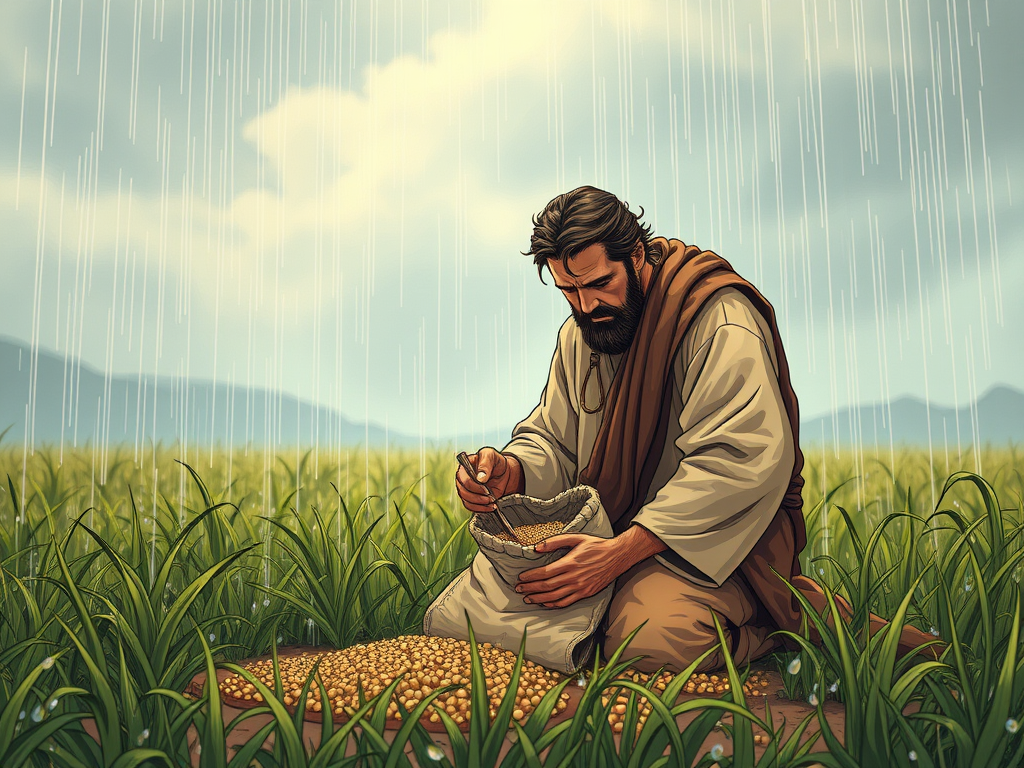
Psalm 126:5 NKJV
Those who sow in tears
Shall reap in joy.
Sowing in Tears, Reaping in Joy

My Notes
Scripture Focus: > “Those who sow in tears Shall reap in joy.” — Psalm 126:5 (NKJV)
Something to think about
In the kingdom of God, sorrow is never a dead end; it is a sowing time. We often view our seasons of distress as permanent walls, but the Psalmist invites us to see them as the “wet weather” necessary for a future harvest. If there were no sowing in tears, there would be no reaping in joy.
The Necessity of the Tear
F.B. Meyer once noted that some farmers “steep” or soak their seeds before planting them. In the same way, our most effective service for God is often steeped in our prayers and tears. It is not enough to simply “do” the work; we must add the passion of a broken heart. As Charles Spurgeon famously said, “Winners of souls are first weepers for souls.” When we are deeply moved by the sins of others or the weight of our own trials, we are being prepared for a harvest that “dry-eyed” labor can never produce.
Sowing While Weeping
The great temptation of affliction is to stop working. We think, “I will serve God again when I feel better,” or “I’ll pray once this grief passes.” But the text commands a different response: Sow in the midst of the tears. Just as rain prepares the ground for the seed, your trials are softening the soil of your heart (and the hearts of others) for the Word of God to take root. Do not let your weeping hinder your sowing. When you suffer, you must continue doing well.
The Certainty of the “Shall”
This verse contains one of the Lord’s great “shalls.” It is a positive, unbreakable promise given to three groups: the workers, the waiters, and the weepers. The harvest may not appear tomorrow—the seed must lie buried under the clods for a time—but it will rise. Whether it is the parent praying for a wayward child, the missionary laboring in a hard field, or the soul struggling through personal repentance, the promise remains: the joy will be more than the weariness.
Prayer
Abba, Father, I thank You that my tears are never wasted in Your sight. You see the seeds I drop with a trembling hand, and You promise that they will not be lost. Give me the strength to keep sowing even when the clouds are dark and the rain is heavy. Steep my heart in Your compassion so that I may be a soul-winner who truly feels the weight of the world’s need. I rest in Your “shall,” trusting that in Your due season, my sorrow will be turned into a harvest of joy that exceeds all my weariness. I thank You and ask for this in Jesus’ name, Amen.
Key Takeaways
- Sorrow is a Process, Not a Destination: Present distress is a means to an end. It is the labor that produces the “sheaves” of future character and joy.
- The Power of Earnestness: “Deep calleth unto deep.” When our own hearts are broken with grief, we are uniquely equipped to reach the broken hearts of others.
- Don’t Wait for Perfect Weather: If you wait for a season without tears to serve God, you may never sow. The most precious seed is often sown when “corn is dear”—when we have little left to give.
- A Guaranteed Return: God’s timing is “due season.” We must wait patiently like a husbandman, knowing that life everlasting and the fullness of joy are the certain results of spiritual sowing.
Cross-References (NKJV)
- Galatians 6:9 — “And let us not grow weary while doing good, for in due season we shall reap if we do not lose heart.”
- Hosea 10:12 — “Sow for yourselves righteousness; Reap in mercy; Break up your fallow ground, For it is time to seek the Lord, Till He comes and rains righteousness on you.”
- John 16:20 — “Most assuredly, I say to you that you will weep and lament, but the world will rejoice; and you will be sorrowful, but your sorrow will be turned into joy.”
- 2 Corinthians 9:6 — “But this I say: He who sows sparingly will also reap sparingly, and he who sows bountifully will also reap bountifully.”
Meditation Questions
- The Current Field: What “wet weather” or season of sorrow are you currently walking through? How can you continue to “sow” (pray, serve, trust) even while the tears are falling?
- Steeping the Seed: Look at your current responsibilities (parenting, work, ministry). How can you add more “passion and tender pity” to these tasks through prayer?
- Remembering the Harvest: Reflect on a past time when you sowed in tears. What “joy” or “sheaves” did the Lord eventually allow you to reap from that difficult season?
Proverb for Today
My son, if you receive my words, And treasure my commands within you, So that you incline your ear to wisdom, And apply your heart to understanding; Yes, if you cry out for discernment, And lift up your voice for understanding, If you seek her as silver, And search for her as for hidden treasures; Then you will understand the fear of the Lord, And find the knowledge of God. For the Lord gives wisdom; From His mouth come knowledge and understanding; He stores up sound wisdom for the upright; He is a shield to those who walk in integrity, He guards the paths of justice, And preserves the way of His saints. Then you will understand righteousness and justice, Equity and every good path. When wisdom enters your heart, And knowledge is pleasant to your soul, Discretion will preserve you; Understanding will keep you, To deliver you from the way of evil, From the man who speaks perverse things. Proverbs 2:1-12 NKJV
Closing
Therefore humble yourselves under the mighty hand of God, that He may exalt you in due time, casting all your care upon Him, for He cares for you. 1Peter 5:6-7 NKJV
Bill
Posted on 1/2/2026 by Bill Stephens
Follow me on X – @billstephens_59
Follow me on Truth – @billstephens1959
Please enter your email and click subscribe to be notified whenever I submit a new post.

Summary of Commentaries:
Psalm 126:5 reveals that sorrow is not a destination, but a necessary “sowing time.” Just as farmers steep seeds, we must saturate our labor with prayer and tears. Weeping should not halt our work; rather, affliction prepares the heart’s soil. This “wet weather” leads to a guaranteed harvest. God’s unbreakable promise—His “shall”—ensures that every faithful weeper will eventually gather sheaves of grace and joy that far outweigh their present distress.
Commentaries:
Charles Spurgeon
“They that sow in tears shall reap in joy.” Hence, present distress must not be viewed as if it would last forever; it is not the end, by any means, but only a means to the end. Sorrow is our sowing, rejoicing shall be our reaping. If there were no sowing in tears, there would be no reaping in joy. If we were never captives, we could never lead our captivity captive. Our mouth had never been filled with holy laughter if it had not been first filled with the bitterness of grief. We must sow: we may have to sow in the wet weather of sorrow, but we shall reap, and reap in the bright summer season of joy. Let us keep to the work of this present sowing time, and find strength in the promise which is here so positively given us. Here is one of the Lord’s shalls and wills; it is freely given both to workers, waiters, and weepers, and they may rest assured that it will not fail: “in due season they shall reap.”
This sentence may well pass current in the church as an inspired proverb. It is not every sowing which is thus insured against all danger, and guaranteed a harvest, but the promise specially belongs to sowing in tears. When a man’s heart is so stirred that he weeps over the sins of others, he is elect to usefulness. Winners of souls are first weepers for souls. As there is no birth without travail, so is there no spiritual harvest without painful tillage. When our own hearts are broken with grief at man’s transgression, we shall break other men’s hearts: tears of earnestness beget tears of repentance: “deep calleth unto deep.”
______________________________________________________
Enduring Word
Those who sow in tears shall reap in joy: The gladness of the first half of this psalm was real, but only part of the picture. With wisdom, the psalmist reminded himself and all of us that great joy is often preceded by a season of tears, as if they are seeds we sow that will bring a crop of joy to be later reaped. (Guzik)
i. “In the first image (the sudden filling of the desert streams, Psalm 126:4), the results are sudden and unearned. In the second image (the harvest after the difficult work of plowing and sowing seed, Psalm 126:5-6) the results come only after a long period of hard work and waiting.” (Boice)
ii. “The two images of renewal (Psalm 126:4b, 5-6) are not only striking: they are complementary. The first of them is all suddenness, a sheer gift from heaven; the second is slow and arduous, with man allotted a crucial part to play in it.” (Kidner)
iii. This illustration puts a connection between the tears and the joy. We want to reap the joy without ever having sown the tears. (Guzik)
iv. F.B. Meyer noted that some farmers soak (steep) their seeds before sowing them, and then applied the idea: “It is well when Christian workers steep their lessons and addresses with their prayers and tears. It is not enough to sow; we may do that lavishly and constantly, but we must add passion, emotion, tender pity, strong cryings and tears.”
v. “He drops a seed and a tear, a seed and a tear, and so goes on his way. In his basket, he has seed which is precious to him, for he has little of it, and it is his hope for the next year. Each grain leaves his hand with anxious prayer that it may not be lost: he thinks little of himself, but much of his seed, and he eagerly asks, ‘Will it prosper? Shall I receive a reward for my labor?’ Yes…doubtless you will gather sheaves from your sowing.” (Spurgeon)
______________________________________________________
Albert Barnes
They that sow in tears shall reap in joy – Though the sowing of seed is a work of labor and sorrow – often a work so burdening the farmer that he weeps – yet the return – the harvest – is accompanied with rejoicing. The truth is expressed in a general form, as illustrating the idea that enterprises which are begun under many difficulties, and which require much labor, will be crowned with success, and that the joy is more than an equivalent for all the weariness and sorrow. Thus it is in respect to the toil of the farmer; the cares and anxieties of the student; the work of conversion and repentance; the labors of the Christian pastor; the efforts of the Sabbath-school teacher; the faithfulness of the Christian parent; the endeavors of a church for a revival of religion; the zeal and sacrifice of the Christian missionary. The particular allusion here is to the exiles, in their long and weary march to their native land. It was a work of toil and tears, but there would be joy, like that of the harvest, when their long journey over, they should again come to their native land. Compare Isaiah 9:3.
______________________________________________________
John Gill
They that sow in tears shall reap in joy. A proverbial expression, encouraging faith in prayer put up for the return of the captivity, whether in a literal or spiritual sense. Praying or seeking the Lord is sowing in righteousness, Hosea 10:12; which is often attended with tears and weeping; the issue of them is not always seen soon: these, like seed, lie buried under the clods, but take effect and will rise up in due time: saints should wait patiently for a return of them, as the husbandman for the fruits of the earth; in due time they will produce a large crop of blessings, a plentiful harvest, which the praying saint will reap with joy; as those that prayed and waited for the redemption in Jerusalem; and as those that pray for the latter day glory, the conversion of the Jews, the fulness of the Gentiles, and the destruction of antichrist; the souls under the altar have been sowing in tears, but before long they will reap in joy, Revelation 6:9. It may be applied to the state and condition of saints in common in this life; now is their sowing time, and careful they should be that they sow not to the flesh, but to the spirit: and a sorrowful time it is, on account of inward corruptions, Satan’s temptations, divine desertions, and the imperfection of their services; but before long they will reap life everlasting, reap in joy, and be in the fulness of it; now they weep, then they shall rejoice; now they mourn, then they shall be comforted.
______________________________________________________
Matthew Henry
Suffering saints have a seedness of tears. They are in tears often; they share in the calamities of human life, and commonly have a greater share in them than others. But they sow in tears; they do the duty of an afflicted state and so answer the intentions of the providences they are under. Weeping must not hinder sowing; when we suffer ill, we must be doing well. Nay, as the ground is by the rain prepared for the seed, and the husbandman sometimes chooses to sow in the wet, so we must improve times of affliction, as disposing us to repentance, and prayer, and humiliation. Nay, there are tears which are themselves the seed that we must sow, tears of sorrow for sin, our own and others, tears of sympathy with the afflicted church, and the tears of tenderness in prayer and under the word. These are precious seed, such as the husbandman sows when corn is dear and he has but little for his family, and therefore weeps to part with it, yet buries it under ground, in expectation of receiving it again with advantage. Thus does a good man sow in tears.
______________________________________________________
Miscellaneous Comments
“They that sow in tears,” etc. Observe two things here.
1. That the afflictions of God’s people are as sowing in tears.
(a) In sowing ye know there is great pains. The land must be first tilled and dressed; and there is pains in casting the seed into it; and then it takes a great dressing all the year, before it be set in the barn-yard.
(b) It requires great charges, too, and therefore it is called “precious seed.” For ye know that seed corn is aye dearest.
(c) There is also a great hazard, for corn, after it is sown, is subject to many dangers. And so it is with the children of God in a good cause.
2. Then after the seed-time follows the harvest, and that comes with joy. There be three degrees of the happiness of God’s children, in reaping of fruits.
(a) In the first fruits. Even when they are enduring anything for the Gospel of Christ, it carries contentment and fruit with it.
(b) After the first-fruits, then come sheaves to refresh the husband-man, and to assure him that the full harvest is coming. The Lord now and then gives testimony of a full deliverance to his own people, especially of the deliverance of Sion, and lets them taste of the sheaves which they have reaped.
(c) And lastly, they get the full harvest, and that is gotten at the great and last day. Then we get peace without trouble, joy without grief, profit without loss, pleasure without pain; and then we have a full sight of the face of God.
—Alexander Henderson.

Leave a Reply