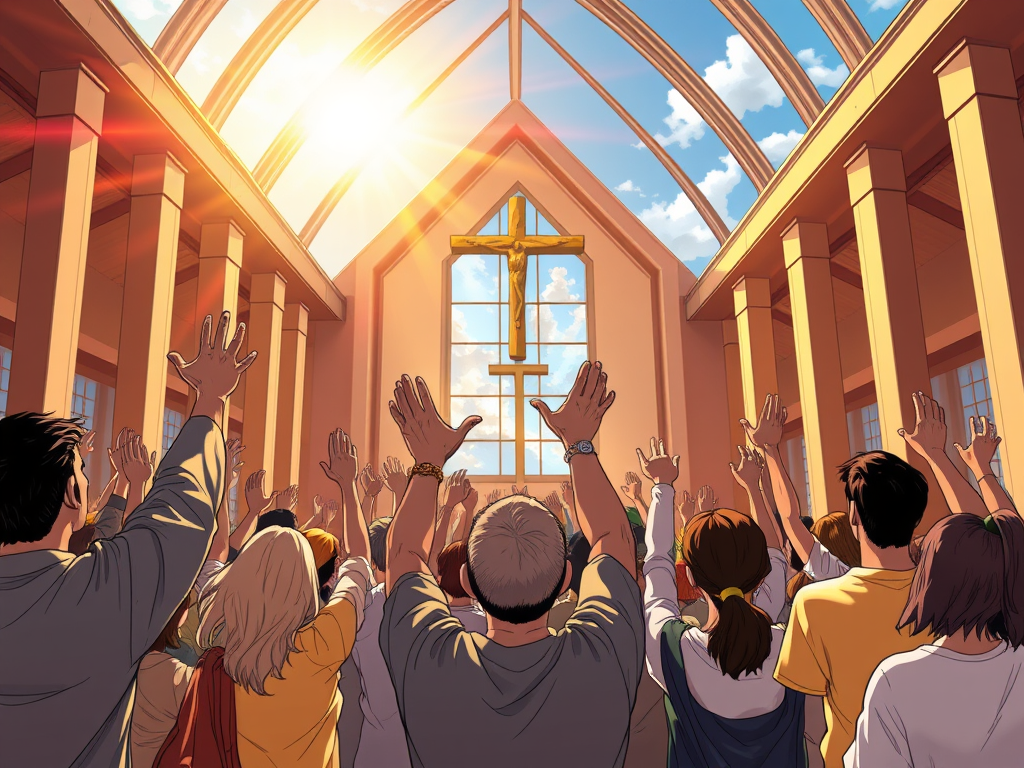
Psalm 122:1 NKJV
I was glad when they said to me,
“Let us go into the house of the Lord.”
Gladness in God’s House

My Notes
Scripture: “I was glad when they said to me, ‘Let us go into the house of the Lord.’” — Psalm 122:1 NKJV
David’s joy was stirred by the invitation to worship. His heart already longed for God’s presence, yet hearing others call him to join in public worship deepened his gladness. Worship is not only a personal duty but a communal privilege. God calls His people to gather, to hear His Word, to pray together, and to rejoice in His mercy.
Private devotion is essential, but it is not enough. The Lord commands His people to assemble, to encourage one another, and to glorify Him in unity. As Hebrews 10:25 reminds us: “Not forsaking the assembling of ourselves together, as is the manner of some, but exhorting one another, and so much the more as you see the Day approaching.”
The beauty of God’s house is not in its outward adornment but in His presence. Solomon’s temple was glorious, yet its true splendor was that there the people heard God’s Word, called upon His name, and received forgiveness and peace. The same is true today: the church is beautiful because Christ dwells among His people by His Spirit.
David was glad for others—glad they desired worship, glad they invited him, glad they loved the place where God’s honor dwelt. He was glad for himself—delighted to be called to worship in company, rejoicing that others valued his presence. This gladness is a mark of true faith. If we rejoice at the thought of gathering with God’s people, it is a foretaste of eternal joy in the Father’s house above (John 14:2).
The invitation to worship is both a kindness and a blessing. When friends call us to join them in prayer, fellowship, or service, we should respond with gladness, knowing that together we draw nearer to God.
Key Takeaways
-
Worship is both personal and communal; God calls His people to gather together.
-
The true beauty of God’s house is His presence, not outward adornment.
-
Gladness in worship reveals a heart prepared for eternal joy in heaven.
-
Invitations to worship are blessings; they strengthen and encourage fellowship.
-
Public worship is a foretaste of the eternal gathering in God’s presence.
Cross References (NKJV)
-
Hebrews 10:25 – “Not forsaking the assembling of ourselves together, as is the manner of some, but exhorting one another, and so much the more as you see the Day approaching.”
-
Isaiah 2:3 – “Many people shall come and say, ‘Come, and let us go up to the mountain of the Lord, To the house of the God of Jacob; He will teach us His ways, And we shall walk in His paths.’ For out of Zion shall go forth the law, And the word of the Lord from Jerusalem.”
-
John 14:2 – “In My Father’s house are many mansions; if it were not so, I would have told you. I go to prepare a place for you.”
-
Psalm 84:10 – “For a day in Your courts is better than a thousand. I would rather be a doorkeeper in the house of my God Than dwell in the tents of wickedness.”
-
Psalm 27:4 – “One thing I have desired of the Lord, That will I seek: That I may dwell in the house of the Lord All the days of my life, To behold the beauty of the Lord, And to inquire in His temple.”
Meditation Questions
-
What does the beauty of God’s house mean to me—outward appearance or His presence?
-
How can I encourage others to join me in worship and rejoice together?
-
In what ways does public worship strengthen my faith compared to private devotion?
-
How does my gladness in worship prepare me for eternal joy in the Father’s house?
Prayer
Abba, I thank You for the gladness that fills my heart when I am called to worship. Teach me to love Your house, not for its outward beauty, but for Your presence among Your people. Help me to encourage others to gather, to rejoice in Your mercy, and to prepare for the eternal fellowship in Your heavenly home. May my gladness in worship today be a foretaste of everlasting joy in Your presence. I thank you for these things in Jesus’ name, Amen.
Proverb for Today
Trust in the Lord with all your heart, And lean not on your own understanding; In all your ways acknowledge Him, And He shall direct your paths. Proverbs 3:5-6 NKJV
Closing
Here is what I have seen: It is good and fitting for one to eat and drink, and to enjoy the good of all his labor in which he toils under the sun all the days of his life which God gives him; for it is his heritage. As for every man to whom God has given riches and wealth, and given him power to eat of it, to receive his heritage and rejoice in his labor—this is the gift of God. For he will not dwell unduly on the days of his life, because God keeps him busy with the joy of his heart. Ecclesiastes 5:18-20 NKJV
Bill
Posted on 12/03/2025 by Bill Stephens
Follow me on X – @billstephens_59
Follow me on Truth – @billstephens1959
Enter your email and click subscribe to be notified whenever I submit a new post.

Summary of Commentaries:
Psalm 122:1 highlights joy in communal worship. Spurgeon emphasizes David’s delight in invitations to God’s house, rejoicing for himself and others, seeing fellowship as a foretaste of heaven. Gill describes the church as God’s true house, built on Christ, where believers find peace and strength. Henry stresses worship together, stirring one another to devotion. Luther notes the temple’s true beauty lies not in adornment but in God’s presence, Word, mercy, and forgiveness, making worship both duty and privilege.
Commentaries:
Charles Spurgeon
“I was glad when they said unto me, Let us go into the house of the LORD.” Good children are pleased to go home and glad to hear their brothers and sisters call them thither. David’s heart was in the worship of God, and he was delighted when he found others inviting him to go where his desires had already gone; it helps the ardor of the most ardent to hear others inviting them to a holy duty. The word was not “go,” but “let us go;” hence, the ear of the Psalmist found a double joy in it. He was glad for the sake of others: glad that they wished to go themselves, glad that they had the courage and liberality to invite others. He knew that it would do them good; nothing better can happen to men and their friends than to love the place where God’s honor dwelleth. What a glorious day shall that be when many people shall go and say, “Come ye, and let us go up to the mountain of the Lord, to the house of the God of Jacob, and he will teach us of his ways, and we will walk in his paths.” But David was glad for his own sake: he loved the invitation to the holy place, he delighted in being called to go to worship in company, and, moreover, he rejoiced that good people thought enough of him to extend their invitation to him. Some men would have been offended and would have said, “Mind your own business; Let my religion alone,” but not so King David, though he had more dignity than any of us, and less need to be reminded of his duty. He was not teased but pleased by being pressed to attend holy services. He was glad to go into the house of the Lord, glad to go in holy company, glad to find good men and women willing to have him in their society. He may have been sad before, but this happy suggestion cheered him up: he pricked up his ears, as the proverb puts it, at the very mention of his Father’s house. Is it so with us? Are we glad when others invite us to public worship, or to church fellowship? Then we shall be glad when the spirits above shall call us to the house of the Lord not made with hands, eternal in the heavens.
Hark! they whisper: angels say,
Sister spirit, come away.
If we are glad to be called by others to our Father’s house, how much more glad shall we be actually to go there. We love our Lord, and therefore we love his house, and pangs of strong desire are upon us that we may soon reach the eternal abode of his glory. An aged saint: when dying, cheered herself with this evidence of grace, for she cried, “I have loved the habitation of thine house, and the place where thine honor dwelleth,” and therefore she begged that she might join the holy congregation of those who forever behold the King in his beauty. Our gladness at the bare thought of being in God’s house is detective as to our character, and prophetic of our being one day happy in the Father’s house on high. What a sweet Sabbath Psalm is this! In prospect of the Lord’s day, and all its hallowed associations, our soul rejoices. How well, also, may it refer to the church! We are happy when we see numerous bands ready to unite themselves with the people of God. The pastor is especially glad when many come forward and ask for his assistance in entering into fellowship with the church. No language is more cheering to him than the humble request, “Let us go into the house of the Lord.”
______________________________________________________
Enduring Word
I was glad when they said to me: David had in mind both the community (when they said) and the individual (I was glad). He pictured the individual coming together with the group to go into the house of the LORD. That invitation and the acceptance of it made him glad. (Guzik)
i. Boice reflected on David’s possible motive in writing Psalm 122: “It is reasonable to suppose that he wrote it both to express joy in his new capital city and to encourage love for and loyalty toward it as the focal point of the nation’s political life and worship.”
Let us go into the house of the LORD: During David’s days there was never a temple, but he knew one would be built, having extensively planned and prepared for it (1 Chronicles 22:2-16). It’s possible that David wrote here of the pilgrimage to the tabernacle, which did exist in his day and was regarded as the house of the LORD. It’s more likely that David wrote this psalm in anticipation of the pilgrims who would come to the house of the LORD built by Solomon. (Guzik)
i. It is wonderful to think of David’s extensive preparation for the people of Israel to come to the temple, especially for the required feasts three times a year.
ii. “That House was supreme in importance because it was the House of Jehovah. Jehovah, the God of Grace, is the One around Whom the people gather.” (Morgan)
Let us go into the house of the LORD: Coming to God’s house made David happy, though he knew that no building could contain God in all His glory and greatness. At the house of the LORD, he could focus his thoughts, prayers, worship, and receiving of God’s word in the community of God’s people in a special way, and David was glad for that. (Guzik)
i. Too many don’t know the gladness David sang of, either because they don’t go into the house of the LORD, or because they do go and it isn’t a glad thing for them. (Guzik)
ii. We should go into the house of the LORD. It is good and important for us to gather with God’s people for prayers, worship, and receiving of God’s word. The gathering should be formal and ordered enough so that it is regarded as a gathering of God’s house – not everyone doing their own thing, but God’s people coming together for His glory and their benefit in His house. (Guzik)
iii. Our going to God’s house should be a glad thing. This isn’t the same as saying it should be entertaining, especially in an age when entertainment is a dangerous idol. Not everything that happens at the house of the LORD must be fun, but it should all be good, both welcoming to the not-yet-believer and good for those who are believers in Jesus. (Guzik)
______________________________________________________
Albert Barnes
Let us go into the house of the Lord – Up to the place where God dwells; the house which he has made his abode. If the psalm was composed in the time of David, this would refer to the tabernacle as fixed by him on Mount Zion; if at a later period, to the temple. The language will admit of either interpretation. Compare the notes at Isaiah 2:3.
______________________________________________________
John Gill
Let us go into the house of the Lord; the house of the sanctuary, as the Targum; the tabernacle, the place of divine worship, typical of the church of God; which is an house of his building, beautifying, and repairing, and where he dwells: it has all the essentiality of a house; its materials are lively stones; its foundation Christ; its pillars ministers of the word; the beams of it stable believers; its windows the ordinances; and the door into it faith in Christ, and a profession of it. Now it is both the duty and privilege of believers to go into it; here they find spiritual pleasure, enjoy abundance of peace and comfort, and have their spiritual strength renewed, as well as it is to their honor and glory: and it becomes them to stir up one another to go thither; some are slothful and backward; some are lukewarm and indifferent; some are worldly and carnally minded; and others are conceited of their knowledge, and think themselves wiser than their teachers, and therefore need to be excited to their duty; and truly gracious souls are glad when they are stirred up to it, both on their own account, and on the account of others, and because of the glory of God.
______________________________________________________
Matthew Henry
It is the will of God that we should worship him in concert, that many should join together to wait upon him in public ordinances. We ought to worship God in our own houses, but that is not enough; we must go into the house of the Lord, to pay our homage to him there, and not forsake the assembling of ourselves together.
We should not only agree with one another, but excite and stir up one another, to go to worship God in public. Let us go; not, “Do you go and pray for us, and we will stay at home;” but, We will go also, Zec. 8:21. Not, “Do you go before, and we will follow at our leisure;” or, “We will go first, and you shall come after us;” but, “Let us go together, for the honor of God and for our mutual edification and encouragement.” We ourselves are slow and backward, and others are so too, and therefore we should thus quicken and sharpen one another to that which is good, as iron sharpens iron.
Those that rejoice in God will rejoice in calls and opportunities to wait upon him. David himself, though he had as little need of a spur to his zeal in religious exercises as any, yet was so far from taking it as an affront that he was glad of it as a kindness when he was called upon to go up to the house of the Lord with the meanest of his subjects. We should desire our Christian friends, when they have any good work in hand, to call for us and take us along with them.
______________________________________________________
Miscellaneous Comments
“I was glad when they said,” etc. These words seem to be very simple, and to contain in them no great matter; but if you look into the same with spiritual eyes, there appeareth a wonderful great majesty in them; which because our Papists cannot see, they do so coldly and negligently pray, read, and sing this Psalm and others, that a man would think there were no tale so foolish or vain, which they would not either recite or hear with more courage and delight. These words, therefore, must be unfolded and laid before the eyes of the faithful: for when he saith, “We will go into the house of the Lord,” what notable thing can we see in these words, if we only behold the stones, timber, gold, and other ornaments of the material temple? But to go into the house of the Lord signifieth another manner of thing; namely, to come together where we may have God present with us, hear his word, call upon his holy name, and receive help and succor in our necessity. Therefore, it is a false definition of the temple which the Papists make; that it is a house built with stones and timber to the honor of God. What this temple is they themselves know not; for the temple of Solomon was not therefore beautiful because it was adorned with gold and silver, and other precious ornaments; but the true beauty of the temple was, because in that place the people heard the word of the Lord, called upon his name, found him merciful, giving peace and remission of sins, etc. This is rightly to behold the temple, and not as the visored bishops behold their idolatrous temple when they consecrate it.
—Martin Luther.
“I was glad when they said unto me,” etc. Such in kind, but far greater in degree, is the gladness, which the pious soul experiences when she is called hence; when descending angels say unto her, Thy labour and sorrow are at an end, and the hour of thy enlargement is come; put off immortality and misery at once; quit thy house of bondage, and the land of thy captivity; fly forth, and “let us go together into the house of the Lord, not made with hands, eternal in the heavens.”
—George Horne.

Leave a Reply