Psalm 119:83
83 NKJV
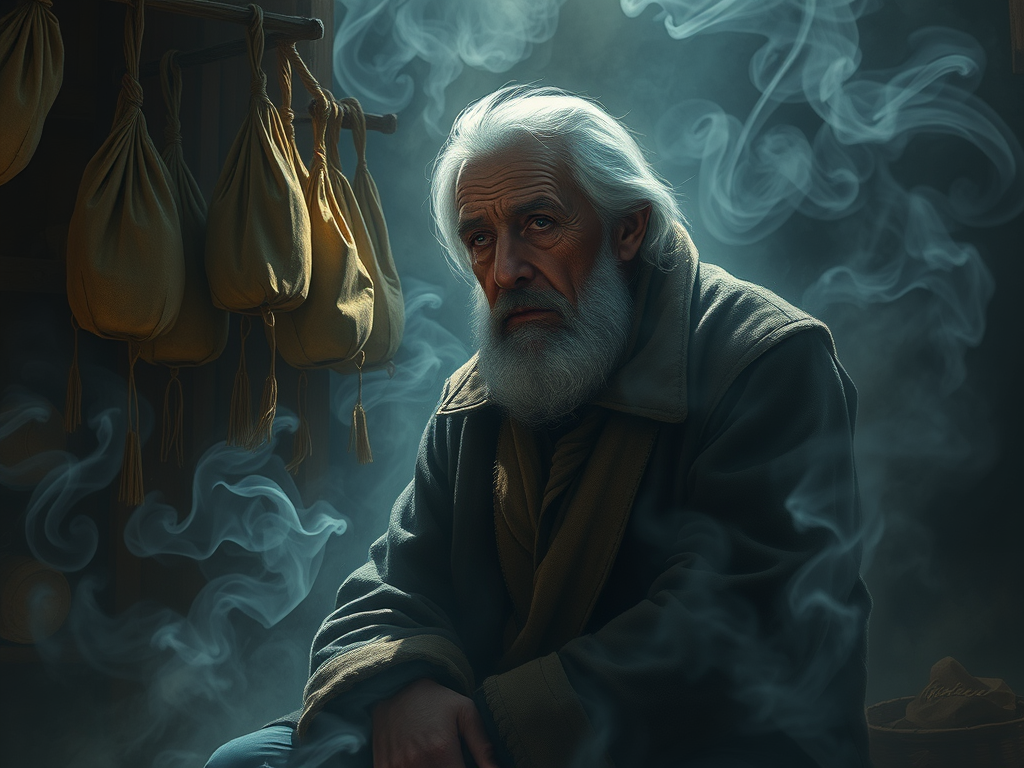
For I have become like a wineskin in smoke,
Yet I do not forget Your statutes.
83 KJV
For I am become like a bottle in the smoke; yet do I not forget thy statutes.
Like a Bottle in the Smoke

My Notes
David paints a vivid picture of suffering: like a wineskin hung in a smoky tent, blackened, shriveled, and worn. In ancient times, these skins—once supple and useful—would become dry and cracked when exposed to smoke and heat. David felt the same way. His sorrow had etched itself into his body and soul, leaving him weary, discolored by grief, and seemingly forgotten.
What a striking metaphor from a man who was not only a poet and prophet, but a man after God’s own heart. Many of us know this feeling—dingy, diminished, and discarded.
Yet David’s trials, like smoke, were uncomfortable but not consuming. They did not destroy him.
And here is the beauty: “Yet I do not forget Your statutes.” Though darkened by affliction, David’s heart remained lit by truth. The worst circumstances could not sever his grip on God’s Word. Grace is a living power—it survives what would suffocate everything else. Even when comfort dries up and strength fades, the soul anchored in God’s Word endures.
David’s weakness did not lead to forgetfulness. He continued to seek the Lord, to worship, to meditate on His ways. He knew that comfort would come—not from circumstance, but from the Word itself. And he was right.
This verse teaches us that no matter how low we sink—whether in poverty, sorrow, or shame—the true child of God will not turn away. Lazarus, clothed in rags and covered in sores, was still carried to Abraham’s bosom. Why? Because affliction did not drive him from his faith.
So let us say: “Let my heart be sound, that I may not fall away. Let me hold fast to Your Word, even when the smoke surrounds me.” No grief, no care, no trial should crowd out the truth of God’s promises.
Summary:
Psalm 119:83 expresses David’s deep sense of suffering by likening himself to a wineskin that has become useless and blackened from smoke. This metaphor illustrates his feelings of despair and weariness, both physically and spiritually. Despite such affliction, he remains steadfast in his faith, refusing to forget God’s statutes. The commentaries below highlight that David’s integrity and dedication to God’s word endure amidst distress. The text emphasizes the resilience of faith, asserting that external trials cannot sever one’s bond with divine truths. David cries out for comfort, trusting that God will respond despite his current hardships.
Note: Psalm 119 is an acrostic pattern. There are 22 letters in the Hebrew alphabet; each of the 22 sections is given a letter of the Hebrew alphabet, and each line in that section begins with that letter. Today, we’re looking at verse 83, which is in the 11th section, which is called “כ KAPH”. According to the hebrews4christians.com website, the letter כ KAPH is the 11th letter of the Aleph-Bet, having the numeric value of twenty. The pictograph for כ KAPH looks like the palm of a hand.
The website https://www.abarim-publications.com/Hebrew_Alphabet_Meaning.html defines the meaning of the letter כ KAPH as:
One of two regular words for hand (the other being the 10th letter). The noun כף (kap) denotes the hand as outstretched, asking, and weak. The word basically encompasses anything that is hollow or outstretched in order to receive something: a dish, a plate, etc. The letter kap is written ך when it occurs at the end of a word, and כ when it occurs at the beginning or halfway through a word.
As a prefix, the letter כ (kaph) expresses comparison (“like” as in the name Mi-ka-el, what’s God like?), and as a postfix, it governs pronouns of the second person singular. Note the graceful transition between the self-oriented fist of the letter yod and the other-oriented open hand of the letter kaph.
……Bill

Commentaries:
Charles Spurgeon
“For I am become like a bottle in the smoke.” The skins used for containing wine, when emptied, were hung up in the tent, and when the place reeked with smoke, the skins grew black and sooty, and in the heat, they became wrinkled and worn. The Psalmist’s face through sorrow had become dark and dismal, furrowed and lined; indeed, his whole body had so sympathized with his sorrowing mind as to have lost its natural moisture, and to have become like a skin dried and tanned. His character had been smoked with slander, and his mind parched with persecution; he was half afraid that he would become useless and incapable through so much mental suffering, and that men would look upon him as an old worn-out skin bottle, which could hold nothing and answer no purpose. What a metaphor for a man to use who was certainly a poet, a divine, and a master in Israel, if not a king, and a man after God’s own heart! It is little wonder if we, commoner folk, are made to think very little of ourselves, and are filled with distress of mind. Some of us know the inner meaning of this simile, for we, too, have felt dinghy, mean, and worthless, only fit to be cast away. Very black and hot has been the smoke which has enveloped us; it seemed to come not alone from the Egyptian furnace, but from the bottomless pit; and it had a clinging power which made the soot of it fasten upon us and blacken us with miserable thoughts.
“Yet do I not forget thy statutes.” Here is the patience of the saints and the victory of faith. Blackened the man of God might be by falsehood, but the truth was in him, and he never gave it up. He was faithful to his King when he seemed deserted and left to the vilest uses. The promises came to his mind, and, what was a still better evidence of his loyalty, the statutes were there too: he stuck to his duties as well as to his comforts. The worst circumstances cannot destroy the true believer’s hold upon his God. Grace is a living power which survives that which would suffocate all other forms of existence. Fire cannot consume it, and smoke cannot smother it. A man may be reduced to skin and bone, and all his comfort may be dried out of him, and yet he may hold fast his integrity and glorify his God. It is, however, no marvel that in such a case the eyes which are tormented with the smoke cry out for the Lord’s delivering hand, and the heart heated and faint longs for the divine salvation.
______________________________________________________
Enduring Word
I have become like a wineskin in smoke: The psalmist felt weak, as if he were a fragile wineskin that had turned dry and had become black with smoke. His soul and spiritual life felt dry. (Guzik)
i. A wineskin in smoke was “…useless, shriveled, and unattractive because of being blackened with soot.” (VanGermen) We don’t know if the psalmist said this about his inward condition, his outward condition, or both.
ii. “My natural moisture is dried and burnt up; I am withered, and deformed, and despised, and my case grows worse and worse every day.” (Poole)
iii. Though this illustration speaks about the difficult nature of the psalmist’s trial, it also speaks to the character of the trial: “Our trials are smoke, but not fire; they are very uncomfortable, but they do not consume us.” (Spurgeon)
Yet I do not forget Your statutes: Despite his sense of weakness, he was determined to not forget God’s statutes. Weakness would not make him forget God’s word. (Guzik)
i. John Trapp quoted a martyr of the Christian faith: “No trouble must pull us from the love of the truth. You may pull my tongue out of my head, but not my faith out of my heart.”
______________________________________________________
Albert Barnes
For I am become like a bottle in the smoke – Bottles in the East were commonly made of skins. See the notes at Matthew 9:17. Such “bottles,” hanging in tents where the smoke had little opportunity to escape, would, of course, become dark and dingy, and would thus be emblems of distress, discomfort, and sorrow. The meaning here is, that, by affliction and sorrow, the psalmist had been reduced to a state which would be well represented by such a bottle. A somewhat similar idea occurs in Psalms 22:15 : “My strength is dried up like a potsherd.” See the notes at that place.
Yet do I not forget thy statutes – Compare the notes at Psalms 119:51. Though thus deeply afflicted, though without comfort or peace, yet I do, I will, maintain allegiance to thee and thy law. The doctrine is that distress, poverty, sorrow, penury, and rags – the most abject circumstances of life – will not turn away a true child of God from obeying and serving him. True religion will abide all these tests. Lazarus from the deepest poverty – from beggary – from undressed sores – went up to Abraham’s bosom.
______________________________________________________
John Gill
For I am become like a bottle in the smoke,…. Like a bottle made of the skins of beasts, as was usual in those times and countries: hence we read of old and new bottles, and of their rending, Judges 9:13 Matthew 9:17. Now such a bottle being hung up in a smoky chimney, would be dried and shriveled up, and be good for nothing; so Jarchi’s note is, “like a bottle made of skin, which is dried in smoke;” and the Targum is, “like a bottle that hangs in smoke.”
It denotes the uncomfortable condition the psalmist was in, or at least thought himself to be in; as to be in the midst of smoke is very uncomfortable, so was he, being in darkness, and under the hidings of God’s face; black and sooty, like a bottle in smoke, with sin and afflictions; like an empty bottle, had nothing in him, as he was ready to fear; or was useless as such an one, and a vessel in which there was no pleasure; like a broken one, as he elsewhere says, despised and rejected of men. It may also have respect unto the form of his body, as well as the frame of his mind; be who before was ruddy, and of a beautiful countenance, now was worn out with cares and old age, was become pale and wrinkled, and like a skin bottle shriveled in smoke;
[yet] do I not forget thy statutes; he still attended to the word, worship, ways, and ordinances of the Lord; hoping in due time to meet with comfort there, in which he was greatly in the right.
______________________________________________________
Matthew Henry
David begs God would make haste to comfort him,
1. Because his affliction was great, and therefore he was an object of God’s pity: Lord, make haste to help me, for I have become like a bottle in the smoke, a leathern bottle, which, if it hung any while in the smoke, was not only blackened with soot, but dried, and parched, and shriveled up. David was thus wasted by age, sickness, and sorrow. See how affliction will mortify the strongest and stoutest of men! David had been of a ruddy countenance, as fresh as a rose; but now he is withered, his color is gone, his cheeks are furrowed. Thus does man’s beauty consume under God’s rebukes, as a moth fretting a garment. A bottle, when it is thus wrinkled with smoke, is thrown by, and there is no more use of it. Who will put wine into such old bottles? Thus was David, in his low estate, looked upon as a despised broken vessel, and as a vessel in which there was no pleasure. Good men, when they are drooping and melancholy, sometimes think themselves more slighted than really they are.
2. Because, though his affliction was great, yet it had not driven him from his duty, and therefore he was within the reach of God’s promise: Yet do I not forget thy statutes. Whatever our outward condition is, we must not cool in our affection to the word of God, nor let that slip out of our minds; no care, no grief, must crowd that out. As some drink and forget the law (Prov. 31:5), so others weep and forget the law; but we must in every condition, both prosperous and adverse, have the things of God in remembrance; and, if we be mindful of God’s statutes, we may pray and hope that he will be mindful of our sorrows, though for a time he seems to forget us.
______________________________________________________
Miscellaneous Comments
“A bottle in the smoke.” Sleep was out of the question, for I was…almost smothered with the smoke from a wood fire, for there was no chimney. I was indeed “like a bottle in the smoke,” turned black and dried almost to cracking; for this was something of what the Psalmist had in view. The bottles, being of leather and being hung up in rooms with large fires of wood and without chimneys, they became smoke-dried, shriveled, and unfit for use.
—From “My Wanderings,” by John Gadby, 1860.
The glory and eagerness of the flesh must be emptied, that the Divine gifts may find room, and the remembrance of the commandments of God may be restrained, which cannot be well kept in bottles which are swollen, inflated, and filled.
—Wolfgang Musculus.
Observe here the difference between the beauty and strength of the body and of the soul: the beauty of the soul groweth fairer by afflictions, whereas that of the body is blasted. David was a bottle shriveled and shrunk up; yet the holy frame of his soul was not altered; his beauty was gone, but not his grace.
—Thomas Manton.
“I am become like a bottle in the frost“ (so the Seventy translate it). When spiritual desires burn, carnal desires without doubt cool: on this account followeth, “Since I am become like a bottle in the frost I do not forget thy righteousnesses.” Truly he desireth this mortal flesh to be understood by the bottle, the heavenly blessing by the frost, whereby the lusts of the flesh as it were by the binding of the frost become sluggish: and hence it ariseth that the righteousnesses of God do not slip from the memory, so long as we do not meditate apart from them; since what the apostle saith (Rom 13:14) is brought to pass: “Make not provision for the flesh, to fulfill the lusts thereof.” Therefore, when he had said, “For I have become like a bottle in the frost,” he added, “and I do not forget thy righteousnesses,” that is, I forget them not, because I have become such. For the fervor of lust had cooled, that the memory of love might glow.
—Augustine.
______________________________________________________
Cross-References
Job 30:30 (KJV 1900)
30 My skin is black upon me,
And my bones are burned with heat.
Matthew 9:17 (KJV 1900)
17 Neither do men put new wine into old bottles: else the bottles break, and the wine runneth out, and the bottles perish: but they put new wine into new bottles, and both are preserved.
Psalm 22:15 (KJV 1900)
15 My strength is dried up like a potsherd;
And my tongue cleaveth to my jaws;
And thou hast brought me into the dust of death.
______________________________________________________
Closing Thoughts
I was thinking of the way that God provides, and naturally my thought went to Jehovah Jireh,” The Lord Will Provide”. I was looking for information and ran across this article, which is exceptional in my opinion, and I wanted to share it. The author’s name is Barnabas Piper and can be found at this link (https://www.biblestudytools.com/bible-study/topical-studies/jehovah-jireh-the-lord-will-provide.html)…….Bill
כ KAPH כ: Fainting from affliction, revived by God’s word.
Psalm 119: 81-88
81
My soul faints for Your salvation,
But I hope in Your word.
82
My eyes fail from searching Your word,
Saying, “When will You comfort me?”
83
For I have become like a wineskin in smoke,
Yet I do not forget Your statutes.
84
How many are the days of Your servant?
When will You execute judgment on those who persecute me?
85
The proud have dug pits for me,
Which is not according to Your law.
86
All Your commandments are faithful;
They persecute me wrongfully;
Help me!
87
They almost made an end of me on earth,
But I did not forsake Your precepts.
88
Revive me according to Your lovingkindness,
So that I may keep the testimony of Your mouth.

- Exploring the Beauty of Psalms: Insights and Commentaries
- Monthly Breakdown of Our Blog Content
- Psalms Commentary: Faith and Inspiration
Leave a Reply