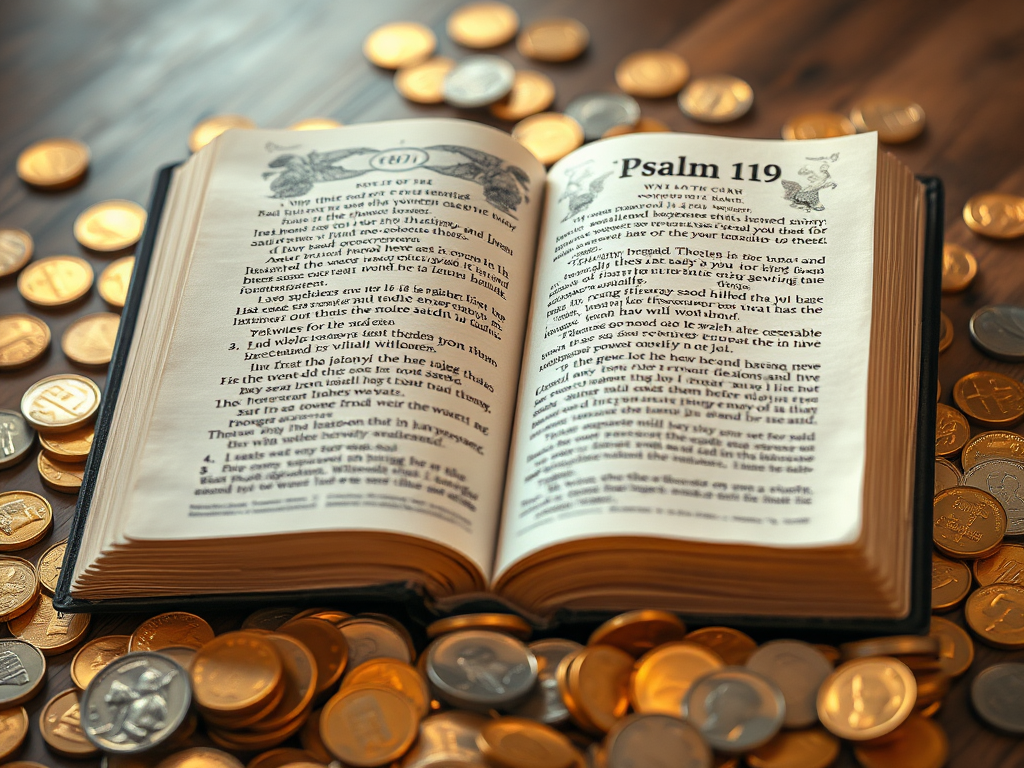
Psalm 119:72 NKJV
72
The law of Your mouth is better to me
Than thousands of coins of gold and silver.
The Treasure Above All Treasures

My Notes
David, though a man of great wealth, counted the Word of God as far more valuable than gold or silver. And this wasn’t theoretical—David had seen wealth on a scale few could imagine.
In preparation for the construction of the House of the Lord, David gathered extraordinary resources for Solomon:
-
100,000 talents of gold
-
1,000,000 talents of silver
-
Bronze and iron beyond measure
-
Timber and stone in abundance (1 Chronicles 22:14)
On top of these public provisions, David gave generously from his personal treasury:
-
3,000 talents of gold from Ophir
-
7,000 talents of refined silver for the temple walls (1 Chronicles 29:3–4)
To put this into perspective: 100,000 talents of gold would be worth over $315 billion today. And still, David saw the Word of the Lord as a possession worth much more.
Wealth is fleeting. It can be lost, stolen, or rendered meaningless in death. But the Word of God is eternal—its value never diminishes, and its promises carry us even beyond the grave.
David didn’t come to this conviction through ease and prosperity. His deep love for God’s Word was forged through a life of pain and redemption. His afflictions weren’t merely endured—they became lessons, and through those lessons, David learned to treasure the statutes of God.
Charles Spurgeon once said, “God’s commands are best read by eyes wet with tears.” That sentiment rings true here. David came to understand that affliction wasn’t meaningless—it was the pathway to deeper spiritual insight.
Paul echoes this in 2 Corinthians 12:9–10:
“And He said to me, ‘My grace is sufficient for you, for My strength is made perfect in weakness.’ Therefore most gladly I will rather boast in my infirmities, that the power of Christ may rest upon me. Therefore I take pleasure in infirmities, in reproaches, in needs, in persecutions, in distresses, for Christ’s sake. For when I am weak, then I am strong.” (2 Corinthians 12:9–10, NKJV)
David discovered that the profit gained through affliction—the wisdom, the closeness to God, the understanding of His Word—was more precious than all the riches he had accumulated. The Word became his delight, his anchor, and his hope. Nothing in his treasury could compare.
In Psalm 119:72, David expresses that God’s word holds greater value than vast riches, such as gold and silver. The commentaries below emphasize the importance of recognizing the word of God as a source of life and guidance, not merely a historical text. Affliction has a role in deepening appreciation for divine statutes, suggesting that experience enhances one’s understanding of spiritual wealth over material wealth. David valued the law of God above earthly possessions, illustrating a perspective that prioritizes spiritual truth and guidance. This sentiment is echoed throughout scripture, reflecting the enduring significance of God’s teachings over worldly treasures.
Note: Psalm 119 is an acrostic pattern. There are 22 letters in the Hebrew alphabet; each of the 22 sections is given a letter of the Hebrew alphabet, and each line in that section begins with that letter. Today, we’re looking at verse 72, which is in the 9th section, which is called “Teth ט”. According to the hebrews4christians.com website, this letter is listed as “TET where the NKJV lists it as “TETH”, the letter Teth ט is the 9th letter of the Aleph-Bet, having the numeric value of nine. The pictograph for Teth ט looks like a snake coiled inside a basket.
The website https://www.abarim-publications.com/Hebrew_Alphabet_Meaning.html defines the meaning of the letter TETH as:
“The origin of the teth is a bit of a mystery. Klein derives from טות (twh), spin, and renders teth to knot, knot together, to twist into each other, to interweave. The letter teth indeed looks like a little vortex or spiral.”
……..Bill
Commentaries:
Charles Spurgeon
“The law of thy mouth.” A sweetly expressive name for the word of God. It comes from God’s own mouth with freshness and power to our souls. Things written are as dried herbs, but speech has a liveliness and dew about it. We do well to look upon the word of the Lord as though it were newly spoken into our ear; for in very truth it is not decayed by years, but is as forcible and sure as though newly uttered. Precepts are prized when it is seen that they come forth from the lips of our Father who is in heaven. The same lips which spoke us into existence have spoken the law by which we are to govern that existence. Whence could a law so sweetly proceed as from the mouth of our covenant God? Well may we prize beyond all price that which comes from such a source.
“Is better unto me than thousands of gold and silver.” If a poor man had said this, the world’s witlings would have hinted that the grapes are sour, and that men who have no wealth are the first to despise it; but this is the verdict of a man who owned his thousands, and could judge by actual experience of the value of money and the value of truth. He speaks of great riches, he heaps it up by thousands, he mentions the varieties of its forms,—”gold and silver,” and then he sets the word of God before it all, as better to him, even if others did not think it better to them. Wealth is good in some respects, but obedience is better in all respects. It is well to keep the treasures of this life, but far more commendable to keep the law of the Lord. The law is better than gold and silver, for these may be stolen from us, but not the word; these take to themselves wings, but the word of God remains; these are useless in the hour of death, but then it is that the promise is most dear. Instructed Christians recognize the value of the Lord’s word, and warmly express it, not only in their testimony to their fellow men, but in their devotions to God. It is a sure sign of a heart which has learned God’s statutes when it prizes them above all earthly possessions, and it is an equally certain mark of grace when the precepts of Scripture are as precious as its promises. The Lord causes us thus to prize the law of his mouth.
See how this portion of the psalm is flavored with goodness. God’s dealings are good (Psa 119:65), holy judgment is good (Psa 119:66), affliction is good (Psa 119:67), God is good (Psa 119:68), and here the law is not only good, but better than the best of treasure. Lord, make us good, through thy good word. Amen.
______________________________________________________
Enduring Word
The law of Your mouth is better to me than thousands of coins of gold and silver: This is a logical extension of the thought in the previous verse. If the psalmist understands that even trouble can be good if it teaches him the word of God – if it is more valuable than his comfort – then it is also possible to say that it is more valuable than riches.
i. This great estimation of the word of God came from a life that had known affliction. It was love and appreciation from the field of battle, not the palaces of ease and comfort.
ii. “Herbert Lockyer recounts a story concerning the largest Bible in the world, a Hebrew manuscript weighing 320 pounds in the Vatican library. Long ago, a group of Italian Jews asked to see this Bible, and when they had seen it, they told their friends in Venice about it. As a result, a syndicate of Russian Jews tried to buy it, offering the church the weight of the book in gold. Julius the Second was Pope at that time, and he refused the offer, even though the value of such a large amount of gold was enormous…. Today, we pay little to possess multiple copies of God’s Word. But do we value it? In many cases, I am afraid not.” (Boice)
iii. “The word of God must be nearer to us than our friends, dearer to us than our lives, sweeter to us than our liberty, and pleasanter to us than all earthly comforts.” (John Mason, cited in Spurgeon)
______________________________________________________
John Gill
The law of thy mouth [is] better unto me than thousands of gold and silver. The word of God, the doctrines contained in it; which, coming out of the mouth of God, and spoken by him, carries in it weight and authority, commands reverence and respect; and ought to be considered as indeed the word of God and not of man; and so of more value than thousands of pieces of gold and silver; or, as the Targum, than a thousand talents of gold and silver. The truths and doctrines of the word of God are not only comparable to gold and silver for their intrinsic worth and value; but are preferable to them, and to be received before them: David had his thousands of gold and silver, but he esteemed the word of God above them all; and willingly suffered afflictions, that he might understand it better; see Psalm 119:127.
______________________________________________________
Matthew Henry
This is a reason why David reckoned that when by his afflictions he learned God’s statutes, and the profit did so much counterbalance the loss, he was really a gainer by them; for God’s law, which he got acquaintance with by his affliction, was better to him than all the gold and silver which he lost by his affliction.
1. David had but a little of the word of God in comparison with what we have, yet see how highly he valued it; how inexcusable then are we, who have both the Old and New Testament complete, and yet account them as a strange thing! Observe, therefore, he valued the law, because it is the law of God’s mouth, the revelation of his will, and ratified by his authority.
2. He had a great deal of gold and silver in comparison with what we have, yet see how little he valued it. His riches increased, and yet he did not set his heart upon them, but upon the word of God. That was better to him, yielded him better pleasures, and better maintenance, and a better inheritance, than all the treasures he was master of. Those that have read and believe David’s Psalms and Solomon’s Ecclesiastes, cannot but prefer the word of God far before the wealth of this world.
______________________________________________________
Adam Clarke
“Who can say this? Who prefers the law of his God, the Christ that bought him, and the heaven to which he hopes to go, when he can live no longer upon earth, to thousands of gold and silver? Yea, how many are there who, like Judas, sell their Saviour even for thirty pieces of silver? Hear this, ye lovers of the world and of money!”
______________________________________________________
Miscellaneous Comments
“The law of thy mouth is better unto me.” The sacred Scriptures are the treasures and pleasures of a gracious soul: to David, they were better than thousands of gold and silver. A mountain of transparent pearls, heaped as high as heaven, is not so rich in treasure as these; hence that good man chose these as his heritage forever, and rejoiced in them as in all riches. A covetous miser could not take such delight in his bags, nor a young heir in a large inheritance, as holy David did in God’s word.
The word law comes from a root that signifies to try, as merchants that search and prove the wares that they buy and lay up; hence also comes the word for gems and jewels that are tried, and found right. The sound Christian is the wise merchant, seeking goodly pearls; he tries what he reads or hears by the standard or touchstone of Scripture, and having found genuine truths, he lays them up to the great enriching of this supreme and sovereign faculty of the understanding.
—Oliver Heywood.
The word of God must be nearer to us than our friends, dearer to us than our lives, sweeter to us than our liberty, and more pleasant to us than all earthly comforts.
—John Mason.
One lesson, taught by sanctified affliction, is the love of God’s word. “This is my comfort, in my affliction: thy word hath quickened me.” In reading a part of the one hundred and nineteenth psalm to Miss Westbrook, who died, she said, “Stop, sir, I never said so much to you before—I never could; but now I can say, ‘The word of thy mouth, is dearer to me, than thousands of gold and silver.’ What can gold and silver do for me by now?”
—George Redford, in “Memoirs of the late Rev. John Cooke,” 1828.
“Thousands of gold and silver.” Worldly riches are gotten with labour, kept with care, lost with grief. They are false friends, farthest from us when we have most need of comfort; as all worldlings shall find to be true in the hour of death. For then, as Jonah’s gourd was taken from him in a morning, when he had most need of it against the sun; so is it with the comfort of worldlings. It is far otherwise with the word of God; for if we will lay it up in our hearts, as Mary did, the comfort thereof shall sustain us, when all other comfort shall fail us.
This it is that makes us rich unto God, when our souls are storehouses, filled with the treasures of his word. Shall we think it poverty to be scant of gold and silver? “An ideo angelus pauperest, quia non habet jumenta,” etc (Chrysostom). Shall we esteem the angels poor, because they have not flocks of cattle? or that S. Peter was poor, because he had not gold nor silver to give unto the cripple? No, he had a store of grace, by infinite degrees more excellent than it.
Let the riches of gold be left unto worldlings: these are not current: in Canaan, not accounted of in our heavenly country. If we would be in any estimation there, let us enrich our souls with spiritual graces, which we have in abundance in the mines and treasures of the word of God.
—William Cowper.
______________________________________________________
Cross-References
Psalm 19:10 (KJV 1900)
10 More to be desired are they than gold, yea, than much fine gold:
Sweeter also than honey and the honeycomb.
Proverbs 8:10–11 (KJV 1900)
10 Receive my instruction, and not silver;
And knowledge rather than choice gold.
11 For wisdom is better than rubies;
And all the things that may be desired are not to be compared to it.
Proverbs 3:14–15 (KJV 1900)
14 For the merchandise of it is better than the merchandise of silver,
And the gain thereof than fine gold.
15 She is more precious than rubies:
And all the things thou canst desire are not to be compared unto her.
______________________________________________________
Closing Thoughts
Not only thy promises, but even thy precepts, which are so unpleasant and hard to ungodly men, to me they are more desirable and more needful and profitable, because they do not only give me abundant satisfaction and comfort in this life, but also they conduct me with safety and delight unto that eternal and most blessed life, where gold and silver bear no price.
Matthew Poole, Annotations upon the Holy Bible, vol. 2 (New York: Robert Carter and Brothers, 1853), 186.
New King James Version
ט TETH: God’s word brings benefit from a time of affliction.
65
You have dealt well with Your servant,
O Lord, according to Your word.
66
Teach me good judgment and knowledge,
For I believe Your commandments.
67
Before I was afflicted I went astray,
But now I keep Your word.
68
You are good, and do good;
Teach me Your statutes.
69
The proud have forged a lie against me,
But I will keep Your precepts with my whole heart.
70
Their heart is as fat as grease,
But I delight in Your law.
71
It is good for me that I have been afflicted,
That I may learn Your statutes.
72
The law of Your mouth is better to me
Than thousands of coins of gold and silver.

- Exploring the Beauty of Psalms: Insights and Commentaries
- Monthly Breakdown of Our Blog Content
- Psalms Commentary: Faith and Inspiration
Leave a Reply