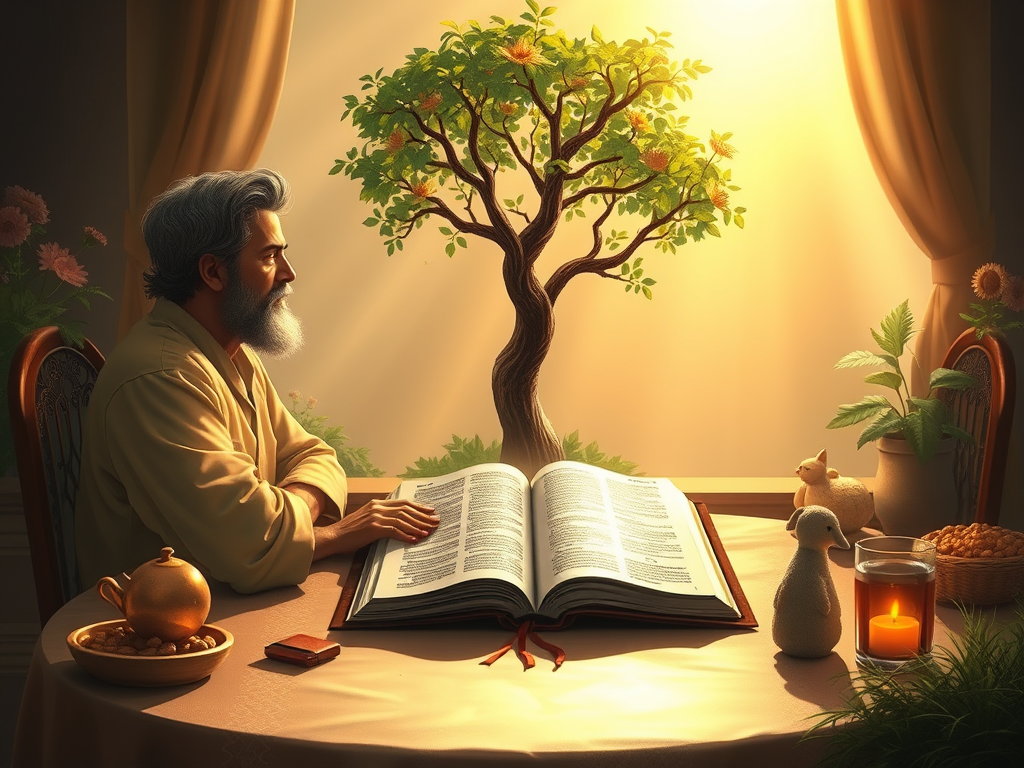
Psalm 112 – New King James Version
Introduction to Psalm 112
Psalm 112 emphasizes the blessings and characteristics of those who fear the Lord. It highlights that a righteous person who delights in God’s commandments will be secure, prosperous, and compassionate. Their descendants will be mighty, and their righteousness will endure. The psalm contrasts the fate of the wicked, who will face grief and destruction. Structured as an acrostic, the psalm serves as a companion to Psalm 111, reflecting on the divine qualities manifested in the lives of the righteous.
The author of this psalm is unknown. In the commentaries below, it is speculated that either David or Zechariah and Haggai wrote it after the captivity………..Bill
_________________________
Commentaries
Tony Evans
112:1–6 The psalmist describes the person who fears the Lord. Such a person is not all talk; rather, he takes delight in [God’s] commands (112:1). He knows that fearing God is about how you live and not merely what you say. The psalmist also recounts the blessings available to those who fear the Lord and describes their godly character (112:2–4). As a result, they will experience goodness and be unshakeable (112:5–6).
112:7–10 The one who fears God will not fear circumstances or people because his heart is confident, trusting in the Lord (112:7–8). He cares for the poor, and God cares for him (112:9). The wicked one, on the other hand, sees the activity of those who fear God and is driven to rage. Nevertheless, such rage is impotent; his desire … leads to ruin (112:10). Thus, we are reminded that, ultimately, the righteous will prosper and the wicked will perish (see Ps 1).
Tony Evans, The Tony Evans Bible Commentary (Nashville, TN: Holman Bible Publishers, 2019), 564.
_________________________
Charles Spurgeon
There is no title to this psalm, but it is evidently a companion to the hundred and eleventh, and, like it, it is an alphabetical psalm. Even in the number of verses and clauses of each verse, it coincides with its predecessor, as also in many of its words and phrases. The reader should carefully compare the two psalms line by line. The subject of the poem before us is—the blessedness of the righteous man, and so it bears the same relation to the preceding which the moon does to the sun; for, while the first declares the glory of God, the second speaks of the reflection of the divine brightness in men born from above. God is here praised for the manifestation of his glory, which is seen in his people, just as in the preceding psalm, he was magnified for his own personal acts. The hundred and eleventh speaks of the great Father, and this describes his children renewed after his image. The psalm cannot be viewed as the extolling of man, for it commences with “Praise ye the Lord,” and it is intended to give to God all the honor of his grace, which is manifested in the sons of God.
_________________________
Barnes
The author of this psalm, as of the preceding, is unknown, and equally with that, it is impossible now to ascertain the time or the occasion of its composition. It is a psalm of the same structure as that, with the same number of verses; like that, it is alphabetical in its form, and composed in the same manner – the first eight verses with two clauses each, beginning with successive letters of the Hebrew alphabet – and the last two verses with “three” clauses, beginning, in like manner, with three letters of the alphabet in succession. This peculiarity of structure makes it highly probable that it was composed by the same author.
It is further to be noticed that this psalm “begins” where the other “ends,” with the happiness or blessedness of “fearing God,” and is designed to set forth that blessedness or to show what are the advantages of true religion. This fact makes it further probable that the two psalms were composed by the same author.
This psalm is very simple in its structure. It sets forth the advantages or benefits of the fear of the Lord, or of religion in respect
(a) to the posterity of the man, Psalms 112:2;
(b) in securing wealth, Psalms 112:3;
(c) in the light which springs up in darkness, Psalms 112:4;
(d) in the discretion with which such a man is enabled to manage his affairs, Psalms 112:5;
(e) in the firmness and composure of his mind in times of danger and trouble, Psalms 112:6-8;
(f) in his being so prosperous, and so exalted, that he will become an object of envy to the wicked, Psalms 112:9-10.
_________________________
John Gill
This psalm, also, very probably, was written by David, and is composed as the former, in an alphabetical order. The inscription of it in the Syriac version is, “When David in it commanded Solomon his son, saying, Keep the commandments of, the Lord, and worship him: likewise the calling of the Gentiles and the righteousness of Christ.” The subject matter of the psalm are the character, conduct, usefulness, and happiness of a good man.
_________________________
Matthew Henry
This psalm is composed alphabetically, as the former is, and is (like the former) entitled “Hallelujah,” though it treats of the happiness of the saints because it redounds to the glory of God, and whatever we have the pleasure of he must have the praise of. It is a comment upon the last verse of the foregoing psalm and fully shows how much it is our wisdom to fear God and do his commandments. We have here,
I. The character of the righteous (v. 1).
II. The blessedness of the righteous.
1. There is a blessing entailed upon their posterity (v. 2).
2. There is a blessing conferred upon themselves.
(1.) Prosperity outward and inward (v. 3).
(2.) Comfort (v. 4).
(3.) Wisdom (v. 5).
(4.) Stability (v. 6-8).
III. The misery of the wicked (v. 10). So that good and evil are set before us, the blessing and the curse.
In singing this psalm, we must not only teach and admonish ourselves and one another to answer to the characters here given of the happy but comfort and encourage ourselves and one another with the privileges and comforts here secured to the holy.
_________________________
Clarke
This is another of the acrostic or alphabetical Psalms, under the title Hallelujah. It is formed exactly as the preceding in the division of its verses. It has ten verses in the whole: the Psalms 112:1-8 contain each two hemistichs, beginning with a consecutive letter of the alphabet; the Psalms 112:9-10; Psalms 112:9-10Psalms 112:9-10 verses, three each, making twenty-two in the whole. It is understood to have been written after the captivity, and probably by Zechariah and Haggai: to them it is ascribed by the Vulgate.
_________________________
John D. Barry
112:1–10 Psalm 112 is structured as an alphabetic acrostic, in which each line begins with a successive letter of the Hebrew alphabet (see 111:1–10 and note). It is a wisdom psalm—meant to pass along wise sayings—that, like Psa 1, contrasts the path of the righteous with the path of the wicked. The psalmist first describes the character of the righteous (v. 1), then recalls the blessings that come to them (vv. 2–5). He shows that the righteous are secure because they can trust in Yahweh (vv. 6–9). The psalmist concludes by mentioning the ultimate fate of the wicked (v. 10).
John D. Barry et al., Faithlife Study Bible (Bellingham, WA: Lexham Press, 2012, 2016), Ps 112:1–10.
_________________________
J. A. Motyer
The psalm moves consecutively through clear topics, devoting four lines to the first four and six lines to the last:
(i) 1–2 Individual and family: Each individual is moved inwardly by reverential fear, issuing outwardly in delighted obedience (1). To this character and conduct, a particular blessedness is attached—children of recognized worth (2a, cf. Pr. 20:7) and a blessing that extends to succeeding generations (2b).
(ii) 3–4 Fortune and misfortune. Righteousness is double-faceted: endlessly right with God, constantly committed to righteousness of life. Such a person is amply provided for (3a, cf. 1:3; 73:23–26) but is not immune from life’s darkness. When such comes, they are faced in the faith that light is bound to dawn. But while the darkness lasts, the duties remain of continuing upright in conduct, gracious and compassionate (cf. 111:4) in relationships and righteous in character.
(iii) 5–6 Generosity and security. As surely as light will dawn in darkness, so good will come—but note how the emphasis still rests on maintained character—a generous spirit (5a, the same word that provided the word for gracious in 4b, 111:4b) practicing liberality (lends freely) and a life lived with justice, i.e. applying principles of righteousness through right decisions.
(iv) 7–8 Threat and trust. The life of the righteous is not a bed of roses. Bad news comes (not now the darkness of 4a, but human hostility, 8b), yet there is no loss of peace. The heart remains steadfast because the Lord is trusted. Furthermore, this is not a passing mood but a maintained attitude until the threat is over. Look in triumph, (lit.) ‘look upon/at his foes’, may be an idiom for ‘see the last of’, certainly no sense of gloating is intended.
(v) 9–10 character, conduct and destiny. Each verse expresses its own telling sequence: generosity in the context of a life that is right with God and right in conduct leads to honour (9, Rom. 2:10); wickedness with animosity is self-destructive (10) and ends in nothing, (lit.) ‘will perish’.
J. A. Motyer, “The Psalms,” in New Bible Commentary: 21st Century Edition, ed. D. A. Carson et al., 4th ed. (Leicester, England; Downers Grove, IL: Inter-Varsity Press, 1994), 561–562.
_________________________
The Blessed State of the Righteous
1
Praise the Lord!
Blessed is the man who fears the Lord,
Who delights greatly in His commandments.
2
His descendants will be mighty on earth;
The generation of the upright will be blessed.
3
Wealth and riches will be in his house,
And his righteousness endures forever.
4
Unto the upright there arises light in the darkness;
He is gracious, and full of compassion, and righteous.
5
A good man deals graciously and lends;
He will guide his affairs with discretion.
6
Surely he will never be shaken;
The righteous will be in everlasting remembrance.
7
He will not be afraid of evil tidings;
His heart is steadfast, trusting in the Lord.
8
His heart is established;
He will not be afraid,
Until he sees his desire upon his enemies.
9
He has dispersed abroad,
He has given to the poor;
His righteousness endures forever;
His horn will be exalted with honor.
10
The wicked will see it and be grieved;
He will gnash his teeth and melt away;
The desire of the wicked shall perish.

- Exploring the Beauty of Psalms: Insights and Commentaries
- Monthly Breakdown of Our Blog Content
- Psalms Commentary: Faith and Inspiration
Closing Thoughts
Let not mercy and truth forsake you; Bind them around your neck, Write them on the tablet of your heart, And so find favor and high esteem In the sight of God and man. Proverbs 3:3-4 NKJV
You will keep him in perfect peace, Whose mind is stayed on You, Because he trusts in You. Trust in the Lord forever, For in Yah, the Lord, is everlasting strength. Isaiah 26:3-4 NKJV
My son, give attention to my words; Incline your ear to my sayings. Do not let them depart from your eyes; Keep them in the midst of your heart; For they are life to those who find them, And health to all their flesh. Keep your heart with all diligence, For out of it spring the issues of life. Proverbs 4:20-23 NKJV


Leave a Reply