4
The Lord has sworn
And will not relent,
“You are a priest forever
According to the order of Melchizedek.”
My Thoughts
Scripture: “The Lord has sworn and will not relent, ‘You are a priest forever according to the order of Melchizedek.’” — Psalm 110:4 (NKJV)
My Thoughts
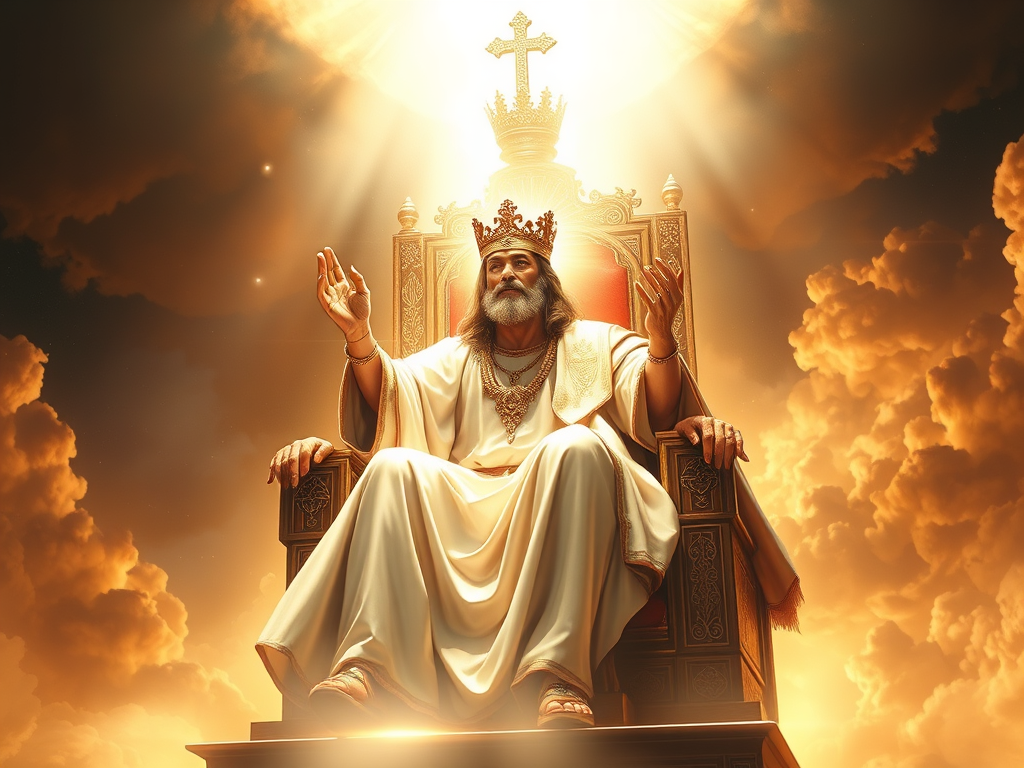
In this verse, we hear the voice of God the Father declaring an unchangeable oath concerning His Son: “You are a priest forever.” This is not a temporary appointment, nor a ceremonial title—it is an eternal calling, sealed by divine promise. Jesus is our Priest-King, ordained not by human lineage, but by heavenly decree.
The priesthood of Christ is unlike any other. It is not patterned after Aaron, whose sons inherited their role by birth. Instead, it follows the mysterious figure of Melchizedek, who appears briefly in Genesis 14. Melchizedek—king of righteousness and king of peace—blessed Abraham and received his tithe, standing as priest of the Most High God. He had no recorded genealogy, no beginning or end, and no successor. His priesthood was unique, timeless, and divinely appointed.
So it is with Jesus. He did not glorify Himself to become High Priest; He was chosen by the Father from eternity past. He ministers not in an earthly tabernacle, but in the heavenly sanctuary. He offers not the blood of animals, but His own perfect sacrifice. He intercedes for us continually, and His priesthood will never be replaced.
Consider the beauty of this truth:
- Jesus is our Mediator—He bridges the gap between God and man.
- Jesus is our Advocate—He pleads for us with compassion and authority.
- Jesus is our Atonement—He offered Himself once for all, securing eternal redemption.
- Jesus is our Blessing—He has left His peace upon the believing, and now reigns in glory.
His priesthood is forever. That means His mercy is forever. His intercession is forever. His grace is forever. We need no other priest, no other sacrifice, no other mediator. Christ is enough—yesterday, today, and forever (Hebrews 13:8).
Let us rest in the permanence of His priesthood and rejoice in the power of His ministry. The King-Priest has come, and He will never leave His post.
Cross Reference
“Therefore He is also able to save to the uttermost those who come to God through Him, since He always lives to make intercession for them.” — Hebrews 7:25 (NKJV)
Questions
- What does it mean to you that Jesus is your priest forever?
- How does His eternal intercession shape your confidence in prayer?
- In what ways can you rest more fully in His finished work today?
Prayer
Lord Jesus, You are my eternal Priest—chosen by the Father, faithful in Your ministry, and forever interceding for me. I rest in Your finished work and rejoice in Your unchanging grace. Teach me to trust You completely and to walk in the peace You have secured for me. In Jesus’ name I pray, Amen.
…..Bill
_____________________________
Commentaries:
Charles Spurgeon
We have now reached the heart of the psalm, which is also the very center and soul of our faith. Our Lord Jesus is a Priest-King by the ancient oath of Jehovah: “he glorified not himself to be made an high priest,” but was ordained there unto from of old, and was called of God an high priest after the order of Melchizedek. It must be a solemn and a sure matter which leads the Eternal to swear, and with him an oath fixes and settles the decree forever; but in this case, as if to make assurance a thousand times sure, it is added, “and will not repent.” It is done, and done forever and ever; Jesus is sworn in to be the priest of his people, and he must abide so even to the end because his commission is sealed by the unchanging oath of the immutable Jehovah. If his priesthood could be revoked and his authority removed, it would be the end of all] hope and life for the people whom he loves; but this sure rock is the basis of our security—the oath of God establishes our glorious Lord both in his priesthood and in his throne. It is the Lord who has constituted him a priest forever, he has done it by oath, that oath is without repentance, is taking effect now, and will stand throughout all ages: hence, our security in him is placed beyond all question.
The declaration runs in the present tense as being the only time with the Lord, and comprehending all other times. “Thou art,” i.e., thou wast and art and art to come, in all ages a priestly King. The order of Melchizedek’s priesthood was the most ancient and primitive, the most free from ritual and ceremony, the most natural and simple, and at the same time the most honorable. That ancient patriarch was the father of his people and at the same time ruled and taught them; he swayed both the scepter and the censer, reigned in righteousness, and offered sacrifice before the Lord. There has never arisen another like to him since his days, for whenever the kings of Judah attempted to seize the sacerdotal office, they were driven back to their confusion: God would have no king-priest save His son. Melchizedek’s office was exceptional none preceded or succeeded him; he comes upon the page of history mysteriously; no pedigree is given, no date of birth, or mention of death; he blesses Abraham, receives tithe and vanishes from the scene amid honors which show that he was greater than the founder of the chosen nation. He is seen but once, and that once suffices. Aaron and his seed came and went; their imperfect sacrifice continued for many generations because it had no finality in it and could never make the comers thereunto perfect. Our Lord Jesus, like Melchizedek, stands forth before us as a priest of divine ordaining; not made a priest by fleshly birth, as the sons of Aaron: he mentions neither father, mother, nor descent, as his right to the sacred office; he stands upon his personal merits, by himself alone; as no man came before him in his work, so none can follow after; his order begins and ends in his own person, and in himself it is eternal, “having neither beginning of days nor end of years The King Priest has been here and left his blessing upon the believing, and now he sits in glory in his complete character, stoning for us by the merit of his blood, and exercising all power on our behalf.”
O may we ever hear thy voice
In mercy to us speak,
And in our Priest we will rejoice,
Thou great Melchizedek.
_____________________________
Enduring Word
The LORD has sworn and will not relent: This puts the statement which follows in the most solemn and strong context possible. Yahweh (specifically, God the Father) made an oath that would never be annulled. (Guzik)
i. “God, as it were, pledges His own name, with its fulness of unchanging power, to the fulfilment of the word; and this irrevocable and omnipotent decree is made still more impressive by the added assurance.” (Maclaren)
You are a priest forever according to the order of Melchizedek: This is the oath of Yahweh (specifically, God the Father) regarding the Messiah, God the Son. He vowed that the Messiah had an eternal priesthood and that it was after the pattern (order) of Melchizedek, who is mentioned in a single account in the Old Testament (Genesis 14:18-20).
i. The Genesis 14 account is brief but densely packed with information about Melchizedek.
· After Abraham defeated the confederation of kings who took his nephew Lot captive, Abraham met with a mysterious priest named Melchizedek, whose name means king of righteousness and who was also king over the city of Salem (an ancient name for the city of Jerusalem), which made him the king of peace.
· Melchizedek was not merely a worshipper of the true God. He had the honored title priest of the Most High God. The greatness of God magnified the greatness of Melchizedek’s priesthood.
· Melchizedek blessed Abraham, demonstrating his greatness over the patriarch.
· Abraham gave Melchizedek a tithe, which is a tenth part of all (all the spoils of battle, as mentioned in Genesis 14:20).
· There is no mention of any father or mother of Melchizedek, and he appears without any genealogy. (Guzik)
You are a priest forever according to the order of Melchizedek: With this oath, God revealed that there is another order of priesthood, apart from the priestly order of Aaron. The Israelite priests were all descended from Aaron and served in the tabernacle (later the temple), offering sacrifices and conducting ceremonies according to God’s law. Here, we see that God established another priestly order after the pattern of Melchizedek. (Guzik)
You are a priest forever according to the order of Melchizedek: This oath was so important that the author of Hebrews refers to it five times (Hebrews 5:6, 5:10, 6:20, 7:17, and 7:21).
· Hebrews 5:5-6 and 5:10 emphasize that this was Yahweh’s declaration, not something that the Messiah claimed for Himself.
· In Hebrews 6:20, the emphasis is on the idea that Jesus the Messiah serves now and forever as a living, active High Priest for His people.
· Hebrews 7:17 emphasizes that the priesthood of Jesus the Messiah, according to the order of Melchizedek, is better than the priestly order of Aaron because it is eternal and will never end.
· Hebrews 7:21 emphasizes that the priesthood of Jesus the Messiah, according to the order of Melchizedek, is better than the priestly order of Aaron because it was founded on a direct oath of Yahweh, unlike the priestly order of Aaron. (Guzik)
i. “His priesthood is not, like that of Aaron, figurative, successive, and transient, but real and effectual, fixed and incommunicable, eternal and unchangeable.” (Horne)
ii. “The Church is collected and conserved not only by Christ’s kingly power, but also by his priestly mediation” (Trapp)
_____________________________
Barnes
The Lord hath sworn – He has confirmed the appointment of the Messiah by a solemn oath, or as by an oath. That is, it is as sure and fixed as if he had taken an oath. Compare Hebrews 6:13. The “time,” so to speak, if the word time can be applied to transactions in a past eternity, was that when he was designated in the divine purpose as Messiah; in the eternal counsels of God. Compare Psalms 2:7.
And will not repent – Will not change his purpose.
Thou art a priest forever after the order of Melchizedek – The word rendered “order” here means properly a word, a thing, a matter; hence, a way or manner. The meaning here is that he would be a priest “after the manner” of Melchizedek, or, such a priest as he was. He would not be of the tribe of Levi; he would not be in the regular line of the priesthood, but he would resemble, in the characteristics of his office, this ancient priest-king, combining in himself the two functions of priest and king; as a priest, standing alone; not deriving his authority from any line of predecessors; and having no successors. See this verse explained at length, in its application to the Messiah, in the notes at Hebrews 5:6 (note), Hebrews 5:10 (note), Hebrews 7:1-3 (note). The passage as it stands here, and as looked at without any reference to the use made of it in the New Testament, would imply these things:
(1) That he who was spoken of would be, in a proper sense, a priest.
(2) that he would have a perpetual or permanent priesthood – “forever.”
(3) that he would not be of the established line of priests in the tribe of Levi, but that his appointment would be unusual and extraordinary.
(4) that the appointment would come directly from God and would not be “derived” from those who went before him.
(5) that as a priest, he would “resemble” Melchizedek, according to the record which was found of Melchizedek in Genesis.
(6) that as Melchizedek was a priest of the Most High God, so he would be.
(7) that as Melchizedek combined in himself the functions of both priest and king, so these would be found in him.
(8) that as Melchizedek had no successors in office, so he would have none.
How far these things were applicable to the Lord Jesus Christ, and with what propriety the passage might be applied to him, may be seen by examining the Epistle to the Hebrews, Heb. 5–7.
_____________________________
John Gill
The Lord hath sworn, and will not repent,…. What he swore about, and did not repent of, was the priesthood of Christ, as follows; and which shows the importance of it, since when Jehovah swears, as it is by himself, because he can swear by no greater; so it is about matters of great moment only that are sworn to by the Lord, as this of the priesthood of Christ was; which was concerned in things pertaining to God and his glory, as well as in making reconciliation for the sins of his people: and it shows the truth, and was for the confirmation of it; since doubts might arise whether the Aaronic priesthood was changed, seeing it was given to Phinehas for an everlasting priesthood; and since so great a person as the Son of God is said to be a priest; and since, in the human nature, he was of the tribe of Judah, of which tribe nothing was said concerning the priesthood: and this oath was not so much for Christ’s sake, to establish the priesthood with him, and assure him of it, as for the sake of his people; who, by two immutable things, the word and oath of God, might have strong consolation from it; and it clearly shows the validity of his priesthood; that he was called of God to this office, and invested with it, and consecrated in it with an oath; and which is expressive of the singularity of it, and of the dignity and preference of the priesthood of Christ to that of Aaron’s, Hebrews 7:20. What follows was said, and this oath was made, in the council of peace, when Christ was called to this office, and he accepted of it, Psalm 40:6, and of this the Lord never repented; as he never does of any of his acts of grace, Numbers 23:19.
Thou art a priest for ever after the order of Melchizedek; or, “according to the word of Melchizedek” {z}; that is, according to what is said of him; there being an agreement between the things said of one and of the other; so the Syriac version, “according to the likeness of Melchizedek,” see Hebrews 7:15 of him no mention is made elsewhere, but in Genesis 14:18 and in the epistle to the Hebrews. Various are the opinions of men concerning him: some think he was not a man, but an angel that appeared to Abraham: others, a divine power, superior to Christ, who were called “Melchizedecians”: and others, that he was the Holy Ghost; and others, the Son of God himself, in an human form. On the other hand, some take him to be a mere man. The general notion of the Jews is, that he was Shem, the son of Noah; others, that he was a Canaanitish king, of the posterity of Ham: but others do not think it proper or lawful to inquire who he was, or from whom he descended; this being purposely hidden from men, that he might be more clearly a type of Christ. That there is a likeness between them is certain; the signification of his name, a title of office, King of righteousness, and King of peace, agrees with Christ the Lord, our righteousness and our peace: his being without father, mother, descent, beginning of days, and end of life, agree with the divinity, humanity, and eternity of Christ; and who is likewise King and Priest, as he was; and who blesses his people, as he did Abraham; and refreshes them with bread and wine, as he did Abraham’s soldiers; See Gill on “Heb 7:2.” See Gill on “Heb 7:3.” Now Christ is a Priest like him; whose office is to offer sacrifice, which he has done, even himself, for the atonement of the sins of his people; to make intercession for them, which he ever lives to do; to introduce their persons to his Father, and present their petitions to him; and to call for every blessing for them, and answer all charges against them: in which office he continues for ever; there never will be any change in his priesthood, as there has been in Aaron’s; nor will he ever have any successor: his priesthood is unchangeable, or does not pass from one to another, Hebrews 7:24, the efficacy of his blood and sacrifice always continues, and intercession is ever made by him, and the glory of his mediation is ever given him. The apostle produces this passage in proof of the change of the Aaronic priesthood, and so of the law, Hebrews 7:11 and about the time Christ appeared as the high priest, the legal priesthood sensibly declined, and which the Jews themselves own; for they say, “after the death of Ishmael Ben Phabi, the splendor of the priesthood ceased;” which man was made priest by Valerius Gratus, governor of Judea, under Tiberius Caesar,
_____________________________
Matthew Henry
That he should be not only a king, but a priest, v. 4. The same Lord that said, Sit thou at my right hand, swore, and will not repent, Thou art a priest, that is, Be thou a priest; for by the word of his oath he was consecrated. Note,
(1.) Our Lord Jesus Christ is a priest. He was appointed to that office and faithfully executes it; he is ordained for men in things pertaining to God, to offer gifts and sacrifices for sin (Heb. 5:1), to make atonement for our sins, and to recommend our services to God’s acceptance. He is God’s minister to us, and our advocate with God, and so is a Mediator between us and God.
(2.) He is a priest forever. He was designed for a priest, in God’s eternal counsels; he was a priest to the Old-Testament saints, and will be a priest for all believers to the end of time, Heb. 13:8. He is said to be a priest forever, not only because we are never to expect any other dispensation of grace than this by the priesthood of Christ, but because the blessed fruits and consequences of it will remain to eternity.
(3.) He is made a priest with an oath, which the apostle urges to prove the pre-eminence of his priesthood above that of Aaron, Heb. 7:20, 21. The Lord has sworn, to show that in the commission there was no implied reserve of a power of revocation; for he will not repent, as he did concerning Eli’s priesthood, 1 Sa. 2:30. This was intended for the honor of Christ and the comfort of Christians. The priesthood of Christ is confirmed by the highest ratifications possible, that it might be an unshaken foundation for our faith and hope to build upon.
(4.) He is a priest, not of the order of Aaron, but of that of Melchizedek, which, as it was prior, so it was upon many accounts superior, to that of Aaron, and a more lively representation of Christ’s priesthood. Melchizedek was a priest upon his throne, so is Christ (Zec. 6:13), king of righteousness and king of peace. Melchizedek had no successor, nor has Christ; his is an unchangeable priesthood. The apostle comments largely upon these words (Heb 7) and builds on them his discourse of Christ’s priestly office, which he shows was no new notion but built upon this most sure word of prophecy. For, as the New Testament explains the Old, so the Old Testament confirms the New, and Jesus Christ is the Alpha and Omega of both.
_____________________________
Clarke
The Lord hath sworn — Has most firmly purposed, and will most certainly perform it, feeling himself bound by his purpose, as an honest man would by his oath.
And will not repent — Will never change this purpose; it is perfectly without condition and without contingency. Nothing is left here to the will of man or angel. Christ shall be incarnated, and the Gospel of his salvation shall be preached over the whole earth. This is an irresistible decree of that God who loves mankind.
Thou art a priest forever — The word כהן cohen signifies not only a priest but also a prince; as, in the patriarchal times, most heads of families had and exercised both political and sacerdotal authority over all their descendants. Every priest had a threefold office:
1. He was an instructor of the family or tribe over which he presided.
2. He offered sacrifices for the sins of the people to reconcile them to God and give them access to his presence.
3. He was their mediator and interceded for them. So is Christ, the grand, the universal Instructor, by his word and Spirit; the Lamb of God, who, by his sacrificial offering of himself, takes away the sin of the world, and still continues to exhibit himself before the throne in his sacrificial character; and also the great Mediator between God and man: and in these characters he is a PRIEST for ever. He will instruct, apply the sacrificial offering, and intercede for man, till time shall be no more.
After the order of Melchizedek. — For the elucidation of this point, the reader is requested to refer to the notes on Ps 14:18-19, Genesis 14:18; “Genesis 14:19“ and to the observations at the end of that chapter, Genesis 14:24, where the subject, relative to the person, name, and office of this ancient king, is fully discussed; and it will be necessary to read that note, c., as if appended to this place.
Melchizedek was king of Salem, that is, king of Jerusalem, for Salem was its ancient name: but שלם salem signifies peace, and צדק tsedek, righteousness. Christ is styled the Prince of peace, and he is the king that rules in the empire of righteousness; and all peace and righteousness proceed from him, Hebrews 7:2.
He is priest after the order of Melchizedek-after his pattern; in the same kind or manner of way in which this ancient king was priest.
Calmet properly observes that there were three orders of priesthood.
1. That of royalty. All ancient kings being, in virtue of their office, priests also. This seems to have been considered as the natural right of royalty, as it obtained in almost every nation of the earth, from the beginning of the world down to the end of the Roman empire.
2. That of the firstborn. This right appertained naturally to Reuben, as the first-born in the family of Jacob.
3. That of the Levites, instituted by God himself, and taken from Reuben because of his transgression. The Levitical priesthood ended with the Jewish polity, and that also of the firstborn, which had been absorbed in it.
This order, therefore, was not perpetual; it was intended to last only for a time. But that of royalty is perpetual, though not now in general use, because founded in what is called natural right. It is, therefore, according to this most ancient order, that Christ is a Priest for ever. The kings of England, as heads of the Church appointing all bishops, continue to assume, in a certain way, this original right.
Melchizedek is said to be “without father without mother, without beginning of days, or end of life.” We have no account of his parents, nothing of his birth, nothing of his death. Christ, as to his Divine nature, is without father or mother, and without beginning of days; nor can he have any end. Other priests could not continue by reason of death, but he is the Eternal, he cannot die, and therefore can have no successor: “He is a priest FOR EVER.” Therefore, as Melchizedek was a priest and a king and had no successor, so shall Christ be: of the increase and government of his kingdom, there shall be no end.
Melchizedek was priest of the Most High God; and consequently not of one people or nation, but of the universe. Aaron was priest of one people, and for a time only; JESUS is priest of all mankind, and forever. He tasted death for every man; he is the King eternal; he has the keys of hell and of death. As God is the King and Governor of all human beings, Christ, being the priest of the Most High God, must also be the priest for and over all whom this most high God made and governs; and therefore he is the priest, the atoning sacrifice, of the whole human race. In this, the main similitude consists between the order of Melchizedek and that of Christ.
_____________________________
Cross-References
6 As he saith also in another place, Thou art a priest for ever after the order of Melchisedec.
The Holy Bible: King James Version, Hebrews 5:6.
17 For he testifieth, Thou art a priest for ever after the order of Melchisedec.
The Holy Bible: King James Version, Hebrews 7:17.
21 (For those priests were made without an oath; but this with an oath by him that said unto him, The Lord sware and will not repent, Thou art a priest for ever after the order of Melchisedec:)
The Holy Bible: King James Version, Hebrews 7:21.
18 And Melchizedek king of Salem brought forth bread and wine: and he was the priest of the most high God. 19 And he blessed him, and said, Blessed be Abram of the most high God, possessor of heaven and earth: 20 And blessed be the most high God, which hath delivered thine enemies into thy hand. And he gave him tithes of all.
The Holy Bible: King James Version, Genesis 14:17–20.
19 God is not a man, that he should lie;
Neither the son of man, that he should repent:
Hath he said, and shall he not do it?
Or hath he spoken, and shall he not make it good?
The Holy Bible: King James Version, Numbers 23:19.
_____________________________
KJV W/Strongs Bible
110:4 The LORD 3068 hath sworn 7650 8738, and will not repent 5162 8735, Thou [art] a priest 3548 for ever 5769 after the order 1700 of Melchizedek 4442.
_____________________________
Geneva Bible 1560
Psalm 110:4
4 The Lord sware and wil not repent, Thou art a Priest for ever after the ordre of (d) Melchi-zédek.
(d) As Melchizedek the figure of Christ was both King and Priest: so the effect cannot be accomplished in any King, save only in Christ.

- Exploring the Beauty of Psalms: Insights and Commentaries
- Monthly Breakdown of Our Blog Content
- Psalms Commentary: Faith and Inspiration
“The Lord bless you and keep you; The Lord make His face shine upon you, And be gracious to you; The Lord lift up His countenance upon you, And give you peace.”
Numbers 6:24-26 NKJV
Leave a Reply