1
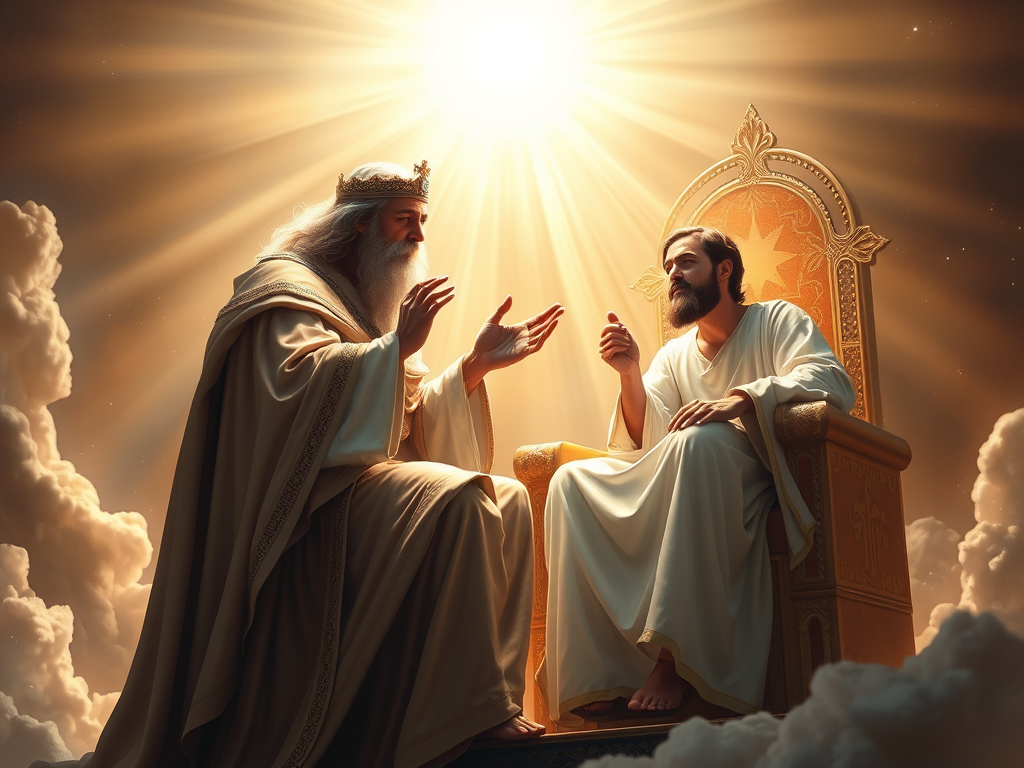
The Lord said to my Lord,
“Sit at My right hand,
Till I make Your enemies Your footstool.”
My Thoughts
Psalm 110:1 reveals a divine conversation between Yahweh and the Messiah, emphasizing the latter’s exalted status. David, recognizing the Messiah as his Lord, captures the intimate relationship within the Trinity. This verse foreshadows Jesus’ authority, and his ultimate victory over enemies, and assures believers of his reigning power that leads to eventual triumph……Bill
_____________________________
Commentaries:
Charles Spurgeon
“The LORD said unto my Lord.” Jehovah said unto my Adonai: David in spirit heard the solemn voice of Jehovah speaking to the Messiah from of old. What wonderful intercourse there has been between the Father and the Son! From this secret and intimate communion spring the covenant of grace and all its marvelous arrangements. All the great acts of grace are brought into actual being by the word of God; had he not spoken, there had been no manifestation of Deity to us, but in the beginning was the Word, and from of old there was mysterious fellowship between the Father and his Son Jesus Christ concerning his people and the great contest on their behalf between himself and the powers of evil. How condescending on Jehovah’s part to permit a mortal ear to hear, and a human pen to record his secret converse with his co-equal Son! How greatly should we prize the revelation of his private and solemn discourse with the Son, herein made public for the refreshing of his people I Lord, what is man that thou shouldst thus impart thy secrets unto him!
Though David was a firm believer in the Unity of the Godhead, he yet spiritually discerns the two persons, distinguishes between them, and perceives that in the second he has a peculiar interest, for he calls him “my Lord.” This was an anticipation of the exclamation of Thomas, ” My Lord and my God,” and it expresses the Psalmist’s reverence, his obedience, his believing appropriation, and his joy in Christ. It is well to have clear views of the mutual relations of the persons of the blessed Trinity; indeed, the knowledge of these truths is essential for our comfort and growth in grace. There is a manifest distinction in the divine persons since one speaks to another; yet the Godhead is one.
“Sit thou at my right hand, until I make thine enemies thy footstool.” Away from the shame and suffering of his earthly lire, Jehovah calls the Adonai, our Lord, to the repose and honors of his celestial seat. His work is done, and he may sit; it is well done, and he may sit at his right hand; it will have grand results, and he may therefore quietly wait to see the complete victory which is certain to follow. The glorious Jehovah thus addresses the Christ as our Savior; for, says David, he said: “unto my Lord.” Jesus is placed in the seat of power, dominion, and dignity, and is to sit there by divine appointment while Jehovah fights for him, and lays every rebel beneath his feet. He sits there by the Father’s ordinance and call and will sit there despite all the raging of his adversaries, till they are all brought to utter shame by his putting his foot upon their necks. In this sitting he is our representative. The mediatorial kingdom will last until the last enemy shall be destroyed, and then, according to the inspired word, “cometh the end, when he shall have delivered up the kingdom to God even the Father.” The work of subduing the nations is now in the hand of the great God, who by his Providence will accomplish it to the glory of his Son; his word is pledged to it, and the session of his Son at his right hand is the guarantee thereof; therefore let us never fear as to the future. While we see our Lord and representative sitting in quiet expectancy, we, too, may sit in the attitude of peaceful assurance, and with confidence await the grand outcome of all events. As surely as Jehovah liveth Jesus must reign, yea, even now he is reigning, though all his enemies are not yet subdued. During the present interval, through which we wait for his glorious appearing and visible millennial kingdom, he is in the place of power, and his dominion is in no jeopardy, or otherwise, he would not remain quiescent. He sits because all is safe, and he sits at Jehovah’s right hand because omnipotence waits to accomplish his will. Therefore there is no cause for alarm whatever may happen in this lower world; the sight of Jesus enthroned in divine glory is the sure guarantee that all things are moving onward towards ultimate victory. Those rebels who now stand high in power shall soon be in the place of contempt, they shall be his footstool. He shall with ease rule them, he shall sit and put his foot on them; not rising to tread them down as when a man puts forth force to subdue powerful foes, but retaining the attitude of rest, and still ruling them as abject vassals who have no longer spirit to rebel, but have become thoroughly tamed and subdued.
_____________________________
Enduring Word
The LORD said to my Lord: David prophetically revealed the words of Yahweh (the LORD) to the Messiah, David’s Lord. This is clear not only from the context but especially by how this verse is quoted in the New Testament.
The first verse of this psalm is one of the Old Testament verses most quoted in the New Testament.
· Jesus quoted it in Matthew 22:43-45 (also Mark 12:36-37), showing how David called the Messiah “Lord” – recognizing that the Messiah was greater than David himself.
· Peter quoted it on Pentecost, explaining how David prophesied the deity and ascension of Jesus (Acts 2:34-35).
· Paul referred to it in 1 Corinthians 15:25, explaining the rule and dominion of Jesus the Messiah.
· The author of Hebrews quotes it in Hebrews 1:13, referring to the superiority of Jesus the Messiah over any angel.
· The author of Hebrews referred to it in Hebrews 10:13, explaining the rule and dominion of Jesus the Messiah. (Guzik)
The LORD said to my Lord: The fact that Yahweh – the LORD, the covenant God of Israel – spoke to one that David himself called Lord (Adonai) demonstrates that both Yahweh and Adonai mentioned in this verse are God. (Guzik)
i. Specifically speaking, we would say that Yahweh is the Triune God, with references to the persons of the Father, Son, and Holy Spirit each being Yahweh. Normally, when Yahweh is mentioned without specific connection to the person of the Son or the Holy Spirit, we assume it refers to God the Father. Therefore, here God the Father is speaking to the Messiah, God the Son. (Guzik)
ii. “Adonai refers to an individual greater than the speaker. Here is a case of David’s citing God’s words in which God tells another personage, who is greater than David, to sit at God’s right hand until God makes the person’s enemies a footstool for the person’s feet. This person can only be a divine Messiah, who is Jesus Christ.” (Boice)
Sit at My right hand, till I make Your enemies Your footstool: Yahweh (specifically, God the Father) spoke to the Messiah (specifically, God the Son), telling Him to take His enthroned place (Ephesians 1:20, Hebrews 8:1) until the Father provided the victory for the Son. (Guzik)
i. Your footstool: “Thy slaves and vassals to be put to the meanest and basest services, as this phrase implies, 1 Kings 5:3, Psalms 18:39, 91:13; being taken from the manner of Eastern princes, who used to tread upon the necks of their conquered enemies, as we read, Joshua 10:24.” (Poole)
_____________________________
Barnes
The Lord said unto my Lord – In the Hebrew, “Spake Jehovah to my Lord.” The word יהוה Yahweh is the incommunicable name of God. It is never given to a created being. The other word translated “Lord – אדני ‘Adonāy – means one who has rule or authority; one of high rank; one who has dominion; one who is the owner or possessor, etc. This word is applied frequently to a creature. It is applied to kings, princes, rulers, and masters. The phrase “my Lord” refers to someone who was superior in rank to the author of the psalm; one whom he could address as his superior. The psalm, therefore, cannot refer to David himself, as if Yahweh had said to him, “Sit thou at my right hand.” Nor was there anyone on earth in the time of David to whom it could be applicable; anyone whom he would call his “Lord” or superior. If, therefore, the psalm was written by David, it must have reference to the Messiah – to one whom he owned as his superior – his Lord – his Sovereign. It cannot refer to God as if he were to have this rule over David, since God himself is referred to as “speaking” to him whom David called his Lord: “Jehovah said unto my Lord.” The reasoning of the Saviour, therefore, in Matthew 22:43-45, was founded on a fair and just interpretation of the psalm, and was so plain and conclusive that the Pharisees did not attempt to reply to it. Matthew 22:46. See the notes at that passage. No other interpretation “can” be given to it, consistently with the proper rules of expounding language, unless it be shown that the psalm was not composed by David, and might, therefore, be applied to someone whom the author would acknowledge as his “Lord.” But there is no evidence of this, and there is no one in the Old Testament history to whom the psalm would be applicable.
Sit thou at my right hand – The position of honor and of rank. Compare the notes at Psalms 16:8. See also Psalms 45:9; Mark 14:62; Luke 22:69; Acts 7:55; Hebrews 1:3; Hebrews 8:1. The phrase is properly applicable to the Messiah as exalted to the highest place in the universe – the right hand of God.
Until I make thine enemies thy footstool – Until they are entirely subdued under time. See the notes at Matthew 22:44. The enemies here referred to are the enemies of the Messiah considered as King (see Psalms 2:1-12), and the promise here is, that “he must reign until he shall have put all enemies under his feet.” See the notes at 1 Corinthians 15:25.
_____________________________
John Gill
The Lord said unto my Lord,…. The Targum is, “the Lord said in his Word.” Galatinus {q} says the true Targum of Jonathan has it, “the Lord said to his Word;” and produces an authority for it. These are the words of Jehovah the Father to his Son the Messiah; the “Adon,” or Lord, spoken of in Isaiah 6:1, the one Lord Jesus, and only Potentate; the Lord of all, the Lord of David, and of every believer; not by right of creation only, as of all mankind; but by redemption, having bought them; and by right of marriage, having espoused them; and by their own consent, they owning him to be their Lord. The words said to him by Jehovah, as follow, were said in his mind, in his eternal purpose and decree; which he, lying in his bosom, was privy when he foreordained him to be the Redeemer; and in the council and covenant of peace, when he promised him this glory as the reward of his sufferings; and in the prophecies of the Old Testament, which speak as of the sufferings of Christ, so of the glory that should follow; and when the fact was done, when, after his death, resurrection, ascension, and entrance into heaven, he was placed, as follows:
_____________________________
Matthew Henry
Some have called this psalm David’s creed, almost all the articles of the Christian faith being found in it; the title calls it David’s psalm, for in the believing foresight of the Messiah he both praised God and solaced himself, much more may we, in singing it, to whom that is fulfilled, and therefore more clearly revealed, which is here foretold. Glorious things are here spoken of Christ, and such as oblige us to consider how great he is.
I. That he is David’s Lord. We must take special notice of this because he himself does. Mt. 22:43, David, in spirit, calls him Lord. And as the apostle proves the dignity of Melchizedek, and in him of Christ, by this, that so great a man as Abraham was paid him tithes (Heb. 7:4), so we may by this prove the dignity of the Lord Jesus that David, that great man, called him his Lord; by him that king acknowledges himself to reign, and to him to be acceptable as a servant to his lord. Some think he calls him his Lord because he was the Lord that was to descend from him, his son and yet his Lord. Thus him immediate mother calls him her Savior (Lu. 1:47); even his parents were his subjects, his saved ones.
II. That he is constituted a sovereign Lord by the counsel and decree of God himself: The Lord, Jehovah, said unto him, Sit as a king. He receives of the Father this honor and glory (2 Pt. 1:17), from him who is the fountain of honor and power, and takes it not to himself. He is therefore rightful Lord, and his title is incontestable; for what God has said cannot be gainsaid. He is therefore everlasting Lord; for what God has said shall not be unsaid. He will certainly take and keep possession of that kingdom which the Father has committed to him, and none can hinder.
III. That he was to be advanced to the highest honor, and entrusted with an absolute sovereign power both in heaven and in earth: Sit thou at my right hand. Sitting is a resting posture; after his services and sufferings, he entered into rest from all his labors. It is a ruling posture; he sits to give law, to give judgment. It is a remaining posture; he sits like a king forever. Sitting at the right hand of God denotes both his dignity and his dominion, the honor put upon him and the trusts reposed in him by the Father. All the favors that come from God to man, and all the service that comes from man to God, pass through his hand.
IV. That all his enemies were in due time to be made his footstool, and not till then; but then also he must reign in the glory of the Mediator, though the work of the Mediator will be, in a manner, at an end. Note,
1. Even Christ himself has enemies that fight against his kingdom and subjects, his honor and interest, in the world. There are those that will not have him to reign over them, and thereby they join themselves to Satan, who will not have him to reign at all.
2. These enemies will be made his footstool; he will subdue them and triumph over them; he will do it easily, as easily as we put a footstool in its proper place, and such a propriety there will be in it. He will make himself easy by the doing of it, as a man that sits with a footstool under his feet; he will subdue them in such a way as shall be most for his honor and their perpetual disgrace; he will tread down the wicked, Mal. 4:3.
3. God the Father has undertaken to do it: I will make them thy footstool, who can do it.
4. It will not be done immediately. All his enemies are now in a chain, but not yet made his footstool. This the apostle observes. Heb. 2:8, We see not yet all things put under him. Christ himself must wait for the completing of his victories and triumphs.
5. He shall wait till it is done, and all their might and malice shall not give the least disturbance to his government. His sitting at God’s right hand is a pledge to him of his setting his feet, at last, on the necks of all his enemies.
_____________________________
Cross-References
44 The Lord said unto my Lord, Sit thou on my right hand, till I make thine enemies thy footstool?
The Holy Bible: King James Version, Mt 22:44.
13 But to which of the angels said he at any time, Sit on my right hand, until I make thine enemies thy footstool?
The Holy Bible: King James Version, Heb 1:13.
25 For he must reign, till he hath put all enemies under his feet.
The Holy Bible: King James Version, 1 Co 15:25.
3 Who being the brightness of his glory, and the express image of his person, and upholding all things by the word of his power, when he had by himself purged our sins, sat down on the right hand of the Majesty on high;
The Holy Bible: King James Version, Heb 1:3.
20 Which he wrought in Christ, when he raised him from the dead, and set him at his own right hand in the heavenly places
The Holy Bible: King James Version, Eph 1:20.
_____________________________
KJV W/ STRONGS BIBLE – PSALMS 110:1
110:1 A Psalm 4210 of David 1732. The LORD 3068 said 5002 8803 unto my Lord 113, Sit 3427 8798 thou at my right hand 3225, until I make 7896 8799 thine enemies 341 8802 thy footstool 1916 7272.
_____________________________
Geneva Bible 1560
Psalm 110:1
1 The (a) Lord said unto my Lord, Sit thou at my right hand, until I make thine enemies thy fotestole.
(a) Jesus Christ in Mt. 22:44 gives the interpretation hereof, and shows that this cannot properly be applied unto David, but to himself.

- Exploring the Beauty of Psalms: Insights and Commentaries
- Monthly Breakdown of Our Blog Content
- Psalms Commentary: Faith and Inspiration
Let the words of my mouth and the meditation of my heart Be acceptable in Your sight, O Lord, my strength and my Redeemer. Psalm 19:14 NKJV


Leave a Reply