Psalm 105 NKJV
Introduction:
Charles Spurgeon
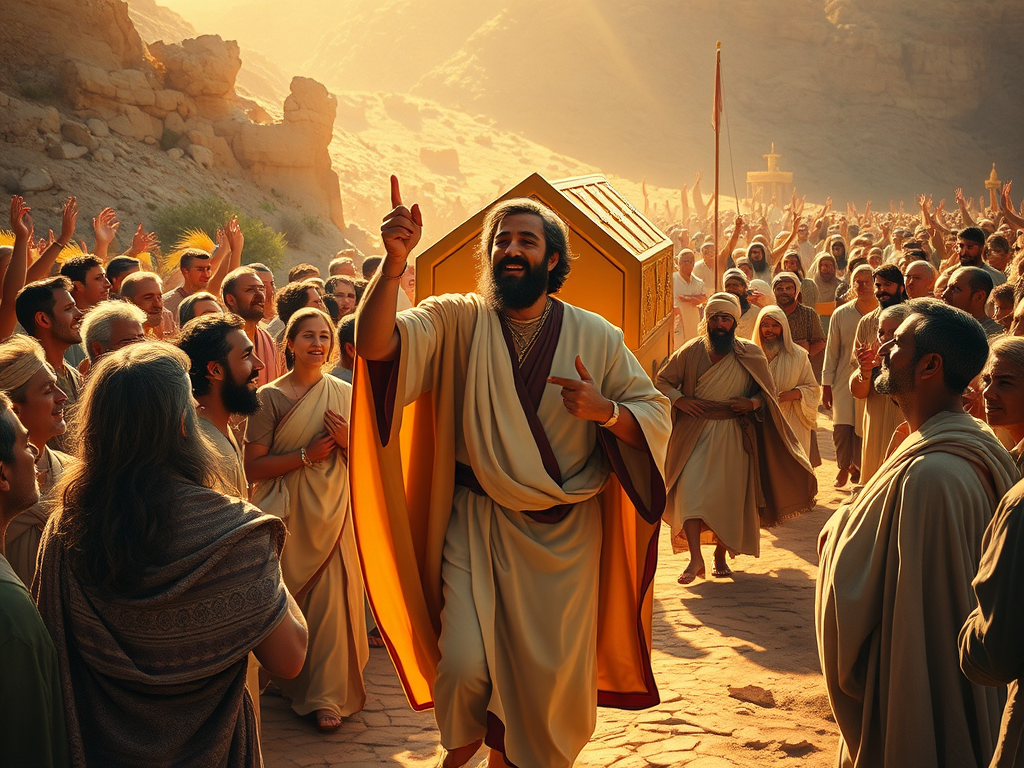
This historical psalm was evidently composed by King David, for the first fifteen verses of it were used as a hymn at the carrying up of the ark from the house of Obed-edom, and we read in 1Ch 16:7, “Then on that day David delivered first this psalm to thank the Lord, into the hand of Asaph and his brethren.” Such a song was suitable for the occasion, for it describes the movements of the Lord’s people and his guardian care over them in every place, and all this on account of the covenant of which the ark, then removing, was a symbol. Our last psalm sang the opening chapters of Genesis, and this takes up its closing chapters and conducts us into Exodus and Numbers.
The first verses are full of joyful praise, and call upon the people to extol Jehovah, Psa 105:1-7; then the earliest days of the infant nation, are described, Psa 105:8-15; the going into Egypt, Psa 105:16-23, the coming forth from it with the Lord’s outstretched arm, Psa 105:24-38, the journeying through the wilderness and the entrance into Canaan (Psa 105:39-45).
We are now among the long Psalms, as at other times we have been among the short ones. These varying lengths of the sacred poems should teach us not to lay down any law either of brevity or prolixity in either prayer or praise. Short petitions and single verses of hymns are often the best for public occasions, but there are seasons when a whole night of wrestling or an entire day of psalm-slinging will be none too long. The Spirit is ever free in his operations, and is not to be confined with, the rules of conventional propriety. The wind bloweth as it listeth, and at one time rushes in short and rapid sweep, while at another it continues to refresh the earth hour after hour with its reviving breath.
_____________________
Enduring Word
Whoever arranged and ordered the psalms placed Psalm 105 and Psalm 106 together purposefully. “This and the following psalm are companions. They reveal the two sides of the relation between God and His people during a long period. This one sings the song of His faithfulness and power; while the next tells the sad story of repeated failure and rebellion on the part of His people.” (G. Campbell Morgan)
The first 15 verses of Psalm 105 are also found in 1 Chronicles 16:8-22 and presented there as a composition of David, written and sung for the bringing of the ark of the covenant into Jerusalem. We can therefore conclude that though this psalm is not here specifically attributed to King David, he is the author of it. (Guzik)
_____________________
Matthew Henry
Some of the psalms of praise are very short, others very long, to teach us that, in our devotions, we should be more observant how our hearts work than how the time passes and neither overstretch ourselves by coveting to be long nor over-stint ourselves by coveting to be short, but either the one or the other as we find in our hearts to pray. This is a long psalm; the general scope is the same with most of the psalms, to set forth the glory of God, but the subject matter is particular. Every time we come to the throne of grace we may, if we please, furnish ourselves out of the word of God (out of the history of the New Testament, as this is out of the history of the Old) with new songs, with fresh thoughts-so copious, so various, so inexhaustible is the subject. In the foregoing psalm, we are taught to praise God for his wondrous works of common providence with reference to the world in general. In this, we are directed to praise him for his special favors to his church. We find the first eleven verses of this psalm in the beginning of that psalm which David delivered to Asaph to be used (as it should seem) in the daily service of the sanctuary when the ark was fixed in the place he had prepared for it, by which it appears both who penned it and when and upon what occasion it was penned, 1 Chr. 16:7, etc. David by it designed to instruct his people in the obligations they lay under to adhere faithfully to their holy religion. Here is the preface (v. 1-7) and the history itself in several articles.
I. God’s covenant with the patriarchs (v. 8-11).
II. His care of them while they were strangers (v. 12-15).
III. His raising up Joseph to be the shepherd and stone of Israel (v. 16-22).
IV. The increase of Israel in Egypt and their deliverance out of Egypt (v. 23-38).
V. The care he took of them in the wilderness and their settlement in Canaan (v. 39-45).
In singing this we must give to God the glory of his wisdom and power, his goodness and faithfulness, and must look upon ourselves as concerned in the affairs of the Old Testament church, both because to it were committed the oracles of God, which are our treasure, and because out of it Christ arose, and these things happened to it for ensamples.
_____________________
Clarke
We find several verses of this Psalm in 1 Chronicles 16:7-14 c., from which it is evident that David was the author of the principal part of it: but it was probably enlarged and sung at the restoration of the people from the Babylonish captivity. The hallelujah which terminates the preceding Psalm, is made the title of this by the Vulgate, Septuagint, AEthiopic, and Arabic: but it has no title either in the Hebrew or Chaldee. The Syriac considers it a paraphrase on the words, “Fear not, Jacob, to go down into Egypt and teach us spiritually not to fear when we are obliged to contend with devils; for God is our shield, and will fight for us.” The Psalm is a history of God’s dealings with Abraham and his posterity, till their settlement in the promised land.
The Eternal Faithfulness of the Lord
1
Oh, give thanks to the Lord!
Call upon His name;
Make known His deeds among the peoples!
2
Sing to Him, sing psalms to Him;
Talk of all His wondrous works!
3
Glory in His holy name;
Let the hearts of those rejoice who seek the Lord!
4
Seek the Lord and His strength;
Seek His face evermore!
5
Remember His marvelous works which He has done,
His wonders, and the judgments of His mouth,
6
O seed of Abraham His servant,
You children of Jacob, His chosen ones!
7
He is the Lord our God;
His judgments are in all the earth.
8
He remembers His covenant forever,
The word which He commanded, for a thousand generations,
9
The covenant which He made with Abraham,
And His oath to Isaac,
10
And confirmed it to Jacob for a statute,
To Israel as an everlasting covenant,
11
Saying, “To you I will give the land of Canaan
As the allotment of your inheritance,”
12
When they were few in number,
Indeed very few, and strangers in it.
13
When they went from one nation to another,
From one kingdom to another people,
14
He permitted no one to do them wrong;
Yes, He rebuked kings for their sakes,
15
Saying, “Do not touch My anointed ones,
And do My prophets no harm.”
16
Moreover He called for a famine in the land;
He destroyed all the provision of bread.
17
He sent a man before them—
Joseph—who was sold as a slave.
18
They hurt his feet with fetters,
He was laid in irons.
19
Until the time that his word came to pass,
The word of the Lord tested him.
20
The king sent and released him,
The ruler of the people let him go free.
21
He made him lord of his house,
And ruler of all his possessions,
22
To bind his princes at his pleasure,
And teach his elders wisdom.
23
Israel also came into Egypt,
And Jacob dwelt in the land of Ham.
24
He increased His people greatly,
And made them stronger than their enemies.
25
He turned their heart to hate His people,
To deal craftily with His servants.
26
He sent Moses His servant,
And Aaron whom He had chosen.
27
They performed His signs among them,
And wonders in the land of Ham.
28
He sent darkness, and made it dark;
And they did not rebel against His word.
29
He turned their waters into blood,
And killed their fish.
30
Their land abounded with frogs,
Even in the chambers of their kings.
31
He spoke, and there came swarms of flies,
And lice in all their territory.
32
He gave them hail for rain,
And flaming fire in their land.
33
He struck their vines also, and their fig trees,
And splintered the trees of their territory.
34
He spoke, and locusts came,
Young locusts without number,
35
And ate up all the vegetation in their land,
And devoured the fruit of their ground.
36
He also destroyed all the firstborn in their land,
The first of all their strength.
37
He also brought them out with silver and gold,
And there was none feeble among His tribes.
38
Egypt was glad when they departed,
For the fear of them had fallen upon them.
39
He spread a cloud for a covering,
And fire to give light in the night.
40
The people asked, and He brought quail,
And satisfied them with the bread of heaven.
41
He opened the rock, and water gushed out;
It ran in the dry places like a river.
42
For He remembered His holy promise,
And Abraham His servant.
43
He brought out His people with joy,
His chosen ones with gladness.
44
He gave them the lands of the Gentiles,
And they inherited the labor of the nations,
45
That they might observe His statutes
And keep His laws.
Praise the Lord!
________________________________________

- Exploring the Beauty of Psalms: Insights and Commentaries
- Monthly Breakdown of Our Blog Content
- Psalms Commentary: Faith and Inspiration
“The Lord bless you and keep you; The Lord make His face shine upon you, And be gracious to you; The Lord lift up His countenance upon you, And give you peace.”
Numbers 6:24-26 NKJV

Leave a Reply