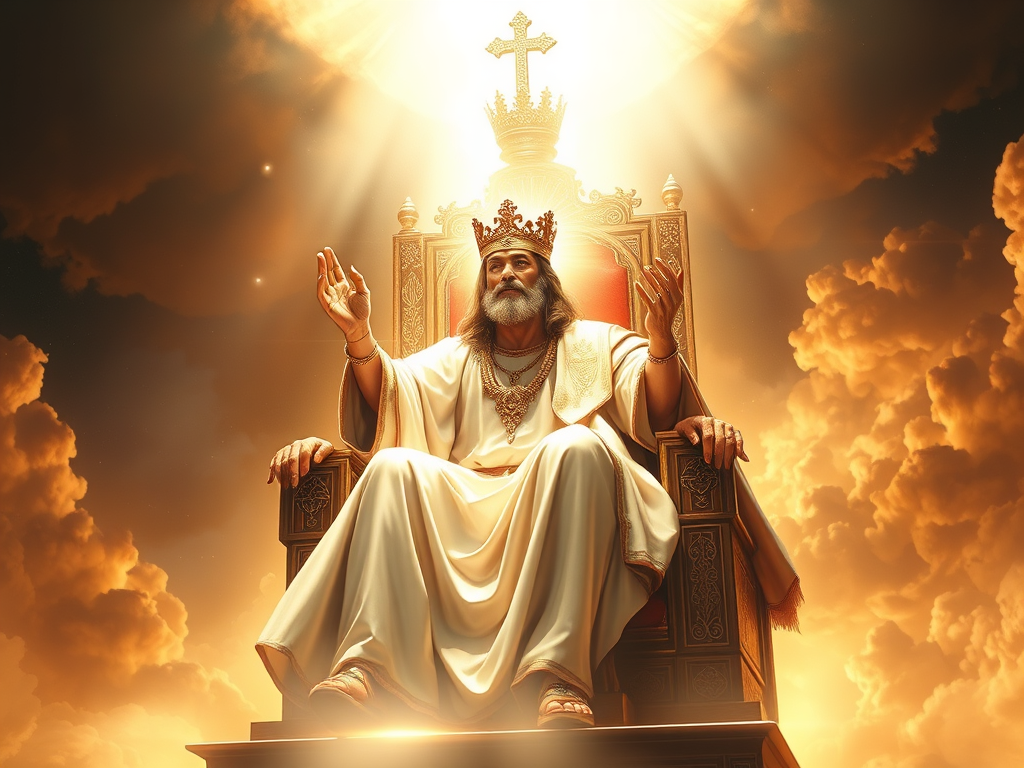
Introduction to Psalm 110:
Psalm 110, attributed to David, emphasizes the exaltation of the Messiah, combining kingship and priesthood in the order of Melchizedek. New Testament references affirm its prophetic nature concerning Jesus. The psalm portrays Christ’s reign, power, and ultimate victory over enemies, underscoring His divine authority and leadership in salvation……Bill
_____________________________
Commentaries:
Charles Spurgeon
A Psalm of David. Of the correctness of this title, there can be no doubt, since our Lord in Mat 22:43 says, “How then doth David in spirit call him Lord.” Yet some critics are so fond of finding new authors for the psalms that they dare to fly in the face of the Lord Jesus himself. To escape from finding Jesus here, they read the title, “Psalm of (or concerning) David,” as though it was not so much written by him as of him, but he that reads with understanding will see little enough of David here except as the writer. He is not the subject of it even in the smallest degree, but Christ is all. How much was revealed to the patriarch David! How blind are some modern wise men, even amid the present blaze of light, as compared with this poet-prophet of the darker dispensation. May the Spirit who spoke by the man after God’s own heart give us eyes to see the hidden mysteries of this marvelous Psalm, in which every word has an infinity of meaning.
_____________________________
Enduring Word
This psalm carries the title A Psalm of David. Strangely, some scholars and commentators deny David’s authorship. Yet as Derek Kinder noted: “Our Lord gave full weight to David’s authorship and David’s words, stressing the former twice by the expression ‘David himself’, and the latter by the comment that he was speaking ‘in the Holy Spirit’ (Mark 12:36f.).”
This remarkable psalm is one of the Old Testament portions most quoted in the New Testament. James Montgomery Boice counted 27 direct quotations or indirect allusions to Psalm 110 in the New Testament.
_____________________________
Barnes
This psalm is entitled “A Psalm of David.” It is also ascribed to David by the Saviour Matthew 22:43; and by Peter Acts 2:34; and there is no reason to doubt the correctness of the title. There is nothing, however, in the title, or in the psalm, to determine at what period of David’s life, or on what occasion it was written. Aben Ezra supposed that it was at the time referred to in 2 Samuel 21:15-17, and others have selected other occasions in the life of David. But all this is conjecture. The psalm has no particular reference to anything in his history, and as it is wholly prophetic of the Messiah, it might have been composed at any period of his life.
The psalm is repeatedly quoted in the New Testament as referring to the Messiah, and in such a manner as to show that this was the customary interpretation among the Jews, or that it might be referred to by way of “proof” in regard to the Messiah so that the relevancy and pertinence of the argument would be at once admitted. Matthew 22:44 (compare Mark 12:36; Luke 20:42); Acts 2:34; Hebrews 5:6; Hebrews 7:17, Hebrews 7:21. The way in which it is quoted shows that this was the prevailing and received mode of interpreting the psalm.
The idea in the psalm is that of the exaltation, the conquest, the priesthood, and the dominion of the Messiah. Two things – the kingship and the priesthood of the Messiah – are combined. The leading idea is that of the “priest-king” or the “king-priest,” as in the case of Melchizedek, in whom the two offices of priest and king were in a very unusual manner and form united in one person. Usually, they were separate, even in the earliest ages of the world. In the case of Melchizedek they were “combined,” and hence, he was selected as a proper representative of the Messiah – of one who should combine these offices, apparently incongruous, in one.
The psalm embraces the following points:
I. The appointment of the Messiah – acknowledged by the author of the psalm as his “Lord” – to that high office, to be held until he should subdue all his enemies, Psalms 110:1.
II. His being endowed with “power” needful for the accomplishment of the design for which he was appointed, Psalms 110:2.
III. The assurance that his people would be made “willing” in the day when he should put forth his power, Psalms 110:3.
IV. The special characteristic of his reign, as that of a “priest-king,” after the order of Melchizedek; combining the two functions of king and priest in his own person and office, Psalms 110:4.
V. His conquest and triumph, Psalms 110:5-7.
_____________________________
John Gill
A Psalm of David. This psalm was written by David, as the title shows, and which is confirmed by our Lord Jesus Christ, Matthew 22:43 and by the Apostle Peter, Acts 2:34 and was not written by anyone of the singers concerning him, as Aben Ezra and Kimchi; nor by Melchizedek, nor by Eliezer the servant of Abraham, concerning him, as Jarchi and others: for the former could not call Abraham his lord, since he was greater than he, Hebrews 7:7 and though the latter might, yet he could not assign his master a place at the right hand of God; nor say he was a priest after the order of Melchizedek: and as it was written by David, it could not be concerning himself, as the Targum, but some other; not of Hezekiah, to whom some of the Jews applied it, as Tertullian {m} affirms; but of the Messiah, as is clear from the quotation by Christ, Matthew 22:43 and from the references to it by the apostle, Acts 2:34. And that this was the general sense of the ancient Jewish church is manifest from the silence of the Pharisees, when a passage out of it was objected to them by our Lord concerning the Messiah; and is the sense that some of the ancient Jews give of it; says R. Joden , “God will make the King Messiah sit at his right hand, &c:” and the same is said by others; and it is likewise owned by some of the more modern ones; and we Christians can have no doubt about it. The psalm is only applicable to Christ, and cannot be accommodated to any other; no, not to David as a type, as some psalms concerning him may.
_____________________________
Matthew Henry
This psalm is pure gospel; it is only, and wholly, concerning Christ, the Messiah promised to the fathers and expected by them. It is plain that the Jews of old, even the worst of them, so understood it, however the modern Jews have endeavored to pervert it and to rob us of it; for when the Lord Jesus proposed a question to the Pharisees upon the first words of this psalm, where he takes it for granted that David, in spirit, calls Christ his Lord though he was his Son, they chose rather to say nothing, and to own themselves graveled, than to make it a question whether David does indeed speak of the Messiah or no; for they freely yield so plain a truth, though they foresee it will turn to their own disgrace, Mt. 22:41, etc. Of him, therefore, no doubt, the prophet here speaks of him and of no other man. Christ, as our Redeemer, executes the office of a prophet, of a priest, and of a king, with reference both to his humiliation and his exaltation; and of each of these, we have here an account.
I. His prophetical office (v. 2).
II. His priestly office (v. 4).
III. His kingly office (v. 1, 3, 5, 6).
IV. His estates of humiliation and exaltation (v. 7).
In singing this psalm we must act faith upon Christ, submit ourselves entirely to him, to his grace and government, and triumph in him as our prophet, priest, and king, by whom we hope to be ruled, and taught, and saved, forever, and as the prophet, priest, and king, of the whole church, who shall reign till he has put down all opposing rule, principality, and power, and delivered up the kingdom to God the Father.
_____________________________
Clarke
The Hebrew, and all the Versions, except the Arabic, attribute this Psalm to David: nor can this be doubted, as it is thus attributed in the New Testament; see the places in the margin. We have in it the celebration of some great potentates’ accession to the crown; but the subject is so grand, the expressions so noble, and the object raised so far above what can be called human, that no history has ever mentioned a prince to whom a literal application of this Psalm can be made. To Jesus Christ alone, to his everlasting priesthood and government, as King of kings and Lord of lords, can it be applied.
The Jews, aware of the advantage which the Christian religion must derive from this Psalm, have labored hard and in vain to give it a contrary sense. Some have attributed it to Eliezer, the servant or steward of Abraham; and state that he composed it on the occasion of his master’s victory over the four kings at the valley of Shaveh, Genesis 14:14-17. Others say it was done by David, in commemoration of his victory over the Philistines. Others make Solomon the author. Some refer it to Hezekiah, and others to Zerubbabel, c.: but the bare reading of the Psalm will show the vanity of these pretensions. A King is described here who is David’s Lord and sits at the right hand of God a conqueror, reigning at Jerusalem, King from all eternity-having an everlasting priesthood, Judge of all nations, triumphing over all potentates, indefatigable in all his operations, and successful in all his enterprises. Where has there ever appeared a prince in whom all these characters met? There never was one, nor is it possible that there ever can be one such, the Person excepted to whom the Psalm is applied by the authority of the Holy Spirit himself. That the Jews who lived in the time of our Lord believed this Psalm to have been written by David, and that it spoke of the Messiah alone, is evident from this, that when our Lord quoted it, and drew arguments from it in favor of his mission, Matthew 22:42, they did not attempt to gainsay it. St. Peter, Acts 2:34, and St. Paul, 1 Corinthians 15:25; Hebrews 1:13; Hebrews 5:6; Hebrews 5:10; Hebrews 7:17; Hebrews 10:12-13, apply it to show that Jesus is the Messiah. Nor was there any attempt to contradict them; not even an intimation that they had misapplied it, or mistaken its meaning. Many of the later Jews also have granted that it applied to the Messiah, though they dispute its application to Jesus of Nazareth. All the critics and commentators whom I have consulted apply it to our Lord; nor does it appear to me to be capable of interpretation on any other ground.
_____________________________
John D. Barry
Psalm 110 is a royal psalm (about kingship) that is structured around two statements from Yahweh. The first is a prophetic oracle (vv. 1–3), and the second is a divine oath (vv. 4–7). Psalm 110 is connected to the messianic understanding of Jesus and His work. New Testament writers quote material from both halves of Psa 110 to support an understanding of Jesus as Messiah.
John D. Barry et al., Faithlife Study Bible (Bellingham, WA: Lexham Press, 2012, 2016), Ps 110:title–7.
_____________________________
A.R.Fausset
The Son of David sits at Jehovah’s right hand showing His might; therefore He will subdue His foes under His rod or sceptre (vv. 1, 2);
Messiah’s people offer themselves to Him in holy beauty, in the day of His power, as the king’s youth-dew out of the womb of the morning (v. 3);
His everlasting priesthood after the order of Melchizedek is the ground of His subduing His foes, and attaching to Him His people, who share His victory (v. 4);
Messiah, in Jehovah’s strength, destroys the God-opposed kings in the day of His wrath (vv. 5, 7).
In vv. 1, 6, 7, the beginning and the close, David speaks of Messiah; in the middle, he speaks to Him. The ark and the seat of government were now in Zion. David’s victory over Edom (Ps. 108:10), Ammon, and Syria typify Messiah’s final victory over all His and our foes. The worldwide dominion promised to Abraham, and then to David’s seed (2 Sam. 7), can only be realized by Messiah at Jehovah’s right hand, wielding God’s omnipotence, having with Him a people in holy garb of beauty, devoted with free-will to Him. Psalm 109 “testified beforehand the sufferings of Christ;” this Psalm 110 “the glory that should follow” (1 Pet 1:11).
A. R. Fausset, A Commentary, Critical, Experimental, and Practical, on the Old and New Testaments: Job–Isaiah, vol. III (London; Glasgow: William Collins, Sons, & Company, Limited, n.d.), 345.
_____________________________
Announcement of the Messiah’s Reign
A Psalm of David.
1
The Lord said to my Lord,
“Sit at My right hand,
Till I make Your enemies Your footstool.”
2
The Lord shall send the rod of Your strength out of Zion.
Rule in the midst of Your enemies!
3
Your people shall be volunteers
In the day of Your power;
In the beauties of holiness, from the womb of the morning,
You have the dew of Your youth.
4
The Lord has sworn
And will not relent,
“You are a priest forever
According to the order of Melchizedek.”
5
The Lord is at Your right hand;
He shall execute kings in the day of His wrath.
6
He shall judge among the nations,
He shall fill the places with dead bodies,
He shall execute the heads of many countries.
7
He shall drink of the brook by the wayside;
Therefore He shall lift up the head.

- Exploring the Beauty of Psalms: Insights and Commentaries
- Monthly Breakdown of Our Blog Content
- Psalms Commentary: Faith and Inspiration
…“Do not be afraid. Stand still, and see the salvation of the Lord, which He will accomplish for you today… Exodus 14:13 NKJV
Leave a Reply